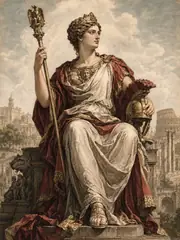
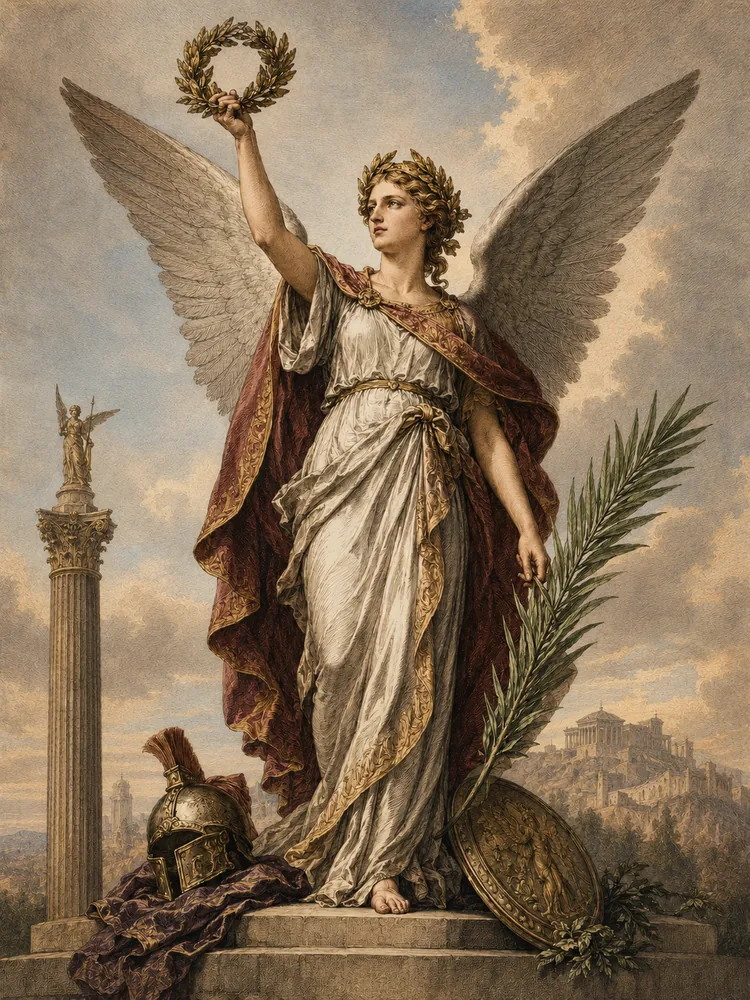
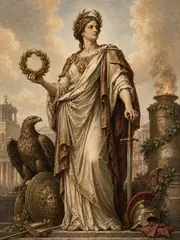
Victoria was the Roman goddess of victory, depicted as a winged woman bearing a wreath of laurel and a palm branch, descending from the heavens to crown the victorious general or to land upon his standard. She was equivalent to the Greek Nike, and indeed her iconography was almost wholly borrowed from the Greek; before the Hellenization of Roman religion the older Italic conception of victory had been embodied in the goddess Vica Pota at Rome, who had a small shrine on the Velia. Victoria displaced Vica Pota as Greek influence advanced.
Her great image stood at the head of the Senate house from 29 BCE — the famous Altar of Victory placed there by Augustus after Actium, with a captured statue from Tarentum mounted upon it. Each session of the Senate began with senators making a small offering of incense and wine at this altar; thus the Roman state, whatever motion it took, opened its proceedings with a salute to the goddess of its victories. The altar stood there for nearly four centuries.
It was removed by Constantius II in 357, restored by Julian, removed again by Gratian in 382. The pagan senator Symmachus made his celebrated appeal to the emperor Valentinian II in 384, requesting the altar's restoration — and Saint Ambrose answered him just as celebratedly, in two letters that are among the great documents of the late ancient transition from paganism to Christianity. The altar was not restored. Victoria continued nevertheless to be depicted on Roman coins and on imperial monuments long into the Christian period — for the goddess of victory was so firmly fused with the imagery of the Roman state that Christian emperors found it impossible to remove her without dismantling the whole symbolic apparatus by which they ruled.
Curator’s note
What the sources say, and what later tradition added. The sources for this bay
Victoria is described in many sources: Livy (10.33.9, 29.14.13), Cassius Dio (51.22.2, the Altar of Victory), Suetonius (Augustus 100), Symmachus (Relatio 3, 384 CE — the appeal for restoration), Ambrose (Epistles 17 and 18, the response). The Altar of Victory controversy is the great document of late-fourth-century religious politics; the appeal of Symmachus and the response of Ambrose have been read together since antiquity as paradigm-cases of the pagan-Christian dialogue. Victoria's image survived on coins through the Byzantine period and was eventually Christianized as the angel of victory; the iconography of the Christian angel-of-victory descends directly from her.
When the sources speak
Dated witnesses for The Deified Virtues and the Imperial Mystery Cults. A date marks when the evidence was written down, not when the belief began. The whole timeline
- c. 1000–750 BCE
- Iron Age communities of Latium and neighboring peoples develop the cult landscapes later absorbed into Roman tradition.
- traditional 753 BCE
- Roman foundation chronology places Romulus and the first civic institutions at the beginning of the city’s sacred history.
- traditional 7th–6th centuries BCE
- The regal period is credited with priesthoods, calendars, temples, and the organization of public rites.
- 509–264 BCE
- Republican expansion incorporates Latin, Sabine, Etruscan, and Italian cults through treaty, migration, and evocatio.
- 264–146 BCE
- Mediterranean conquest accelerates Greek interpretation and the importation or redefinition of foreign gods.
- 204 BCE
- The Magna Mater is formally brought from Pessinus during the Second Punic War.
- 1st century BCE
- Varro, Cicero, and other antiquarians document rites and divine names amid civil war and institutional change.
- 27 BCE–14 CE
- Augustan restoration monumentalizes selected ancestral cults and rewrites Roman sacred history.