A Compendium of the Ancient Gods
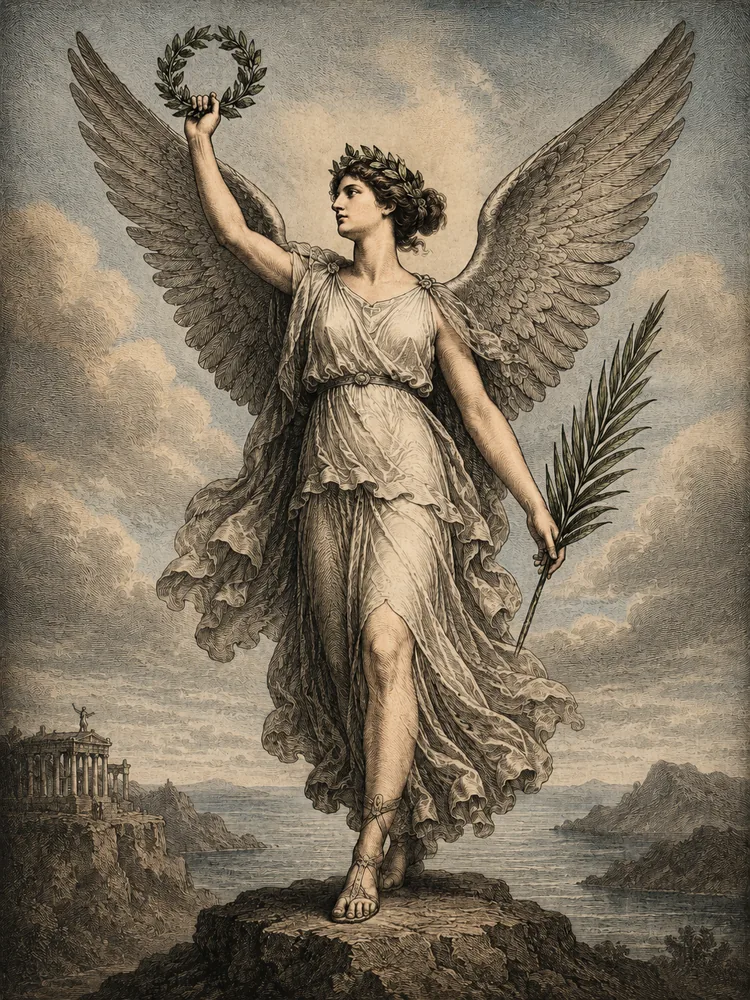
Nike, plate

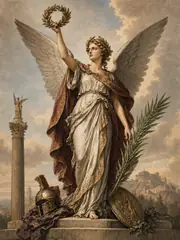
Nike was the goddess of victory — winged daughter of the Titan Pallas and the underworld river Styx, sister of Cratos (Strength), Bia (Might), and Zelus (Zeal). Her mother having joined Zeus's side in the Titanomachy with all four of her children, Nike thereafter stood beside Zeus in his battles, awarded victory to those whom Zeus favored, and crowned the victors of human contests athletic and martial. She was a constant attendant upon Athena, who sometimes carries a small statue of Nike in her own hand — the famous Athena Parthenos by Phidias held a Nike on her right palm — and she was honored with her own temple on the Athenian Acropolis (the small Temple of Athena Nike, c. 420 BCE, with its exquisite Ionic columns and its frieze of victory-figures).

The most celebrated artistic representation of Nike is the so-called Nike of Samothrace (Hellenistic, probably c. 200–190 BCE), an over-life-size marble figure of the winged goddess alighting upon the prow of a warship — discovered on the island of Samothrace in 1863 and now in the Louvre, where it is among the most admired works of ancient sculpture. Her Roman counterpart was Victoria, with whom her identification was thorough; the Latin name has given many subsequent uses, while the Greek name has, in our own era, given the brand-name of a manufacturer of athletic shoes.
Curator’s note

What the sources say, and what later tradition added. The sources for this bay

Hesiod, Theogony 383–388; the Temple of Athena Nike is well-preserved on the Acropolis; the Nike of Samothrace was discovered by Charles Champoiseau in 1863. The transition from cult-figure to brand-mascot is one of the more curious afterlives of any ancient deity.

Kin in the sources

Each tie is quoted from the entry that states it.

The same god in other rooms

The ancient sources themselves name these as one god under different names. See Nike and Victoria hung together

When the sources speak

Dated witnesses for The Mysteries. A date marks when the evidence was written down, not when the belief began. The whole timeline

c. 1600–1100 BCE
Mycenaean palace tablets in Linear B record offerings and divine names, but little continuous myth.
c. 1100–800 BCE
Post-palatial oral traditions and changing cult landscapes precede the surviving alphabetic epics.
late 8th–7th centuries BCE
The Iliad, Odyssey, Hesiodic Theogony and Works and Days give influential but non-exclusive divine orders.
7th–6th centuries BCE
Homeric Hymns, lyric poetry, colonization, and local sanctuary traditions multiply regional narratives.
6th–5th centuries BCE
Orphic, Pythagorean, and mystery materials develop alternative cosmogonies and afterlife doctrines.
5th century BCE
Athenian tragedy and comedy recast heroic houses and divine justice for civic audiences.
4th century BCE
Philosophers, antiquarians, and local historians interpret or criticize inherited myth.
323–31 BCE
Hellenistic poets and scholars systematize variants across an enlarged Greek world.

Floor plan

The rooms follow one another in the order their peoples first appear in the written record.

  1. The Cradle of Citiesc. 3400 BCE to 395 CE. 115 works
  2. The Gift of the Nilec. 4000 BCE to 395 CE. 73 works
  3. The Olympian Orderc. 1600 BCE to 750 CE. 152 works
  4. The Persian Worldc. 2000 BCE to 1010 CE. 30 works
  5. The Levantine Borderlandsc. 1200 BCE to 500 CE. 20 works
  6. The Edges of Empirec. 2000 BCE to 1500 CE. 33 works
  7. The Etruscan Worldc. 900 BCE to 750 CE. 22 works
  8. The Roman Inheritancec. 1200 BCE to 500 CE. 58 works
  9. The Northern Inheritancec. 2000 BCE to 1600 CE. 131 works