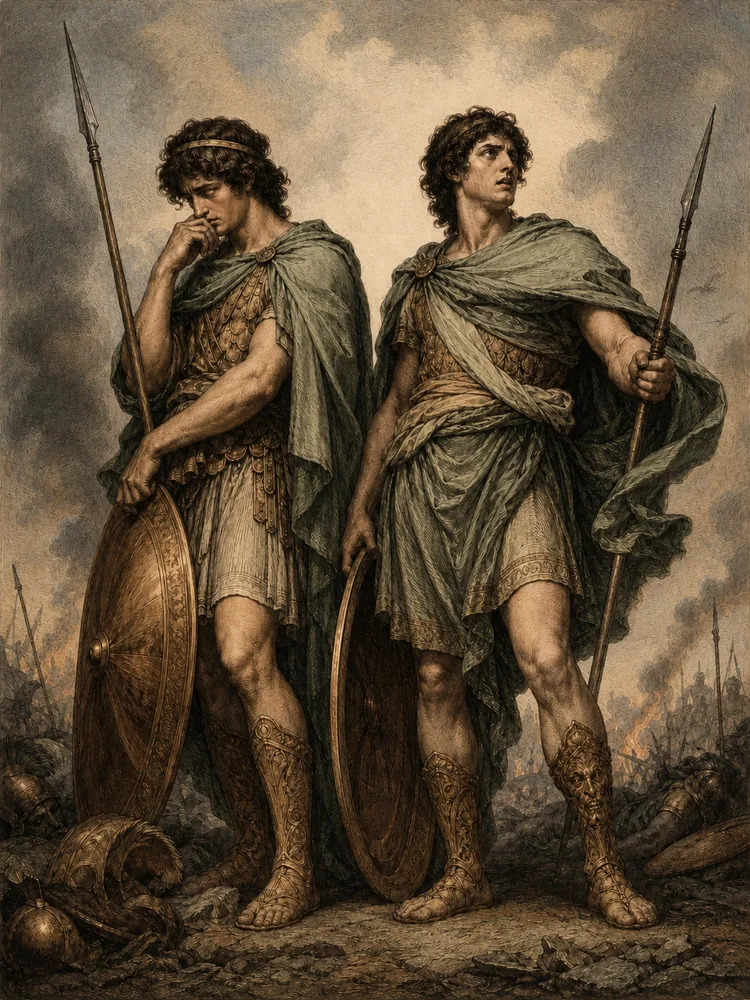
Phobos ("fear") and Deimos ("terror") were the sons of Ares and Aphrodite — the children of war and love, an ambivalent parentage that perhaps reflected the Greek understanding that strong feelings of love and of fear were close kin. They attended their father in battle, sowing panic among his enemies; their faces were depicted upon the shields of warriors to terrify their opponents (the shield of Agamemnon, in the Iliad, bears their image). They had little independent narrative — they were appendages to Ares — but their names have an extensive afterlife: the two moons of Mars discovered by Asaph Hall in 1877 were named Phobos and Deimos in their honor, and these names have become the standard designations in modern astronomy.
 Before thisEnyo
 Next on the wallNike
Curator’s note
What the sources say, and what later tradition added. The sources for this bay
Hesiod, Theogony 933–937; Homer, Iliad 11.36–37 (the shield of Agamemnon), 13.299 (with Ares). The naming of Mars's moons by Hall in 1877 made the names familiar to modern astronomy.
Kin in the sources
Each tie is quoted from the entry that states it.
 Child ofAres
the sons of Ares and Aphrodite — the children of war and love
 Child ofAphrodite
the sons of Ares and Aphrodite — the children of war and love
- Companion ofAres
They attended their father in battle, sowing panic among his enemies
When the sources speak
Dated witnesses for The Mysteries. A date marks when the evidence was written down, not when the belief began. The whole timeline
- c. 1600–1100 BCE
- Mycenaean palace tablets in Linear B record offerings and divine names, but little continuous myth.
- c. 1100–800 BCE
- Post-palatial oral traditions and changing cult landscapes precede the surviving alphabetic epics.
- late 8th–7th centuries BCE
- The Iliad, Odyssey, Hesiodic Theogony and Works and Days give influential but non-exclusive divine orders.
- 7th–6th centuries BCE
- Homeric Hymns, lyric poetry, colonization, and local sanctuary traditions multiply regional narratives.
- 6th–5th centuries BCE
- Orphic, Pythagorean, and mystery materials develop alternative cosmogonies and afterlife doctrines.
- 5th century BCE
- Athenian tragedy and comedy recast heroic houses and divine justice for civic audiences.
- 4th century BCE
- Philosophers, antiquarians, and local historians interpret or criticize inherited myth.
- 323–31 BCE
- Hellenistic poets and scholars systematize variants across an enlarged Greek world.