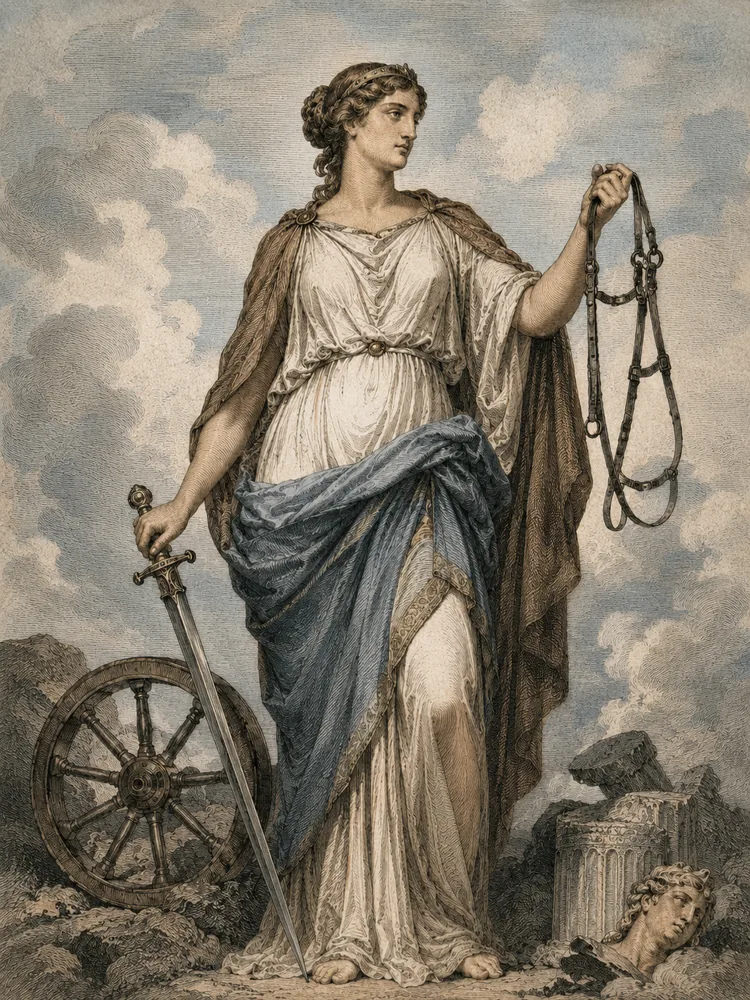
Nemesis was the goddess of righteous indignation against pride — the divine principle that brought low those who had risen above their proper station, who had received more than their share of fortune, who had displayed insolent pride or injustice toward the gods or other mortals. She was a daughter of Nyx (in Hesiod's catalogue), and she was depicted with various attributes: a wheel (the wheel of fortune that her presence turned); a cubit-rule (the measuring-stick by which she rebuked excess); a sword and bridle. Her great cult-center was at Rhamnous in Attica, where her marble temple (mid-fifth century BCE) housed a colossal cult-statue by Agoracritus of Paros, said to have been carved from the very block of marble that the Persians had brought with them to make a victory-monument after their expected conquest of Greece — a sublime exemplification of Nemesis's principle, the Persians' presumption rebounding upon them after their defeat at Marathon and Salamis.
Nemesis was associated with several mythological narratives. In one tradition, she was the actual mother (rather than the merely heavenly Leda) of Helen of Troy: pursued by Zeus, she transformed herself into various forms to escape him, ending as a goose; he caught her as a swan; and the egg from which Helen was born was deposited with Leda for incubation, providing the conventional account of Helen's parentage with a different actual genesis. In another, she pronounced the doom upon Narcissus the beautiful youth who refused all lovers; she sentenced him to fall in love with his own reflection, which was the cause of his pining away into the flower that bears his name. Her name has passed into English as a synonym for an inescapable agent of one's downfall; the original Greek figure, with her exact concern with the proportionate retribution of pride, has not always been remembered.