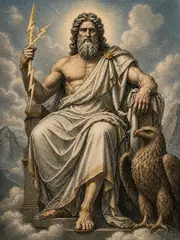
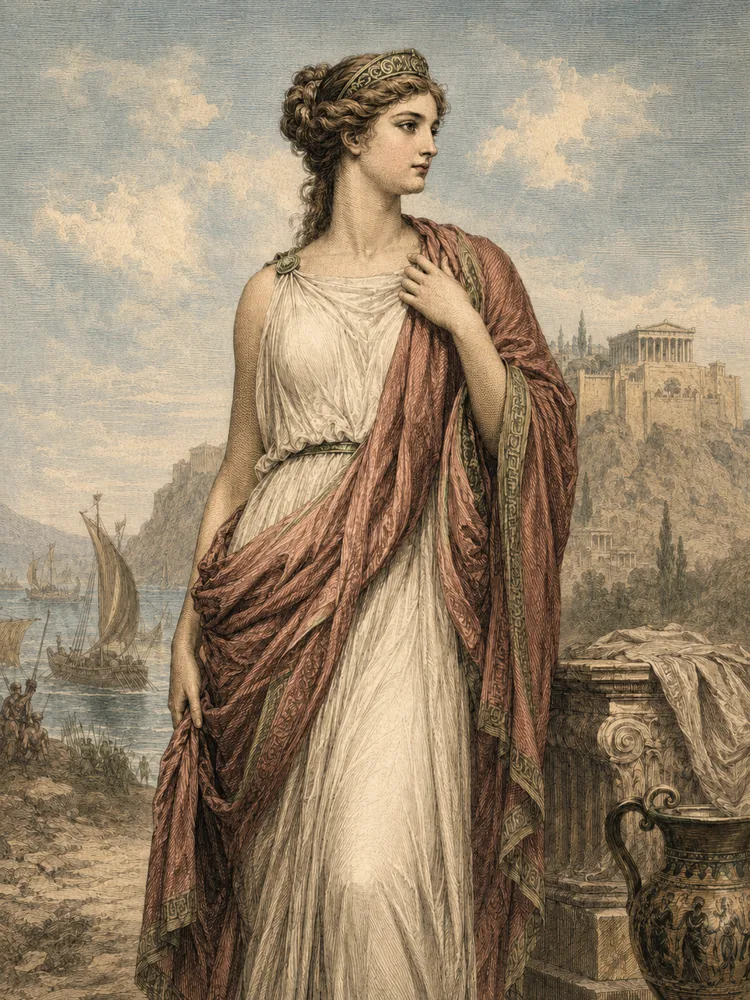
Zeus, taking the form of a swan, lay with Leda the wife of Tyndareus king of Sparta; and from this union (or rather, from the egg that Leda afterward laid) was born Helen, of beauty so surpassing that no mortal had her equal. There was born with her also her brother Polydeuces, who was likewise the child of Zeus; while in another egg, born of Leda's union with Tyndareus the same night, were Castor and Clytemnestra, of mortal blood. Polydeuces and Castor became afterward the Dioscuri, the heavenly twins, and Clytemnestra became wife of Agamemnon and slew him; but the central thread of the legend was Helen.
When Helen came of age, the kings and princes of Greece sought her hand, so many of them and so jealous of one another that her father Tyndareus feared a war over her marriage. Odysseus, who was among the suitors but doubted of his own success, advised Tyndareus to bind all the suitors by an oath: that whoever should win Helen, the rest should defend his marriage against any who tried to take her from him. The suitors swore, and Helen was given to Menelaus brother of Agamemnon; and a daughter Hermione was born to them.
But Aphrodite had promised Helen to Paris, son of Priam king of Troy, when she had been chosen by him as fairest of the three goddesses on Mount Ida. Paris came to Sparta as a guest of Menelaus, and when his host was away in Crete he persuaded Helen — or seized her, the poets did not agree — and carried her off to Troy. The suitors of Helen, bound by their oath, gathered at Aulis and sailed against Troy; and the war that followed lasted ten years, and ended in the destruction of the city and the death of Paris.
Of Helen herself the ancient sources gave conflicting accounts. The Iliad treats her with sympathy, even pity — she laments her own beauty and the war it has caused, and the old men of Troy say that she is too lovely to blame. But others held that the Helen at Troy was a phantom only, a phasma created by the gods, while the real Helen had been carried by Hermes to Egypt and waited there in the household of King Proteus until Menelaus on his way home should find her. So the Egyptian version, given by Stesichorus and developed by Euripides; the Homeric version, in which she is at Troy throughout, is otherwise. Whichever is true, Menelaus took her back at the end of the war, and they returned together to Sparta, where they reigned in peace.