A Compendium of the Ancient Gods
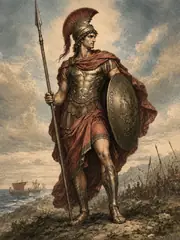
Hector, plate

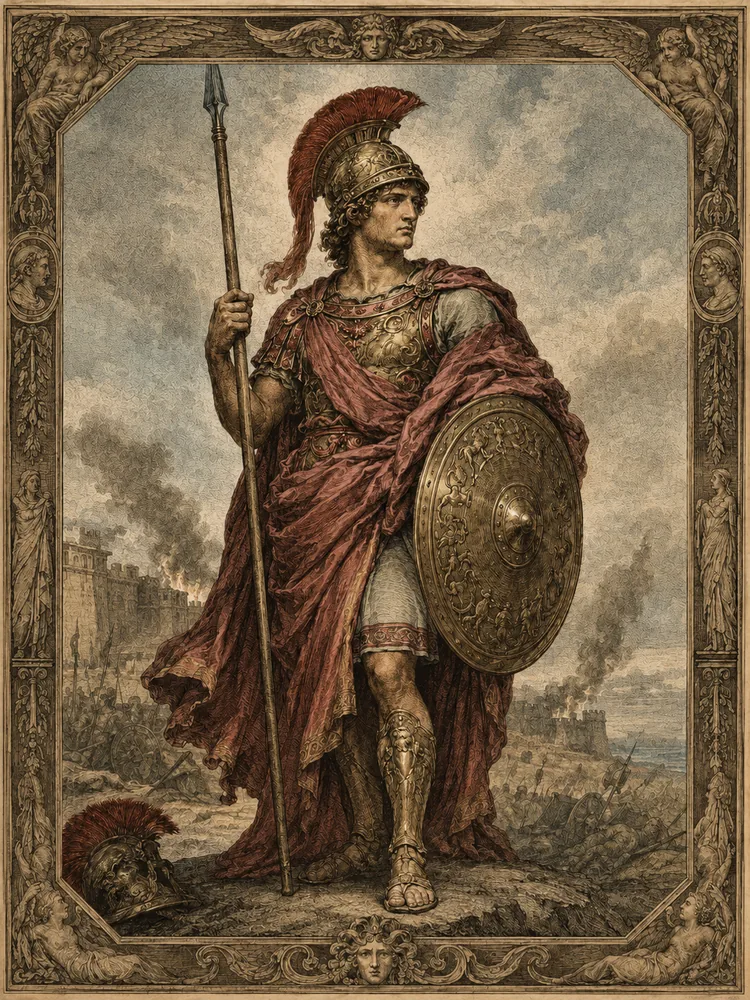
Hector was the eldest son of Priam king of Troy and his wife Hecuba, and the chief commander of the Trojan armies. He was unlike his brother Paris in every respect that the Greeks valued: brave where Paris was cowardly, devoted to his city where Paris had ruined it, dutiful as son and husband and father where Paris was self-indulgent. Of all the warriors at Troy on either side, Hector was the most generally admired, even by his enemies; and the central books of the Iliad are arranged about his fate.

He was wedded to Andromache, daughter of Eetion king of Cilician Thebe, and they had a small son, Astyanax, whom Hector loved tenderly. The famous scene at the Scaean gate of Troy, in which Hector, departing for the battle, takes his son in his arms — the boy frightened by the great helmet, crying away from his father; Hector laughing, lifting off the helmet, kissing the child, praying for his future — is one of the most affecting passages in all ancient literature, and the moment in which the human cost of the war is most clearly shown.

After the death of Patroclus, the closest friend of Achilles, the Greek hero returned to the field with new armor forged by Hephaestus and pursued Hector with a wrath that no other warrior could withstand. The Trojans fell back into the city; only Hector remained outside the walls, ashamed to retreat. Achilles closed upon him, and Hector — at the last — turned and fled, three times round the walls of Troy, with Achilles in pursuit, until the gods checked him and he turned to face his death. They fought; Hector fell. Achilles dragged the body behind his chariot back to the Greek camp, and refused for many days to give it up.

At last Priam, guided through the Greek lines by Hermes, came to Achilles's tent by night and begged for the body of his son, kissing the hands that had killed him. Achilles, moved by the old king's grief, gave back the corpse; the truce was kept; and the Iliad ends with the funeral of Hector at Troy, lamented by Andromache, by Hecuba, and by Helen herself — for he alone of the Trojans had treated her with consistent kindness.
Curator’s note

What the sources say, and what later tradition added. The sources for this bay

Hector is, after Achilles, the central figure of the Iliad — the Greek epic devotes Books 6, 7, 12-15, and 22-24 substantially to him. The funeral of Hector is the closing scene of the poem (24.776-804). The earlier and later parts of his story (his exploits before the period covered by the Iliad, his prior relationship with Helen, etc.) appear in the lost Trojan Cycle, especially the Cypria. Vergil's Aeneid (2.268-297) gives the haunting scene of Hector's ghost appearing to Aeneas on the night of Troy's fall. The hero-cult of Hector is attested at Thebes — the Thebans claimed his bones had been brought there from Troy, and Pausanias (9.18.5) records the tomb. The Iliadic Hector is the great instance in Greek literature of the noble enemy: Homer makes him sympathetic without ever making him a Greek.

Kin in the sources

Each tie is quoted from the entry that states it.

When the sources speak

Dated witnesses for The Heroic Cycle and the Tragic Houses. A date marks when the evidence was written down, not when the belief began. The whole timeline

c. 1600–1100 BCE
Mycenaean palace tablets in Linear B record offerings and divine names, but little continuous myth.
c. 1100–800 BCE
Post-palatial oral traditions and changing cult landscapes precede the surviving alphabetic epics.
late 8th–7th centuries BCE
The Iliad, Odyssey, Hesiodic Theogony and Works and Days give influential but non-exclusive divine orders.
7th–6th centuries BCE
Homeric Hymns, lyric poetry, colonization, and local sanctuary traditions multiply regional narratives.
6th–5th centuries BCE
Orphic, Pythagorean, and mystery materials develop alternative cosmogonies and afterlife doctrines.
5th century BCE
Athenian tragedy and comedy recast heroic houses and divine justice for civic audiences.
4th century BCE
Philosophers, antiquarians, and local historians interpret or criticize inherited myth.
323–31 BCE
Hellenistic poets and scholars systematize variants across an enlarged Greek world.

Floor plan

The rooms follow one another in the order their peoples first appear in the written record.

  1. The Cradle of Citiesc. 3400 BCE to 395 CE. 115 works
  2. The Gift of the Nilec. 4000 BCE to 395 CE. 73 works
  3. The Olympian Orderc. 1600 BCE to 750 CE. 152 works
  4. The Persian Worldc. 2000 BCE to 1010 CE. 30 works
  5. The Levantine Borderlandsc. 1200 BCE to 500 CE. 20 works
  6. The Edges of Empirec. 2000 BCE to 1500 CE. 33 works
  7. The Etruscan Worldc. 900 BCE to 750 CE. 22 works
  8. The Roman Inheritancec. 1200 BCE to 500 CE. 58 works
  9. The Northern Inheritancec. 2000 BCE to 1600 CE. 131 works