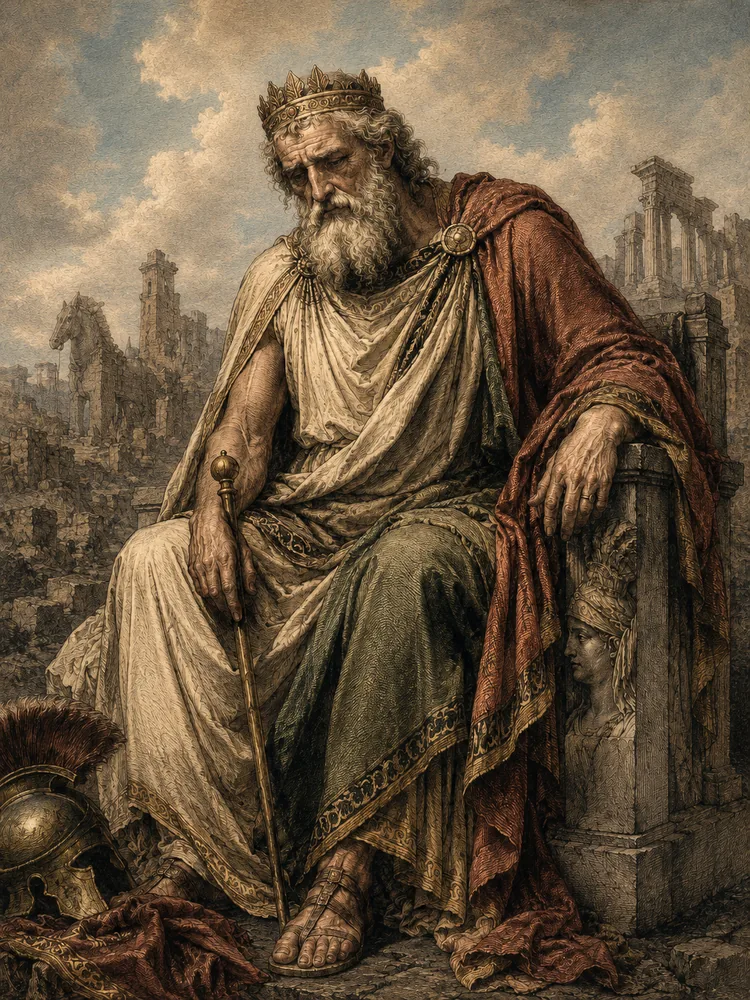

Priam was king of Troy in its last age, son of Laomedon and grandson of Ilus the city's founder. He had fifty sons, by his queen Hecuba and by various concubines, and a number of daughters; he was an old man already when the Greeks landed, and ten years older when the war ended. The Iliad treats him with great dignity: he is never made foolish, and never compromised in his own person by the conduct of his son Paris. His grief for his children and his city, mounting through the years, gives the poem its elegiac depth.
When Hector was killed by Achilles and the body dragged back to the Greek camp, it was Priam himself, in a feat that astonished the gods, who came alone by night through the Greek lines — guided by Hermes in disguise — to the tent of his enemy. There the old king kneeled before Achilles, kissed the hands that had slain his son, and begged for the body. Achilles, moved at the sight of the white-haired king and remembering his own father Peleus, agreed; the body was returned, and a truce kept for the funeral games of Hector. This scene, the night-meeting of Priam and Achilles, is the moral and dramatic summit of the Iliad and the moment toward which the whole poem is built.
But Troy was doomed, and Priam outlived his sons only to see the city fall. On the night of the wooden horse, when the Greeks had broken in, the old king put on his armor — armor he could no longer carry — and would have died fighting. His queen Hecuba persuaded him to take refuge with her at the altar of Zeus in the courtyard. There Pyrrhus the son of Achilles found them, killed Priam's last son Polites in his very sight, and then dragged the old king from the altar by his hair and slew him there, his blood falling upon the altar he had clutched. Virgil's Aeneid (Book 2) is the great account of this death — the second father of fathers, the king of kings, lying headless on the shore of his own city, and unrecognizable by anyone.