
When Oedipus had gone into exile, the kingship of Thebes was disputed between his two sons, Eteocles and Polyneices. They had agreed to rule in alternate years; but Eteocles, when his year was done, refused to step down, and Polyneices went into exile and married the daughter of Adrastus king of Argos, and led an Argive army against Thebes — the famous expedition of the Seven against Thebes. The two brothers met in single combat before the gates and slew each other; the Argive army was driven off, and the kingship passed to Creon, the brothers' uncle, who was Antigone's mother's brother.
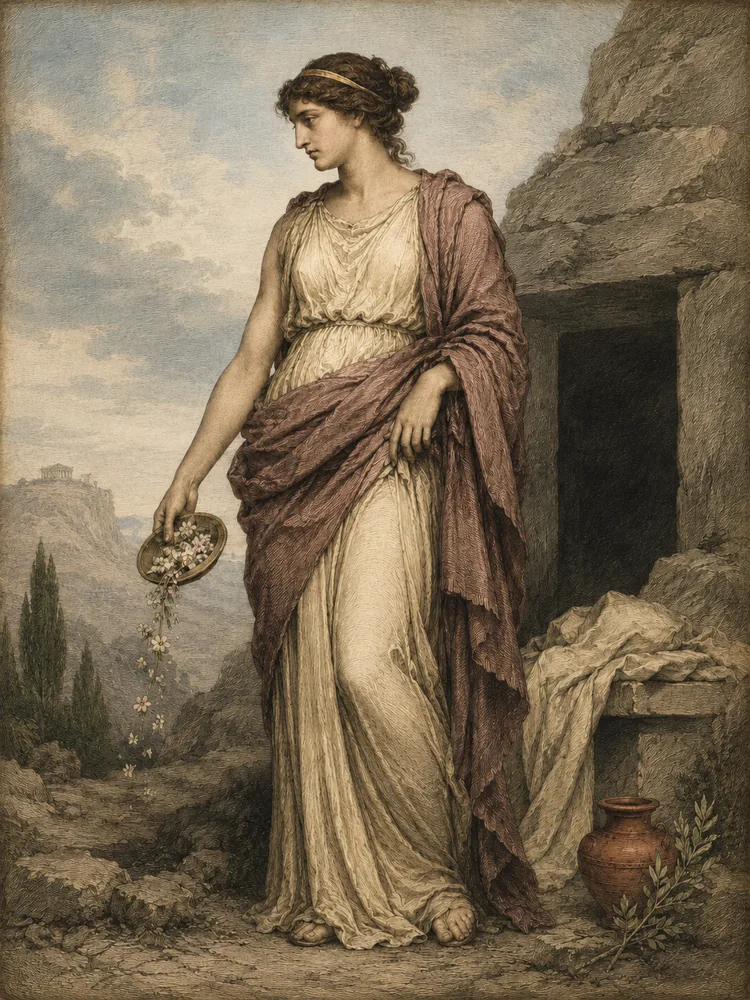
Creon decreed that Eteocles, who had died defending the city, should receive a hero's burial, but that Polyneices, who had brought the foreign army, should be left unburied — a body for the dogs and the carrion-birds, with the death-penalty for any who attempted to inter him. The decree was an offense against the divine law, which required that the dead be given to the earth; but no one in Thebes dared oppose it. Antigone alone went out by night, scattered earth upon her brother's body in token-burial, and was caught by the watchmen and brought before Creon.
She did not deny what she had done. Creon condemned her to death — not by the executioner, but by being walled up in a rock-cut tomb with a little bread and water, that the city might not be polluted by direct killing. Her sister Ismene, who had not joined her in the deed, asked to share her fate, but Antigone refused her: "You chose to live; I chose this." Haemon, Creon's son, who was Antigone's betrothed, pleaded for her life, and was rebuffed. Tiresias the prophet then came and warned Creon that the gods were offended; Creon, repenting too late, hastened to the tomb to release her — and found Antigone hanged within, by her own hand, and Haemon collapsed beside her body, and when Creon entered, Haemon stabbed himself and died. Eurydice the queen, hearing the news, killed herself also. Creon was left alive, alone, with the consequences of his decree.