A Compendium of the Ancient Gods
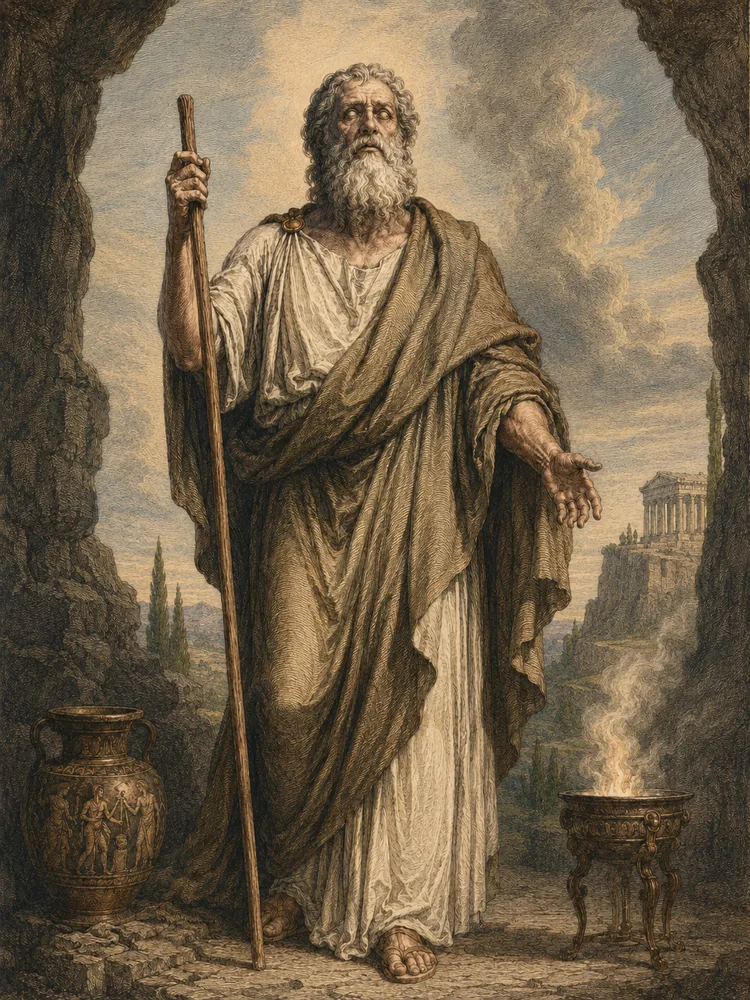
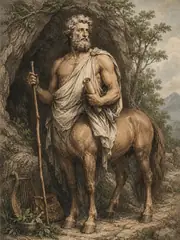
Tiresias, plate

Tiresias was the great blind seer of Thebes, whose prophetic counsel ran through the entire Theban tragic cycle from Cadmus to the war of the Epigoni. The accounts of his blindness and his prophetic gift were two: in one version, he had stumbled upon Athena bathing, and the goddess in the privacy-protective convention had blinded him, but afterwards (mollified by his mother Chariclo's pleas) had compensated him with the gift of prophecy and the understanding of the speech of birds. In the other and more famous version, he had once come upon a pair of mating snakes on Mount Cyllene and struck them with his stick, killing the female; he was thereupon transformed into a woman, and lived for seven years (or in some versions one year) as a woman before encountering another pair of snakes and, by the same act, being restored to manhood.

Having been thus uniquely both man and woman, he was called upon when Zeus and Hera quarreled over which sex enjoyed greater pleasure in love (Zeus saying women, Hera saying men); they referred the question to Tiresias, who answered that of ten parts of the pleasure of love, the woman has nine and the man one. Hera, in fury at having her case lost (or, in a kinder version, simply at the public discussion), blinded him; Zeus, unable to undo Hera's act, gave him the gift of prophecy and a long life as compensation.

The figure thereafter appears in the great Theban narratives. He warned Pentheus against opposing Dionysus; he was consulted by Oedipus and revealed (with prophetic indirection) the truth of the king's parricide and incest; he advised Creon during the war against Thebes, and was the prophet who instructed Eteocles and Polynices's successors on the matter of the buried serpent at Thebes; he died at length on the road from Thebes after the city had fallen, drinking from a cold spring near Tilphusa. His ghost, in the Odyssey, is the one Odysseus consults at the borders of the underworld for prophetic guidance — the only ghost retaining its full memory and prophetic capacity in the realm of the dead.
Curator’s note

What the sources say, and what later tradition added. The sources for this bay

The principal sources are Sophocles's Oedipus Tyrannus and Antigone; Euripides's Bacchae and Phoenissae; Homer, Odyssey 11; Apollodorus 3.6.7; Ovid, Metamorphoses 3.316–338 (the seven-years-as-woman). Callimachus's Hymn to Athena 5 gives the alternative blindness-and-Athena version. The figure has had a long literary afterlife, most famously in T. S. Eliot's Waste Land, where Tiresias is the symbolic observer of the poem.

Kin in the sources

Each tie is quoted from the entry that states it.

When the sources speak

Dated witnesses for The Heroic Cycle and the Tragic Houses. A date marks when the evidence was written down, not when the belief began. The whole timeline

c. 1600–1100 BCE
Mycenaean palace tablets in Linear B record offerings and divine names, but little continuous myth.
c. 1100–800 BCE
Post-palatial oral traditions and changing cult landscapes precede the surviving alphabetic epics.
late 8th–7th centuries BCE
The Iliad, Odyssey, Hesiodic Theogony and Works and Days give influential but non-exclusive divine orders.
7th–6th centuries BCE
Homeric Hymns, lyric poetry, colonization, and local sanctuary traditions multiply regional narratives.
6th–5th centuries BCE
Orphic, Pythagorean, and mystery materials develop alternative cosmogonies and afterlife doctrines.
5th century BCE
Athenian tragedy and comedy recast heroic houses and divine justice for civic audiences.
4th century BCE
Philosophers, antiquarians, and local historians interpret or criticize inherited myth.
323–31 BCE
Hellenistic poets and scholars systematize variants across an enlarged Greek world.

Floor plan

The rooms follow one another in the order their peoples first appear in the written record.

  1. The Cradle of Citiesc. 3400 BCE to 395 CE. 115 works
  2. The Gift of the Nilec. 4000 BCE to 395 CE. 73 works
  3. The Olympian Orderc. 1600 BCE to 750 CE. 152 works
  4. The Persian Worldc. 2000 BCE to 1010 CE. 30 works
  5. The Levantine Borderlandsc. 1200 BCE to 500 CE. 20 works
  6. The Edges of Empirec. 2000 BCE to 1500 CE. 33 works
  7. The Etruscan Worldc. 900 BCE to 750 CE. 22 works
  8. The Roman Inheritancec. 1200 BCE to 500 CE. 58 works
  9. The Northern Inheritancec. 2000 BCE to 1600 CE. 131 works