A Compendium of the Ancient Gods
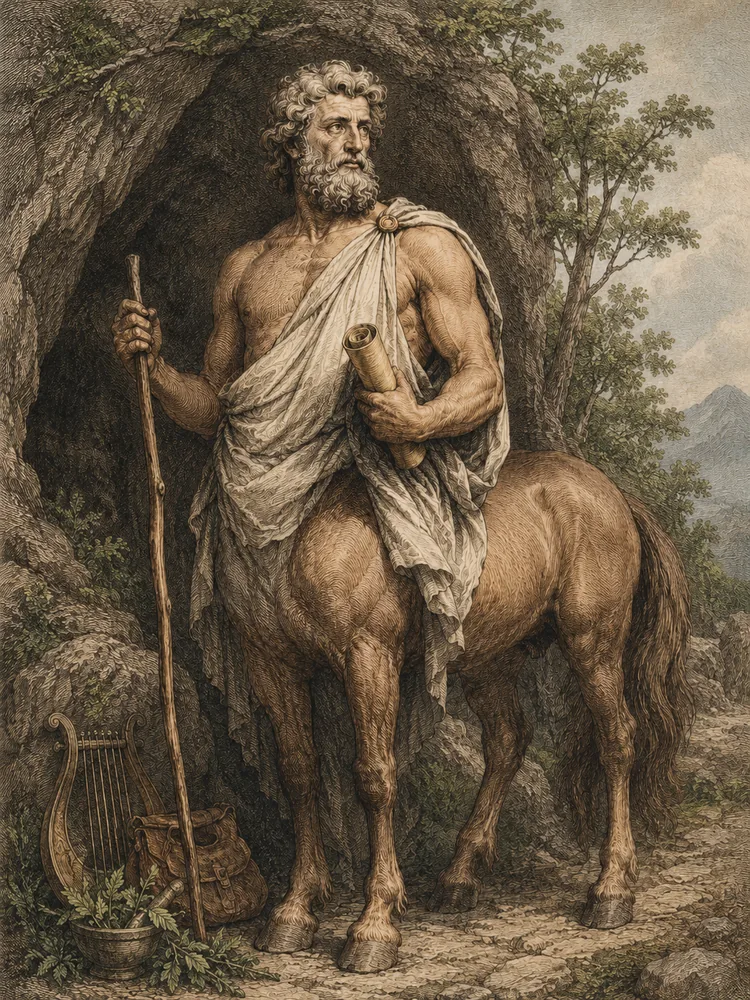
Chiron, plate

Chiron was the wisest of the centaurs — a creature half man, half horse, like the rest of his tribe, but unlike them in being civilized, learned, and immortal. He was not, like the other centaurs, a son of Ixion and the cloud-Hera; he was a son of Cronus by the Oceanid Philyra, conceived when Cronus had taken the form of a horse to escape Rhea's notice. He lived in a cave on Mount Pelion in Thessaly and was the teacher of heroes: Asclepius the physician, Achilles the warrior, Jason the leader of the Argonauts, Heracles (briefly), Theseus, Aeneas (in the Roman tradition), and many others were entrusted to him in their boyhoods, and from him received the disciplines of heroic life — hunting, riding, the herbs of healing, the poems of Orpheus, the stars by which to navigate, the proper conduct of a noble man.

His death came accidentally and at the hands of the very greatest of his pupils. When Heracles had been driven to fight the centaurs (in the course of an episode at the cave of Pholus, where the centaurs had attacked over a jar of wine), one of his arrows — poisoned with the gall of the Hydra — passed through the chaos of the battle and lodged in Chiron's leg or knee. The wound was, by the Hydra's poison, both incurable and (since Chiron was immortal) impossible to die of; the centaur was condemned to suffer agony forever. He at length begged Zeus to allow him to surrender his immortality, which Zeus permitted by transferring it to Prometheus (who needed an immortal to take his place at the eagle-torment, the rotation through which finally allowed Heracles to free Prometheus). Chiron then died of his wound and was placed in the heavens as the constellation Centaurus (or, in some traditions, Sagittarius). His teaching had been the foundation of more than one heroic life; his death by accident at his pupil's hand was one of the more poignant Greek instances of the tragedy of unintended consequence.
Curator’s note

What the sources say, and what later tradition added. The sources for this bay

The principal sources are Pindar (Pythian 3, Pythian 4, Nemean 3, with Pindar making considerable use of Chiron as the type of the wise teacher); Apollodorus 1.2.4 (his parentage), 2.5.4 (the Heracles wound); Ovid, Metamorphoses (scattered references); Statius's Achilleid (the upbringing of Achilles). The transfer of his immortality to Prometheus is in Apollodorus 2.5.4, 2.5.11, where the mechanism by which the eagle-tormented Prometheus is finally freed depends on this transaction.

Kin in the sources

Each tie is quoted from the entry that states it.

When the sources speak

Dated witnesses for The Heroic Cycle and the Tragic Houses. A date marks when the evidence was written down, not when the belief began. The whole timeline

c. 1600–1100 BCE
Mycenaean palace tablets in Linear B record offerings and divine names, but little continuous myth.
c. 1100–800 BCE
Post-palatial oral traditions and changing cult landscapes precede the surviving alphabetic epics.
late 8th–7th centuries BCE
The Iliad, Odyssey, Hesiodic Theogony and Works and Days give influential but non-exclusive divine orders.
7th–6th centuries BCE
Homeric Hymns, lyric poetry, colonization, and local sanctuary traditions multiply regional narratives.
6th–5th centuries BCE
Orphic, Pythagorean, and mystery materials develop alternative cosmogonies and afterlife doctrines.
5th century BCE
Athenian tragedy and comedy recast heroic houses and divine justice for civic audiences.
4th century BCE
Philosophers, antiquarians, and local historians interpret or criticize inherited myth.
323–31 BCE
Hellenistic poets and scholars systematize variants across an enlarged Greek world.

Floor plan

The rooms follow one another in the order their peoples first appear in the written record.

  1. The Cradle of Citiesc. 3400 BCE to 395 CE. 115 works
  2. The Gift of the Nilec. 4000 BCE to 395 CE. 73 works
  3. The Olympian Orderc. 1600 BCE to 750 CE. 152 works
  4. The Persian Worldc. 2000 BCE to 1010 CE. 30 works
  5. The Levantine Borderlandsc. 1200 BCE to 500 CE. 20 works
  6. The Edges of Empirec. 2000 BCE to 1500 CE. 33 works
  7. The Etruscan Worldc. 900 BCE to 750 CE. 22 works
  8. The Roman Inheritancec. 1200 BCE to 500 CE. 58 works
  9. The Northern Inheritancec. 2000 BCE to 1600 CE. 131 works