A Compendium of the Ancient Gods
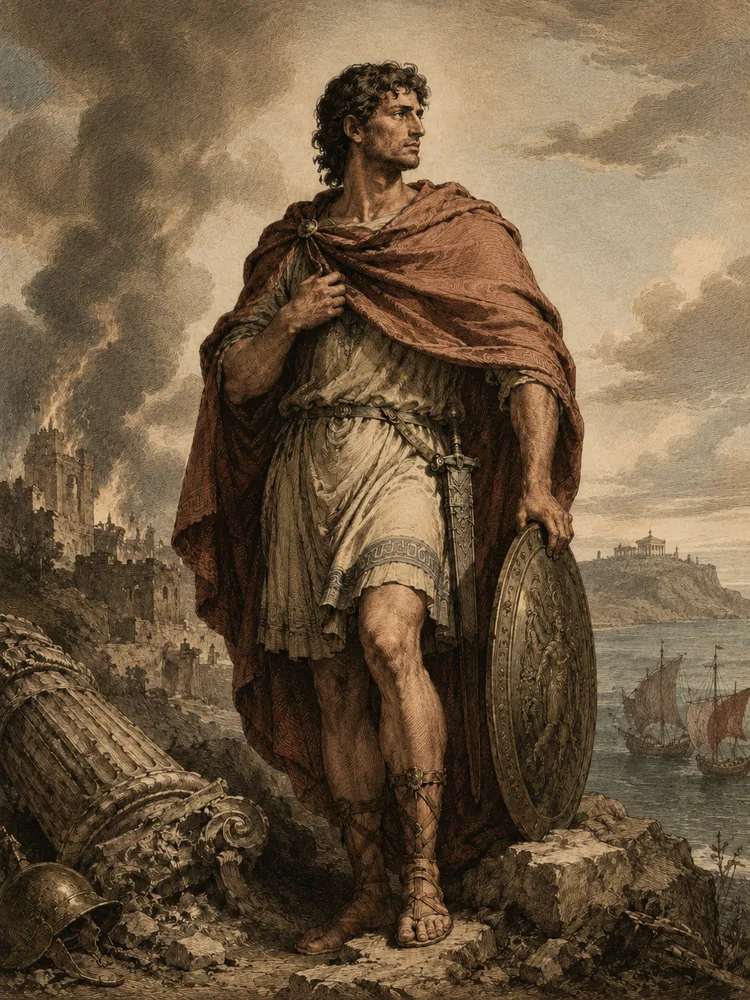
Aeneas, plate

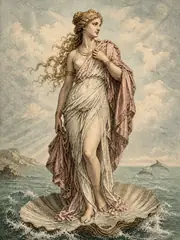
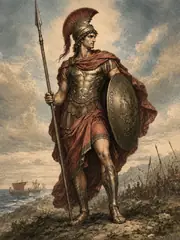
Aeneas was the son of Anchises, a prince of the Dardanian branch of the Trojan royal house, and of the goddess Aphrodite, who had loved Anchises upon Mount Ida and borne him this child. He was thus a cousin of Hector and Paris, but of higher divine lineage, and the Iliad gives him a special destiny: when the gods debate his fate during a duel with Achilles, Poseidon himself rescues him from the field, declaring that Aeneas's lineage shall not perish from the earth, but shall reign over Trojans yet to be.

On the night Troy fell, Aeneas at first attempted to die fighting in the streets, but his mother Aphrodite appeared to him and showed him that the gods themselves were tearing down the city — Neptune working at the walls, Juno at the gates, Athena upon the citadel — and bade him save what he could of his family. So Aeneas took up his old father Anchises upon his shoulders, took his small son Iulus (also called Ascanius) by the hand, and led his wife Creusa out through the burning streets. Creusa was lost in the flight and could not be found again; her ghost appeared to Aeneas to tell him she was held now by the Mother of the Gods, and to send him on his way.

What followed was the seven-year voyage of Aeneas and his small remnant of Trojan exiles, seeking the country promised them by oracle — first to Thrace, then to Delos, then to Crete, then to the Strophades where they met the Harpies, then to Epirus, then to Sicily where Anchises died, then to Carthage where Queen Dido received him and loved him, and from where Aeneas was at last torn away by divine command (Dido killed herself when he sailed). Coming at length to Italy, Aeneas landed at Cumae, descended to the underworld with the Sibyl, and there beheld the souls of his ancestors and the future heroes of the Roman race; thus reassured, he sailed up the coast of Latium, and there made war against King Turnus of the Rutuli for the hand of Lavinia daughter of King Latinus, and prevailed.

From his marriage with Lavinia, and from the line of his son Iulus, descended the kings of Alba Longa, and from them, in the fullness of time, Romulus and Remus the founders of Rome, and from them the Julian gens — Caesar and Augustus — who claimed Aeneas as their forefather and Aphrodite (whom the Romans called Venus) as their divine ancestress. So Aeneas, fugitive of the burning city, became the founder of a greater city; and the Romans, conscious of this lineage, treated their Trojan ancestry not as legend but as history.
Curator’s note

What the sources say, and what later tradition added. The sources for this bay

Aeneas appears in the Iliad (especially Book 5, where Aphrodite rescues him, and Book 20, where Poseidon does the same and pronounces his future). His Roman destiny is the subject of Virgil's Aeneid (composed 29-19 BCE, the great national epic of Rome), which absorbs and reworks earlier Greek material. The earlier Greek tradition is preserved in Hellanicus, Stesichorus, Lycophron's Alexandra, and Dionysius of Halicarnassus's Roman Antiquities (Book 1). The Roman cult of Aeneas at Lavinium is well-attested; the federal sanctuary of the Penates, supposedly brought from Troy, was a real cult-place. The Julian claim of Trojan descent is attested in Caesar's funeral oration for his aunt Julia (Suetonius, Divus Julius 6) and in Augustan propaganda generally. The reader will note that Aeneas figures in this volume as the Greek-Trojan hero of Iliadic tradition; his Roman afterlife belongs more properly to the next volume.

Kin in the sources

Each tie is quoted from the entry that states it.

When the sources speak

Dated witnesses for The Heroic Cycle and the Tragic Houses. A date marks when the evidence was written down, not when the belief began. The whole timeline

c. 1600–1100 BCE
Mycenaean palace tablets in Linear B record offerings and divine names, but little continuous myth.
c. 1100–800 BCE
Post-palatial oral traditions and changing cult landscapes precede the surviving alphabetic epics.
late 8th–7th centuries BCE
The Iliad, Odyssey, Hesiodic Theogony and Works and Days give influential but non-exclusive divine orders.
7th–6th centuries BCE
Homeric Hymns, lyric poetry, colonization, and local sanctuary traditions multiply regional narratives.
6th–5th centuries BCE
Orphic, Pythagorean, and mystery materials develop alternative cosmogonies and afterlife doctrines.
5th century BCE
Athenian tragedy and comedy recast heroic houses and divine justice for civic audiences.
4th century BCE
Philosophers, antiquarians, and local historians interpret or criticize inherited myth.
323–31 BCE
Hellenistic poets and scholars systematize variants across an enlarged Greek world.

Floor plan

The rooms follow one another in the order their peoples first appear in the written record.

  1. The Cradle of Citiesc. 3400 BCE to 395 CE. 115 works
  2. The Gift of the Nilec. 4000 BCE to 395 CE. 73 works
  3. The Olympian Orderc. 1600 BCE to 750 CE. 152 works
  4. The Persian Worldc. 2000 BCE to 1010 CE. 30 works
  5. The Levantine Borderlandsc. 1200 BCE to 500 CE. 20 works
  6. The Edges of Empirec. 2000 BCE to 1500 CE. 33 works
  7. The Etruscan Worldc. 900 BCE to 750 CE. 22 works
  8. The Roman Inheritancec. 1200 BCE to 500 CE. 58 works
  9. The Northern Inheritancec. 2000 BCE to 1600 CE. 131 works