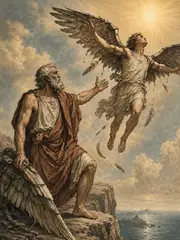
A Compendium of the Ancient Gods
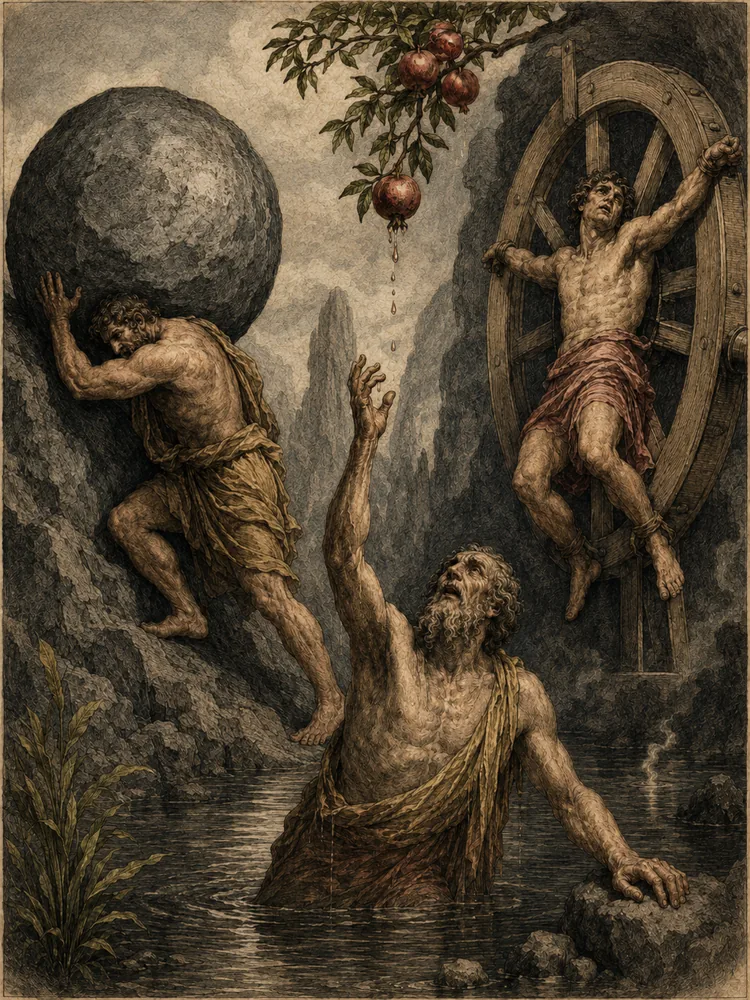
The Great Sinners, plate

Three figures came to stand in Greek mythology as the great instances of impiety punished — Sisyphus, Tantalus, and Ixion — and the torments invented for them have entered the language of every European people.

Sisyphus was king of Corinth, a man of cleverness who used it for ill. He revealed to the river-god Asopus where Zeus had hidden Asopus's daughter, and so betrayed the secrets of the gods; afterward, when Death came for him, he tricked Death into chains, so that for a season no one died upon the earth, until Ares released the prisoner. Then he tricked Hades a second time — instructing his wife to leave his body unburied so that he might complain in the underworld, and then begging leave to return to the upper world to settle the matter, where he refused to come back. At last he was retrieved by Hermes. His punishment in Tartarus was to roll a great stone up a hill — and at the very moment when the summit was reached, the stone slipped from his hands and rolled to the bottom, and he must begin again, forever.

Tantalus was a king of Lydia (or, others said, of Phrygia), and a son of Zeus, who had been admitted to the table of the gods and shared their nectar. He stole their food and gave it to mortals; or, in the worse version, he killed his own son Pelops, cooked him, and served the dish to the gods to test their omniscience. (The gods recognized the dish; they restored Pelops to life, except for one shoulder which Demeter, distracted by grief for her own daughter, had eaten. The shoulder was replaced with one of ivory.) Tantalus was condemned to stand in a pool of water beneath a fruit-laden branch — eternally hungry, eternally thirsty — for whenever he stooped to drink the water receded, and whenever he reached for the fruit the branch swung up beyond his grasp.

Ixion was king of the Lapiths in Thessaly, and his crime was the murder of his father-in-law Deioneus, whom he had pushed into a pit of burning coals to avoid paying the bride-price. No king on earth would purify him of the kin-murder; in the end Zeus himself purified Ixion and brought him to Olympus. There Ixion repaid the favor by attempting to seduce Hera. Zeus, learning of the design, made a cloud-figure (Nephele) in Hera's likeness, and Ixion lay with the cloud, fathering thereby the race of Centaurs. For this, the most ungrateful of all crimes, Zeus bound Ixion to a fiery wheel that turns forever in Tartarus, with the words "a man should always honor his benefactor" written, the older mythographers said, upon the wheel itself.
Curator’s note

What the sources say, and what later tradition added. The sources for this bay

Sisyphus's punishment is described in Odyssey 11.593-600 (the Nekyia); his stratagems are in Theognis 700-718, Pherecydes (FGrH 3 F 119), and Pseudo-Apollodorus (Bibliotheca 1.9.3, 3.12.6). Tantalus's punishment is in Odyssey 11.582-592; his crime varies — Pindar (Olympian 1.46-66) gives the noblest version (he stole the gods' food), while Pseudo-Apollodorus (Epitome 2.3) and the older sources give the cannibalism. Ixion's story is in Pindar (Pythian 2.21-48) and Diodorus Siculus (4.69.3-5). All three figures are punished for sins against xenia (the bond of host and guest) and against piety toward the gods — Sisyphus for betraying divine secrets and cheating Death, Tantalus for abusing the gods' hospitality, Ixion for repaying his benefactor with attempted seduction. The triad becomes canonical in Hellenistic and Roman moral writing; Lucretius (De rerum natura 3.978-1023) gives the great rationalizing reading, in which the three torments are allegories for psychological states in this life.

Kin in the sources

Each tie is quoted from the entry that states it.

When the sources speak

Dated witnesses for The Heroic Cycle and the Tragic Houses. A date marks when the evidence was written down, not when the belief began. The whole timeline

c. 1600–1100 BCE
Mycenaean palace tablets in Linear B record offerings and divine names, but little continuous myth.
c. 1100–800 BCE
Post-palatial oral traditions and changing cult landscapes precede the surviving alphabetic epics.
late 8th–7th centuries BCE
The Iliad, Odyssey, Hesiodic Theogony and Works and Days give influential but non-exclusive divine orders.
7th–6th centuries BCE
Homeric Hymns, lyric poetry, colonization, and local sanctuary traditions multiply regional narratives.
6th–5th centuries BCE
Orphic, Pythagorean, and mystery materials develop alternative cosmogonies and afterlife doctrines.
5th century BCE
Athenian tragedy and comedy recast heroic houses and divine justice for civic audiences.
4th century BCE
Philosophers, antiquarians, and local historians interpret or criticize inherited myth.
323–31 BCE
Hellenistic poets and scholars systematize variants across an enlarged Greek world.

Floor plan

The rooms follow one another in the order their peoples first appear in the written record.

  1. The Cradle of Citiesc. 3400 BCE to 395 CE. 115 works
  2. The Gift of the Nilec. 4000 BCE to 395 CE. 73 works
  3. The Olympian Orderc. 1600 BCE to 750 CE. 152 works
  4. The Persian Worldc. 2000 BCE to 1010 CE. 30 works
  5. The Levantine Borderlandsc. 1200 BCE to 500 CE. 20 works
  6. The Edges of Empirec. 2000 BCE to 1500 CE. 33 works
  7. The Etruscan Worldc. 900 BCE to 750 CE. 22 works
  8. The Roman Inheritancec. 1200 BCE to 500 CE. 58 works
  9. The Northern Inheritancec. 2000 BCE to 1600 CE. 131 works