A Compendium of the Ancient Gods
Daedalus and Icarus, plate

Daedalus was an Athenian, a craftsman of such skill that he was held to be the inventor of carpentry, of shipbuilding, of statuary that opened its eyes — and his name, in Greek, means simply "the cunning-worker." He was a descendant of the royal house of Athens, but had to flee the city after he killed his nephew Talos (who, an apprentice, had begun to surpass him), throwing him from the Acropolis in a fit of jealousy. Convicted of the murder, Daedalus took refuge in Crete at the court of King Minos.

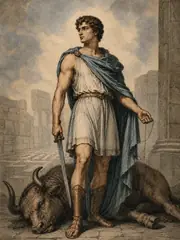
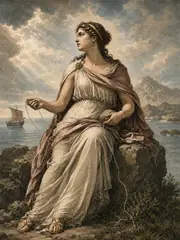
There he served Minos for many years, building works of great fame: the Labyrinth, that intricate maze in which the Minotaur was imprisoned; the wooden cow within which Pasiphaë the queen lay with the bull and conceived the Minotaur; the dancing-floor at Cnossus that Homer mentions. He had a son, Icarus, by a slave-woman of Minos's household. But when Theseus came to Crete and was helped by Daedalus to escape the Labyrinth (it was Daedalus, prompted by the princess Ariadne, who instructed her in the use of the thread), Minos's anger at the escape fell upon the craftsman; Daedalus and Icarus were imprisoned together within the Labyrinth, that they might be lost in their own creation.

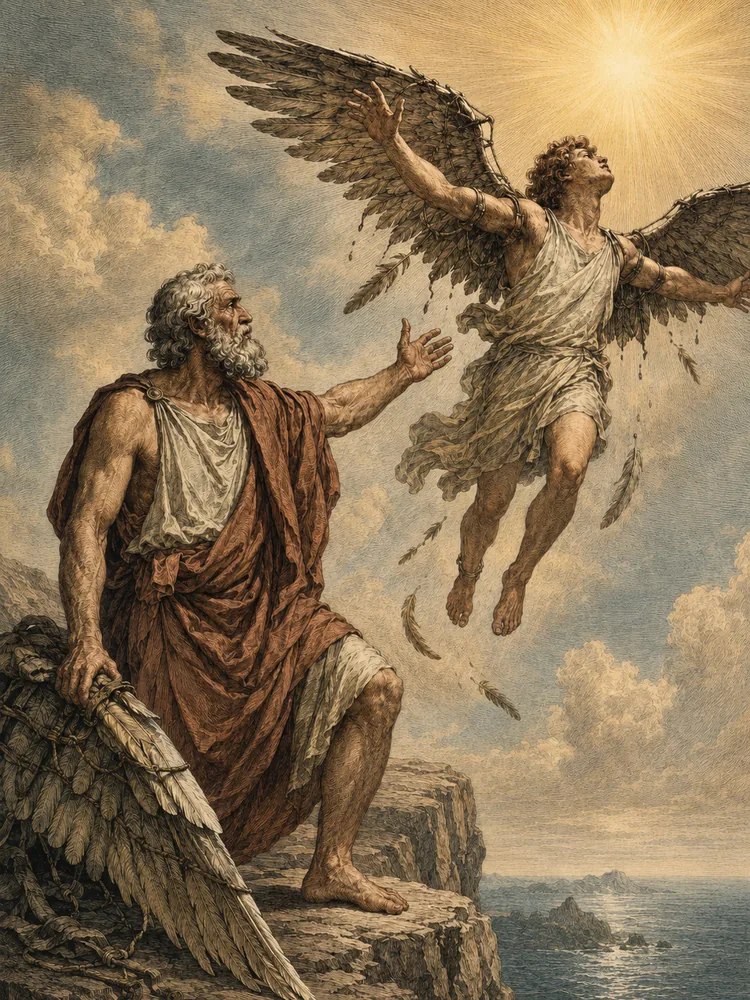
Daedalus, considering what means of escape might be left him, observed that Minos controlled the land and the sea but not the air. He gathered feathers from the seabirds that nested in the cliffs, and constructed two pairs of wings, fastening the feathers in beeswax to a wooden frame. Before they took flight he warned Icarus: "Fly the middle course; if you fly too low, the spray of the sea will weight your wings; if you fly too high, the sun will melt the wax." The boy promised, and they took off.

Icarus, exulting in his ascent, forgot the warning; he climbed higher and higher, until the sun softened the wax and the feathers detached, and he fell into the sea — that part of the Aegean which from him took the name Icarian. Daedalus, seeing his son's fall, could do nothing; he flew on alone, and made landfall at last in Sicily, where King Cocalus received him and protected him from the pursuit of Minos (whom Cocalus afterward had killed in his bath). The body of Icarus washed up on a small island, and Heracles, passing by, recognized it and gave it burial; that island was thereafter called Icaria.
Curator’s note

What the sources say, and what later tradition added. The sources for this bay

The Daedalus-Icarus story is preserved fullest in Ovid (Metamorphoses 8.183-235), with the brief flight and the fatal fall told with Ovidian tenderness and irony. Pseudo-Apollodorus (Epitome 1.12-15) gives the framework. Diodorus Siculus (4.77) preserves variants and the death of Minos at the hand of Cocalus's daughters. Pausanias (9.11.4-5) records Daedalus's archaic statues of which several were said to survive in his own time. The killing of Talos (also called Perdix in some sources) and the Athenian origins of Daedalus are at Pseudo-Apollodorus 3.15.8-9. The Labyrinth at Cnossus has been the subject of much speculation since Sir Arthur Evans's excavations identified the Minoan palace as a possible source; the Greek word labyrinthos is pre-Greek, like hyacinth, and probably reflects a Minoan term. The myth itself preserves something of the impression that the great Bronze Age palaces made on the simpler Greeks who came after.

Kin in the sources

Each tie is quoted from the entry that states it.

When the sources speak

Dated witnesses for The Heroic Cycle and the Tragic Houses. A date marks when the evidence was written down, not when the belief began. The whole timeline

c. 1600–1100 BCE
Mycenaean palace tablets in Linear B record offerings and divine names, but little continuous myth.
c. 1100–800 BCE
Post-palatial oral traditions and changing cult landscapes precede the surviving alphabetic epics.
late 8th–7th centuries BCE
The Iliad, Odyssey, Hesiodic Theogony and Works and Days give influential but non-exclusive divine orders.
7th–6th centuries BCE
Homeric Hymns, lyric poetry, colonization, and local sanctuary traditions multiply regional narratives.
6th–5th centuries BCE
Orphic, Pythagorean, and mystery materials develop alternative cosmogonies and afterlife doctrines.
5th century BCE
Athenian tragedy and comedy recast heroic houses and divine justice for civic audiences.
4th century BCE
Philosophers, antiquarians, and local historians interpret or criticize inherited myth.
323–31 BCE
Hellenistic poets and scholars systematize variants across an enlarged Greek world.

Floor plan

The rooms follow one another in the order their peoples first appear in the written record.

  1. The Cradle of Citiesc. 3400 BCE to 395 CE. 115 works
  2. The Gift of the Nilec. 4000 BCE to 395 CE. 73 works
  3. The Olympian Orderc. 1600 BCE to 750 CE. 152 works
  4. The Persian Worldc. 2000 BCE to 1010 CE. 30 works
  5. The Levantine Borderlandsc. 1200 BCE to 500 CE. 20 works
  6. The Edges of Empirec. 2000 BCE to 1500 CE. 33 works
  7. The Etruscan Worldc. 900 BCE to 750 CE. 22 works
  8. The Roman Inheritancec. 1200 BCE to 500 CE. 58 works
  9. The Northern Inheritancec. 2000 BCE to 1600 CE. 131 works