A Compendium of the Ancient Gods
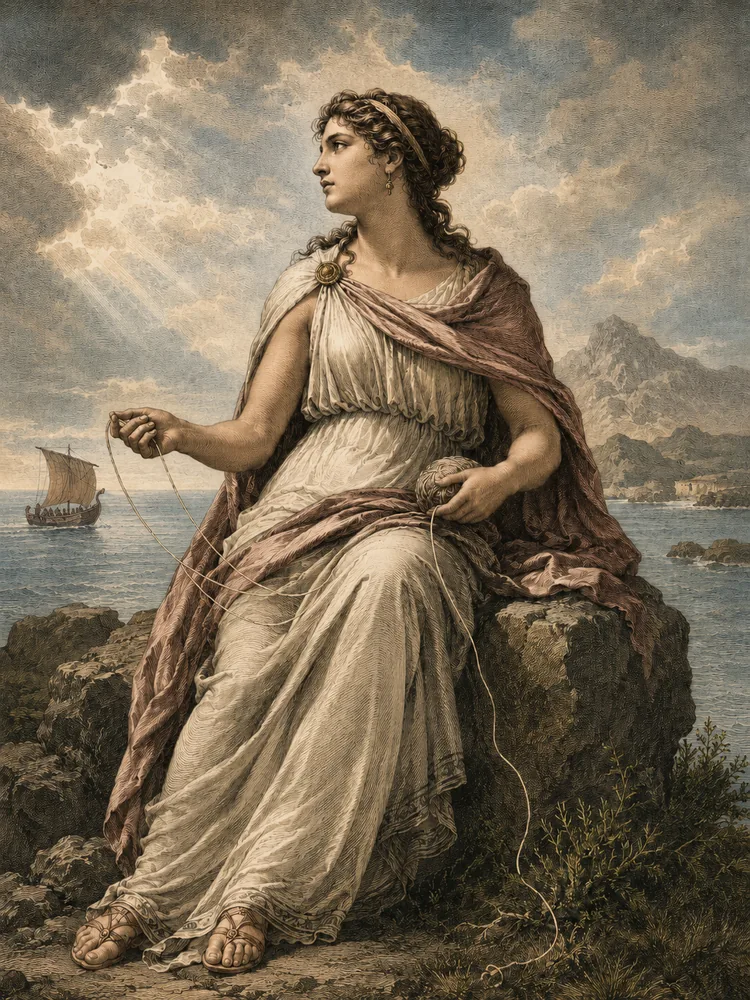
Ariadne, plate

Ariadne was the daughter of King Minos of Crete and Pasiphaë, and so half-sister to the Minotaur in the Labyrinth. When the seven Athenian youths and seven maidens were brought to Crete as the annual tribute to be devoured by the Minotaur, and Theseus was among them, Ariadne saw the prince and fell in love with him. By night she went to Daedalus the craftsman of the Labyrinth and obtained from him the secret of the maze: a ball of thread, fastened at the entrance, which when unwound would mark the path inward and rewound would lead the hero out. This she gave to Theseus, and with it he killed the Minotaur and led the Athenians safely from the Labyrinth.

They escaped together — Theseus, the rescued tributes, and Ariadne — and the Athenian ship made for home. But on the island of Naxos, where they put in for water, Theseus left her behind. Whether he abandoned her by his own design (the older view, preserved in Homer), or whether he was commanded by Dionysus to leave her there for the god to claim (the later, gentler view), or whether he simply forgot her in the press of affairs (the rationalizing view) — the ancient sources differed.

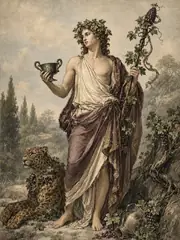
Ariadne, finding herself abandoned, lamented upon the shore. But Dionysus came to her in his procession of satyrs and maenads, with the leopards drawing his chariot and the vines twining about his thyrsus; he loved her, and made her his wife. The wedding-crown he gave her — set with seven stars — was afterward placed in the sky as the constellation Corona Borealis, the Northern Crown, which is still seen there. By Dionysus, Ariadne bore several children: Oenopion the wine-keeper, Staphylus the grape, Thoas, and Peparethus.

After her death (or, as some said, she was made immortal by her husband and never died), Ariadne was honored at Naxos with a double festival — one of mourning, for the abandonment by Theseus, and one of joy, for her marriage to Dionysus. Plutarch records that the two festivals were kept on consecutive days, and that the first was held to be of much greater antiquity than the second.

Curator’s note

What the sources say, and what later tradition added. The sources for this bay

Ariadne appears first in Odyssey 11.321-325 (the Nekyia), where the abandonment is mentioned and Artemis is said to have killed her on Naxos at Dionysus's bidding — an early variant in which she is not made immortal. The thread and the Theseus episode are recounted in Pseudo-Apollodorus (Epitome 1.7-9). The Dionysiac marriage and the Crown is the subject of Catullus 64 (the great Latin epyllion on the wedding of Peleus and Thetis, with Ariadne's story as ekphrasis), and in Ovid (Heroides 10, the letter of Ariadne to Theseus, and Metamorphoses 8.169-182). Plutarch's Theseus 20 records the Naxian double festival. Hero-cult of Ariadne is attested at Naxos, Cyprus (where she had a tomb), and Argos. The Cretan figure is in origin a Minoan goddess of vegetation, taken into Greek mythology and given a romantic interpretation; the Linear B tablets from Cnossus mention an a-ja-di-ne, who has been plausibly identified with the Greek Ariadne.

Kin in the sources

Each tie is quoted from the entry that states it.

When the sources speak

Dated witnesses for The Heroic Cycle and the Tragic Houses. A date marks when the evidence was written down, not when the belief began. The whole timeline

c. 1600–1100 BCE
Mycenaean palace tablets in Linear B record offerings and divine names, but little continuous myth.
c. 1100–800 BCE
Post-palatial oral traditions and changing cult landscapes precede the surviving alphabetic epics.
late 8th–7th centuries BCE
The Iliad, Odyssey, Hesiodic Theogony and Works and Days give influential but non-exclusive divine orders.
7th–6th centuries BCE
Homeric Hymns, lyric poetry, colonization, and local sanctuary traditions multiply regional narratives.
6th–5th centuries BCE
Orphic, Pythagorean, and mystery materials develop alternative cosmogonies and afterlife doctrines.
5th century BCE
Athenian tragedy and comedy recast heroic houses and divine justice for civic audiences.
4th century BCE
Philosophers, antiquarians, and local historians interpret or criticize inherited myth.
323–31 BCE
Hellenistic poets and scholars systematize variants across an enlarged Greek world.

Floor plan

The rooms follow one another in the order their peoples first appear in the written record.

  1. The Cradle of Citiesc. 3400 BCE to 395 CE. 115 works
  2. The Gift of the Nilec. 4000 BCE to 395 CE. 73 works
  3. The Olympian Orderc. 1600 BCE to 750 CE. 152 works
  4. The Persian Worldc. 2000 BCE to 1010 CE. 30 works
  5. The Levantine Borderlandsc. 1200 BCE to 500 CE. 20 works
  6. The Edges of Empirec. 2000 BCE to 1500 CE. 33 works
  7. The Etruscan Worldc. 900 BCE to 750 CE. 22 works
  8. The Roman Inheritancec. 1200 BCE to 500 CE. 58 works
  9. The Northern Inheritancec. 2000 BCE to 1600 CE. 131 works