A Compendium of the Ancient Gods
Actaeon, plate

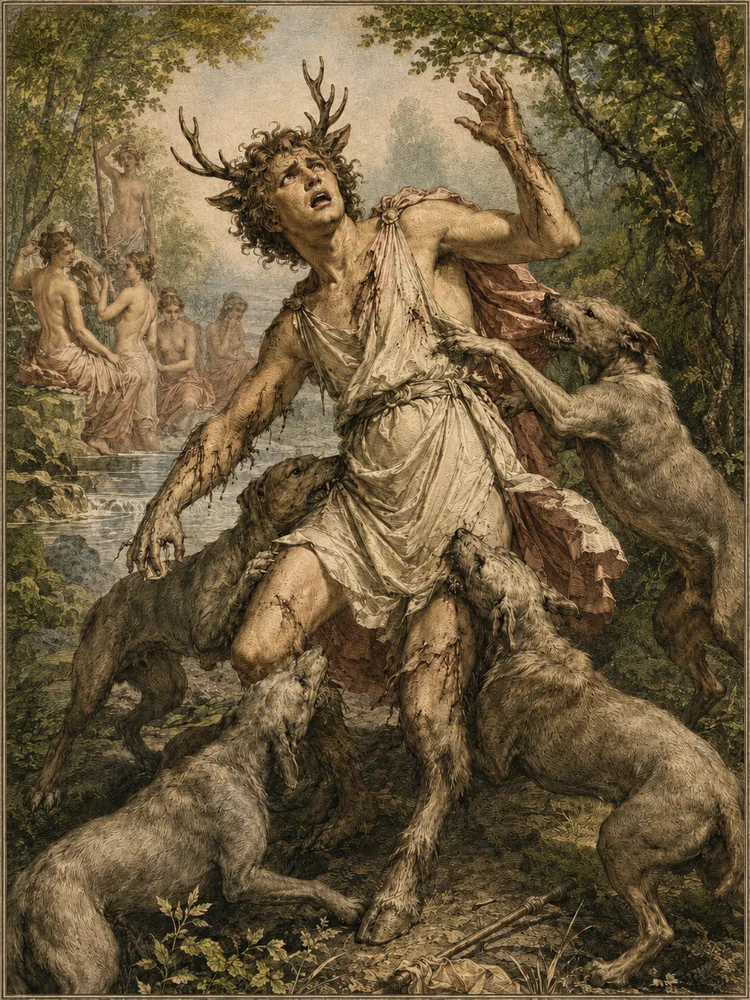
Actaeon was the son of Aristaeus and Autonoë, and a grandson of Cadmus the founder of Thebes. He was a great hunter, trained by the Centaur Chiron, and he had a famous pack of fifty hounds with which he ranged the mountains of Boeotia. One day, hot from the pursuit of a stag, he came at noon to a hidden glen at the foot of Mount Cithaeron, where there was a clear pool overhung with ferns; and there, by ill chance, he saw the goddess Artemis bathing with her nymphs.

It was no fault of his — he was simply hunting in his own country, at the height of the day, when his feet brought him to the place; he had not sought to spy upon the goddess, and indeed he started back when he saw her. But Artemis was a virgin and a goddess, and the sight of her body by mortal eyes could not be permitted. There was no time for explanation. The goddess threw water in his face, and as the drops struck him, antlers sprouted from his forehead, his neck lengthened, his arms became forelegs ending in hooves, his skin took the spots of a deer; and the man Actaeon was gone, and a stag stood in his place.

His own hounds, scenting the deer where their master had been a moment before, gave chase. He fled, but they overtook him; and he could not call them off, for he had lost the power of human speech. They tore him to pieces upon the mountainside, while his fellow huntsmen shouted in the distance, calling for Actaeon to come and see the splendid kill. Only Chiron afterward, hearing the news, made an image of him in stone, which his hounds (still grieving for their master) might be brought to, that they might know him again.
Curator’s note

What the sources say, and what later tradition added. The sources for this bay

The Actaeon story is preserved in Ovid (Metamorphoses 3.138-252) — the locus classicus, who frames it carefully so that Actaeon's offense is innocent, the punishment grossly disproportionate. Older tradition, however, gave Actaeon a fault: in Stesichorus he had boasted of his hunting prowess against Artemis, in the Hesiodic Catalogue (Frag. 217a Merkelbach-West) he had wished to marry Semele his cousin, in Pseudo-Apollodorus (Bibliotheca 3.4.4) he had attempted to woo Artemis. The variant of innocent offense (Ovidian) and the variant of guilty offense (older) ran parallel through antiquity. The hounds' name-list — fifty individual canine names — is given by both Ovid and Hyginus (Fabulae 181), and is one of the more curious survivals of ancient hunting culture. A hero-cult of Actaeon at Orchomenos, where his bones were said to be interred, is recorded by Pausanias (9.38.5).

Kin in the sources

Each tie is quoted from the entry that states it.

When the sources speak

Dated witnesses for The Heroic Cycle and the Tragic Houses. A date marks when the evidence was written down, not when the belief began. The whole timeline

c. 1600–1100 BCE
Mycenaean palace tablets in Linear B record offerings and divine names, but little continuous myth.
c. 1100–800 BCE
Post-palatial oral traditions and changing cult landscapes precede the surviving alphabetic epics.
late 8th–7th centuries BCE
The Iliad, Odyssey, Hesiodic Theogony and Works and Days give influential but non-exclusive divine orders.
7th–6th centuries BCE
Homeric Hymns, lyric poetry, colonization, and local sanctuary traditions multiply regional narratives.
6th–5th centuries BCE
Orphic, Pythagorean, and mystery materials develop alternative cosmogonies and afterlife doctrines.
5th century BCE
Athenian tragedy and comedy recast heroic houses and divine justice for civic audiences.
4th century BCE
Philosophers, antiquarians, and local historians interpret or criticize inherited myth.
323–31 BCE
Hellenistic poets and scholars systematize variants across an enlarged Greek world.

Floor plan

The rooms follow one another in the order their peoples first appear in the written record.

  1. The Cradle of Citiesc. 3400 BCE to 395 CE. 115 works
  2. The Gift of the Nilec. 4000 BCE to 395 CE. 73 works
  3. The Olympian Orderc. 1600 BCE to 750 CE. 152 works
  4. The Persian Worldc. 2000 BCE to 1010 CE. 30 works
  5. The Levantine Borderlandsc. 1200 BCE to 500 CE. 20 works
  6. The Edges of Empirec. 2000 BCE to 1500 CE. 33 works
  7. The Etruscan Worldc. 900 BCE to 750 CE. 22 works
  8. The Roman Inheritancec. 1200 BCE to 500 CE. 58 works
  9. The Northern Inheritancec. 2000 BCE to 1600 CE. 131 works