A Compendium of the Ancient Gods
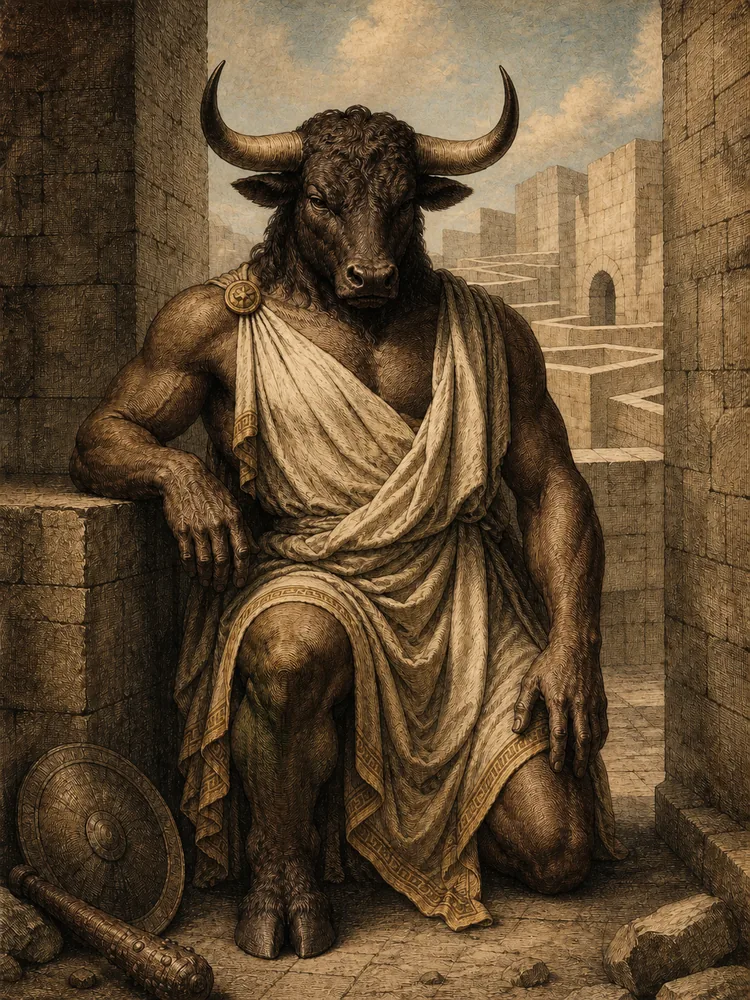
Minotaur, plate

The Minotaur was the offspring of an unnatural union: King Minos of Crete had failed to sacrifice a magnificent bull that Poseidon had sent him from the sea (intending the bull as a sacrificial victim, Minos kept it for breeding); in vengeance Poseidon caused Minos's wife Pasiphae to conceive an unnatural passion for the bull, and the craftsman Daedalus (then at Minos's court) constructed for her a hollow wooden cow within which she could consummate the desire. The product was the Minotaur — a creature with a bull's head and a man's body, of monstrous appetite, fed only on human flesh. Minos, ashamed but unable to kill it, had Daedalus construct the Labyrinth — a maze so cunning that none who entered could find the way out — and confined the Minotaur there.

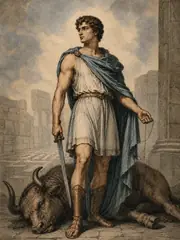
Each year (or each three years, in some versions, or each nine, in others), as tribute exacted from defeated Athens after a war with Crete, seven Athenian youths and seven Athenian maidens were sent to Crete and put into the Labyrinth, to wander until the Minotaur found and devoured them. The hero Theseus volunteered for the third such tribute (in the most familiar version), came to Crete, was loved by Minos's daughter Ariadne, who gave him the famous ball of thread (which he tied at the entrance and unwound as he advanced), and so was able to find the Minotaur, kill it with his bare hands or with a sword Ariadne had given him, and follow the thread out of the maze. The story is told in Theseus's entry in the next book.
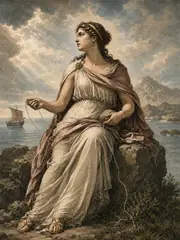
Curator’s note

What the sources say, and what later tradition added. The sources for this bay

Apollodorus 3.1.4 (Minos and the bull); Plutarch, Life of Theseus 15–19 (the principal connected narrative); Ovid, Metamorphoses 8.169–182. The historical-cultural background — the Greek memory of the Bronze Age Minoan thalassocracy of Crete, with its bull-leaping iconography (preserved in the Knossos frescoes excavated by Arthur Evans from 1900 onward) and its labyrinthine palace at Knossos — has long been understood to underlie the myth, but the precise relationships are debated. The myth conserves a memory of Minoan dominance and Athenian subjection; the bull-and-Labyrinth motif may reflect actual Minoan ritual practices known to the later Greeks only through dim tradition.

Kin in the sources

Each tie is quoted from the entry that states it.

When the sources speak

Dated witnesses for The Heroic Bestiary. A date marks when the evidence was written down, not when the belief began. The whole timeline

c. 1600–1100 BCE
Mycenaean palace tablets in Linear B record offerings and divine names, but little continuous myth.
c. 1100–800 BCE
Post-palatial oral traditions and changing cult landscapes precede the surviving alphabetic epics.
late 8th–7th centuries BCE
The Iliad, Odyssey, Hesiodic Theogony and Works and Days give influential but non-exclusive divine orders.
7th–6th centuries BCE
Homeric Hymns, lyric poetry, colonization, and local sanctuary traditions multiply regional narratives.
6th–5th centuries BCE
Orphic, Pythagorean, and mystery materials develop alternative cosmogonies and afterlife doctrines.
5th century BCE
Athenian tragedy and comedy recast heroic houses and divine justice for civic audiences.
4th century BCE
Philosophers, antiquarians, and local historians interpret or criticize inherited myth.
323–31 BCE
Hellenistic poets and scholars systematize variants across an enlarged Greek world.

Floor plan

The rooms follow one another in the order their peoples first appear in the written record.

  1. The Cradle of Citiesc. 3400 BCE to 395 CE. 115 works
  2. The Gift of the Nilec. 4000 BCE to 395 CE. 73 works
  3. The Olympian Orderc. 1600 BCE to 750 CE. 152 works
  4. The Persian Worldc. 2000 BCE to 1010 CE. 30 works
  5. The Levantine Borderlandsc. 1200 BCE to 500 CE. 20 works
  6. The Edges of Empirec. 2000 BCE to 1500 CE. 33 works
  7. The Etruscan Worldc. 900 BCE to 750 CE. 22 works
  8. The Roman Inheritancec. 1200 BCE to 500 CE. 58 works
  9. The Northern Inheritancec. 2000 BCE to 1600 CE. 131 works