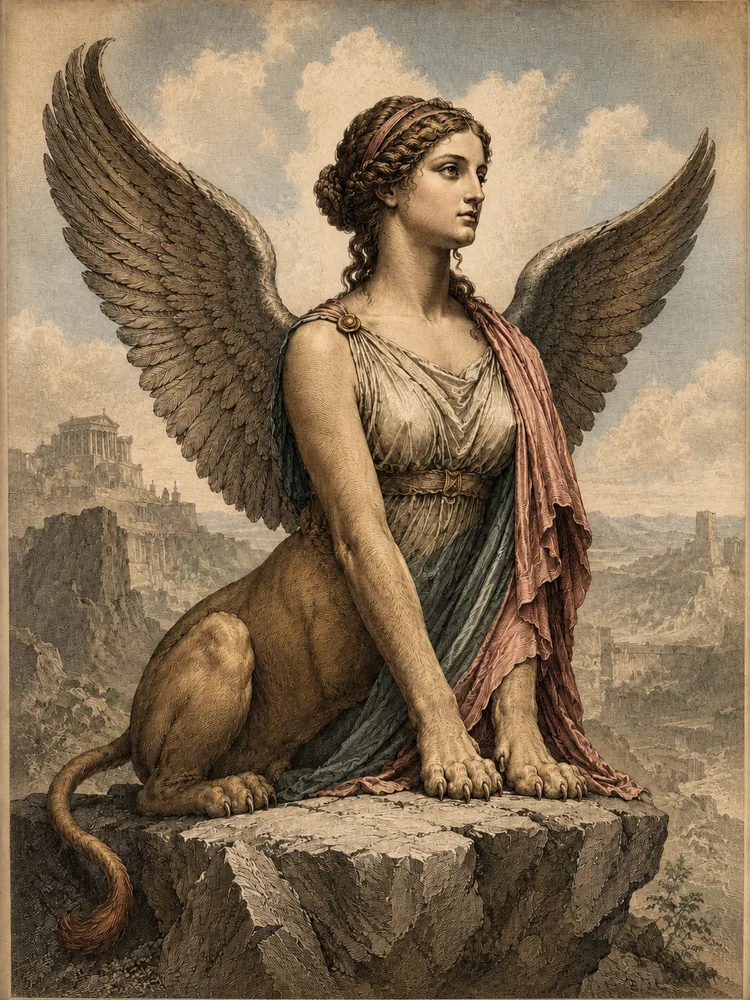
The Sphinx — to be carefully distinguished from the lion-bodied human-headed Egyptian sphinxes, which were a different and (largely) older tradition (Volume II) — was a Greek monster of the city of Thebes: a creature with the body of a winged lion, the breasts and face of a woman, and the disposition of a riddle-asking cannibal. She had been sent by Hera (in some accounts) or by Apollo (in others) to plague the city of Thebes after the offenses of King Laius, and she sat upon a rock outside the city, putting to every passing traveler the same riddle: "What walks on four legs in the morning, two at noon, and three in the evening?" Those who answered wrongly she devoured; and since no one had answered rightly, the road was closed and the city was beginning to starve. The young Oedipus, fleeing from the supposed parents he was attempting to escape (a theme that runs through his story, treated in part below in Tiresias's entry), came to the Sphinx and was challenged. He answered: "Man — who crawls on hands and feet as an infant, walks upright in his prime, and leans upon a staff in old age." The Sphinx, defeated by the correct answer, hurled herself from her rock in despair (or, in some versions, was killed by Oedipus); the road was opened; and Oedipus's reward — the throne of the dead Laius and the hand of the widowed queen Jocasta — was granted him, with consequences that took the next several years and the entire Sophoclean trilogy to work out.
 Before thisMinotaur
 Next on the wallScylla
Curator’s note
What the sources say, and what later tradition added. The sources for this bay
The Sphinx and the riddle are in Apollodorus 3.5.8 and in the scholiastic traditions on Sophocles's Oedipus the King; the riddle itself is preserved in late sources (Athenaeus, Asclepiades). The Greek Sphinx is to be distinguished from the Egyptian iconographic type, with which she shares only the lion-body; the Greek figure is winged and female, the Egyptian usually wingless and male. The genealogical connection of the Sphinx to Echidna and Typhon (Hesiod, Theogony 326) makes her a sister of the other great Greek monsters; Apollodorus gives her a different parentage. The localization at Thebes is constant.
Kin in the sources
Each tie is quoted from the entry that states it.
 Slain byOedipus
The Sphinx, defeated by the correct answer, hurled herself from her rock in despair (or, in some versions, was killed by Oedipus)
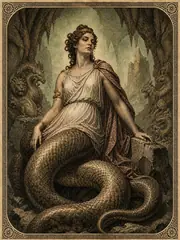 Child ofEchidna
The genealogical connection of the Sphinx to Echidna and Typhon (Hesiod, Theogony 326) makes her a sister of the other great Greek monsters
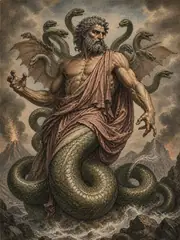 Child ofTyphon
The genealogical connection of the Sphinx to Echidna and Typhon (Hesiod, Theogony 326) makes her a sister of the other great Greek monsters
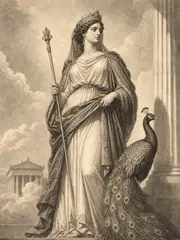 Companion ofHera
She had been sent by Hera (in some accounts) or by Apollo (in others) to plague the city of Thebes
When the sources speak
Dated witnesses for The Heroic Bestiary. A date marks when the evidence was written down, not when the belief began. The whole timeline
- c. 1600–1100 BCE
- Mycenaean palace tablets in Linear B record offerings and divine names, but little continuous myth.
- c. 1100–800 BCE
- Post-palatial oral traditions and changing cult landscapes precede the surviving alphabetic epics.
- late 8th–7th centuries BCE
- The Iliad, Odyssey, Hesiodic Theogony and Works and Days give influential but non-exclusive divine orders.
- 7th–6th centuries BCE
- Homeric Hymns, lyric poetry, colonization, and local sanctuary traditions multiply regional narratives.
- 6th–5th centuries BCE
- Orphic, Pythagorean, and mystery materials develop alternative cosmogonies and afterlife doctrines.
- 5th century BCE
- Athenian tragedy and comedy recast heroic houses and divine justice for civic audiences.
- 4th century BCE
- Philosophers, antiquarians, and local historians interpret or criticize inherited myth.
- 323–31 BCE
- Hellenistic poets and scholars systematize variants across an enlarged Greek world.