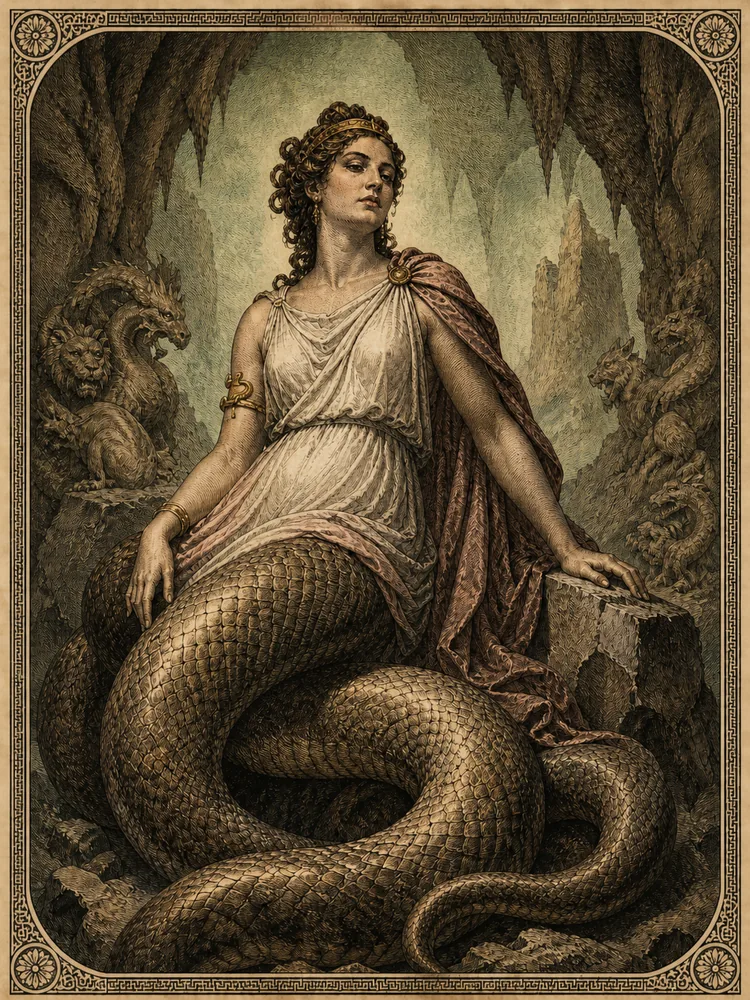
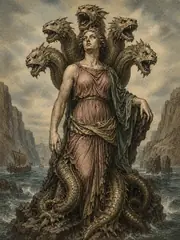
Echidna was a creature half nymph and half serpent — beautiful in her upper half, dreadful in her lower — who dwelt in a cave under the earth, mate of Typhon and mother by him of most of the great monsters of Greek mythology. From her loins came Cerberus the three-headed underworld dog; the Lernaean Hydra; the Chimera; the Sphinx (the Theban one) and the Nemean Lion (slain by Heracles); the eagle that tortured Prometheus, in some accounts; the dragon Ladon that guarded the apples of the Hesperides; in some traditions Scylla; and other lesser monsters. After Typhon was confined beneath Etna, Echidna lived on, dwelling in her cave and (in some versions) preying upon passing travelers, until at length the giant Argus Panoptes (the hundred-eyed) caught her sleeping and killed her.
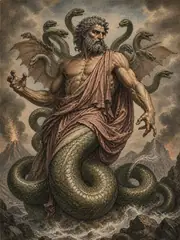 Before thisTyphon
 Next on the wallCerberus
Curator’s note
What the sources say, and what later tradition added. The sources for this bay
Hesiod, Theogony 295–336 (the principal text, with the catalogue of her monstrous offspring). Echidna's name has passed into modern zoology as the genus designation of the spiny anteaters of Australia and New Guinea (echidnas) — egg-laying mammals first described by European naturalists in the late eighteenth century, who chose the mythological name in reference to a creature that combined attributes of multiple types.
Kin in the sources
Each tie is quoted from the entry that states it.
- Consort ofTyphon
mate of Typhon and mother by him of most of the great monsters of Greek mythology
- Parent ofCerberus
From her loins came Cerberus the three-headed underworld dog
 Parent ofSphinx
the Sphinx (the Theban one) and the Nemean Lion (slain by Heracles)
 Parent ofScylla
the dragon Ladon that guarded the apples of the Hesperides; in some traditions Scylla
When the sources speak
Dated witnesses for The Heroic Bestiary. A date marks when the evidence was written down, not when the belief began. The whole timeline
- c. 1600–1100 BCE
- Mycenaean palace tablets in Linear B record offerings and divine names, but little continuous myth.
- c. 1100–800 BCE
- Post-palatial oral traditions and changing cult landscapes precede the surviving alphabetic epics.
- late 8th–7th centuries BCE
- The Iliad, Odyssey, Hesiodic Theogony and Works and Days give influential but non-exclusive divine orders.
- 7th–6th centuries BCE
- Homeric Hymns, lyric poetry, colonization, and local sanctuary traditions multiply regional narratives.
- 6th–5th centuries BCE
- Orphic, Pythagorean, and mystery materials develop alternative cosmogonies and afterlife doctrines.
- 5th century BCE
- Athenian tragedy and comedy recast heroic houses and divine justice for civic audiences.
- 4th century BCE
- Philosophers, antiquarians, and local historians interpret or criticize inherited myth.
- 323–31 BCE
- Hellenistic poets and scholars systematize variants across an enlarged Greek world.