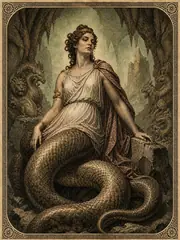
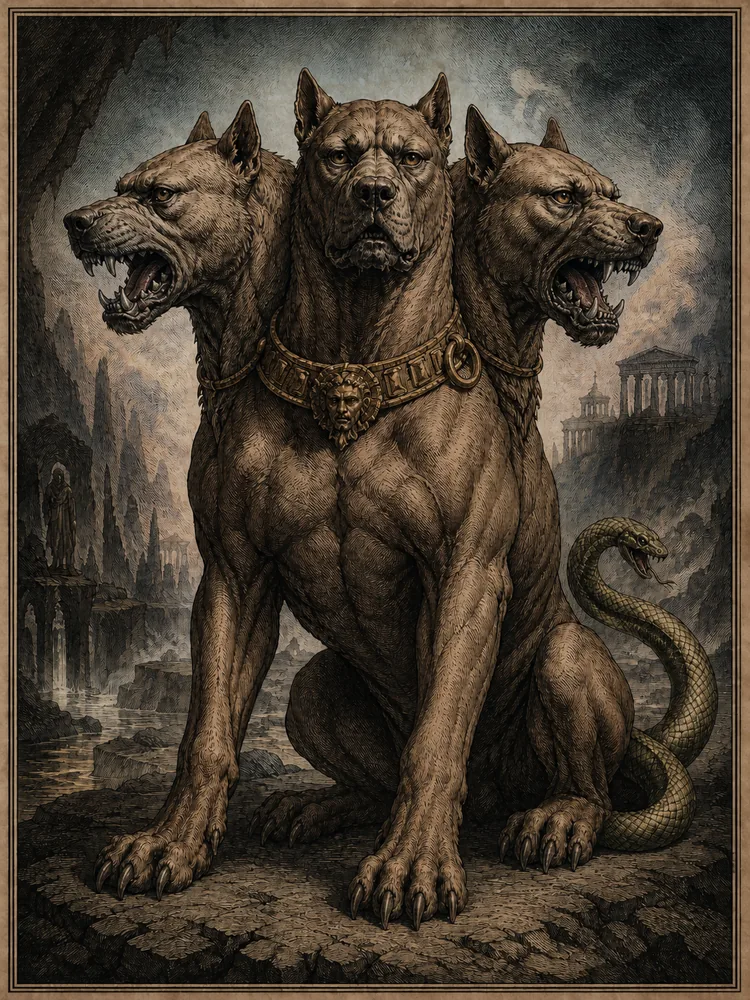
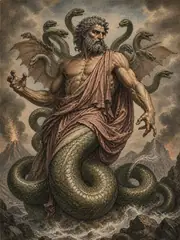
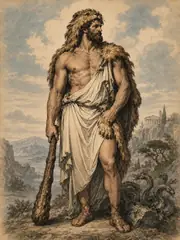
Cerberus was the great three-headed dog (in some versions fifty-headed or hundred-headed, but three is the canonical number) who guarded the entrance to the underworld, preventing the living from descending and the dead from departing. He was a son of Typhon and Echidna, brother of the Hydra and the Chimera. His backbone was set with serpents; serpents grew from his necks instead of fur in some descriptions; his three heads barked together in an unbearable noise; his bite was venomous. He was friendly to those entering the underworld (welcoming the dead with wagging tail) and ferocious to any attempting to leave; so the Greeks understood the asymmetry of death, that the door swings only one way.
His most famous appearance is in the twelfth and final labor of Heracles, who was sent by Eurystheus to bring Cerberus up from the underworld alive. Heracles descended (with Hermes and Athena as guides), wrestled Cerberus with bare hands (since Hades had stipulated that he might take the hound only without weapons), dragged him up to Eurystheus's court — whereat Eurystheus, terrified, hid in his bronze jar — and then dutifully returned him to his post in the underworld. Heracles's success in this descent and return is one of the few exceptions to the rule that mortals do not return from the dead, and Cerberus's brief absence from his post was one of the rare moments when the boundary between the worlds was open.
Curator’s note
What the sources say, and what later tradition added. The sources for this bay
Hesiod, Theogony 310–312, 769–774; Apollodorus 2.5.12 (the Heracles encounter); the descent and the bringing-up is the matter of the twelfth labor in the standard catalogue. Cerberus appears in numerous later treatments (Vergil, Aeneid 6.417–425; Dante, Inferno 6, where he is reused as the guardian of the gluttons). The Greek name's etymology is uncertain; possibly Indo-European, related to a Sanskrit name for the hound of Yama (the Vedic god of the dead), but the connection is contested.
When the sources speak
Dated witnesses for The Heroic Bestiary. A date marks when the evidence was written down, not when the belief began. The whole timeline
- c. 1600–1100 BCE
- Mycenaean palace tablets in Linear B record offerings and divine names, but little continuous myth.
- c. 1100–800 BCE
- Post-palatial oral traditions and changing cult landscapes precede the surviving alphabetic epics.
- late 8th–7th centuries BCE
- The Iliad, Odyssey, Hesiodic Theogony and Works and Days give influential but non-exclusive divine orders.
- 7th–6th centuries BCE
- Homeric Hymns, lyric poetry, colonization, and local sanctuary traditions multiply regional narratives.
- 6th–5th centuries BCE
- Orphic, Pythagorean, and mystery materials develop alternative cosmogonies and afterlife doctrines.
- 5th century BCE
- Athenian tragedy and comedy recast heroic houses and divine justice for civic audiences.
- 4th century BCE
- Philosophers, antiquarians, and local historians interpret or criticize inherited myth.
- 323–31 BCE
- Hellenistic poets and scholars systematize variants across an enlarged Greek world.