A Compendium of the Ancient Gods
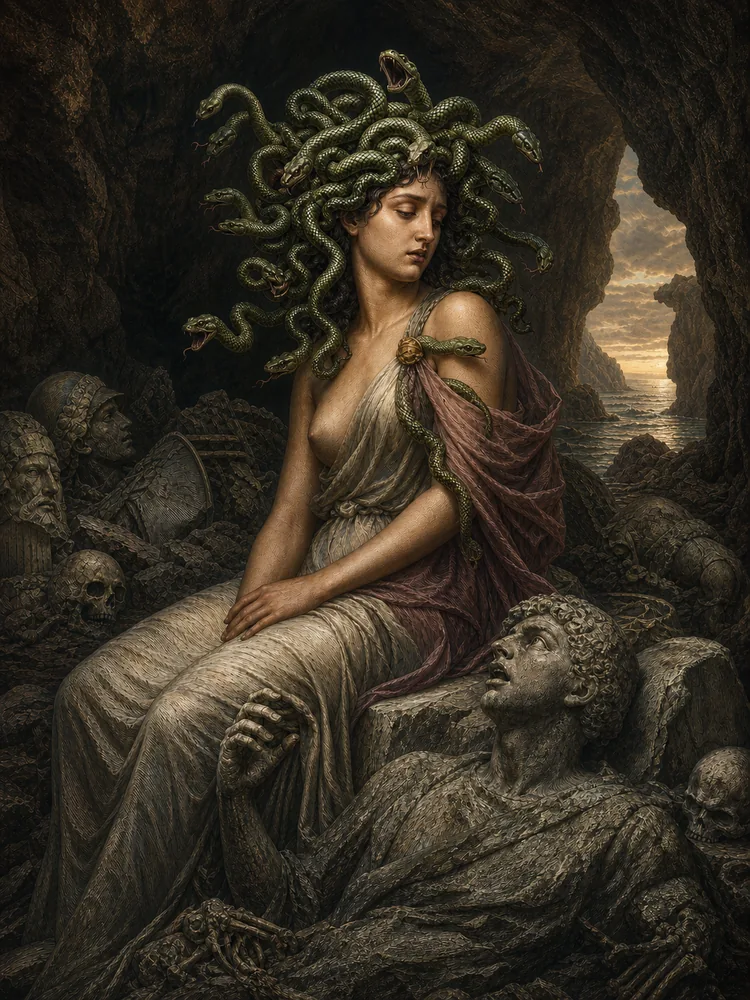
Medusa, plate

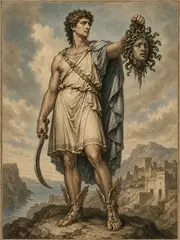
Medusa was the third of the three Gorgons (the other two being Stheno and Euryale), daughters of Phorcys and Ceto. Medusa alone among the three was mortal; she had been (in the most famous version, given by Ovid) a beautiful young woman, a priestess of Athena's temple, who had been raped by Poseidon within the temple itself and who had been punished — not for her violation, but as the easier victim of the offended Athena's anger — by being turned into a hideous monster, with snakes for hair, with a face so horrible that any who looked upon it was turned to stone, with a tongue lolling between great tusks. She lived with her two sisters at the western edge of the world, in a cavern where the petrified bodies of those who had attempted upon her stood in eternal silence.

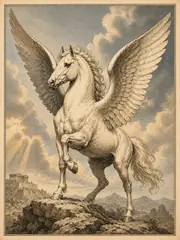
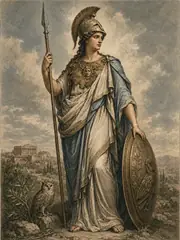
She was killed by the hero Perseus, whose adventure is told in his entry below. The instruments of his victory were given him by the gods: a polished shield from Athena (in which he could see Medusa's reflection without being turned to stone by direct sight); winged sandals from Hermes; a cap of invisibility from Hades; a sickle from Hephaestus. With these aids Perseus approached Medusa as she slept, beheaded her with the sickle while looking at her reflection in the shield, and put her head in a pouch. From the blood that fell upon the ground at her killing arose two offspring whom she had conceived by Poseidon: the winged horse Pegasus, and the warrior Chrysaor. Perseus took the head with him and used it (the gaze remained petrifying after death) against various subsequent enemies, before finally giving it to Athena, who set it upon her aegis and shield as the gorgoneion that would terrify her opponents — and so Medusa, in her death, became the protective face of her killer's patron-goddess, an irony characteristic of the Greek imagination.
Curator’s note

What the sources say, and what later tradition added. The sources for this bay

Hesiod, Theogony 270–283 (the Gorgons and the parentage); Apollodorus 2.4.2 (the Perseus narrative); Ovid, Metamorphoses 4.604–803 (the elaborated version with the rape and the punishment-by-Athena). The earlier Hesiodic Medusa is simply a monster from birth; Ovid's version is later and reflects different theological concerns. The gorgoneion as protective face appears throughout Greek art from the Archaic period and is one of the most distinctive Greek apotropaic motifs.

Kin in the sources

Each tie is quoted from the entry that states it.

When the sources speak

Dated witnesses for The Heroic Bestiary. A date marks when the evidence was written down, not when the belief began. The whole timeline

c. 1600–1100 BCE
Mycenaean palace tablets in Linear B record offerings and divine names, but little continuous myth.
c. 1100–800 BCE
Post-palatial oral traditions and changing cult landscapes precede the surviving alphabetic epics.
late 8th–7th centuries BCE
The Iliad, Odyssey, Hesiodic Theogony and Works and Days give influential but non-exclusive divine orders.
7th–6th centuries BCE
Homeric Hymns, lyric poetry, colonization, and local sanctuary traditions multiply regional narratives.
6th–5th centuries BCE
Orphic, Pythagorean, and mystery materials develop alternative cosmogonies and afterlife doctrines.
5th century BCE
Athenian tragedy and comedy recast heroic houses and divine justice for civic audiences.
4th century BCE
Philosophers, antiquarians, and local historians interpret or criticize inherited myth.
323–31 BCE
Hellenistic poets and scholars systematize variants across an enlarged Greek world.

Floor plan

The rooms follow one another in the order their peoples first appear in the written record.

  1. The Cradle of Citiesc. 3400 BCE to 395 CE. 115 works
  2. The Gift of the Nilec. 4000 BCE to 395 CE. 73 works
  3. The Olympian Orderc. 1600 BCE to 750 CE. 152 works
  4. The Persian Worldc. 2000 BCE to 1010 CE. 30 works
  5. The Levantine Borderlandsc. 1200 BCE to 500 CE. 20 works
  6. The Edges of Empirec. 2000 BCE to 1500 CE. 33 works
  7. The Etruscan Worldc. 900 BCE to 750 CE. 22 works
  8. The Roman Inheritancec. 1200 BCE to 500 CE. 58 works
  9. The Northern Inheritancec. 2000 BCE to 1600 CE. 131 works