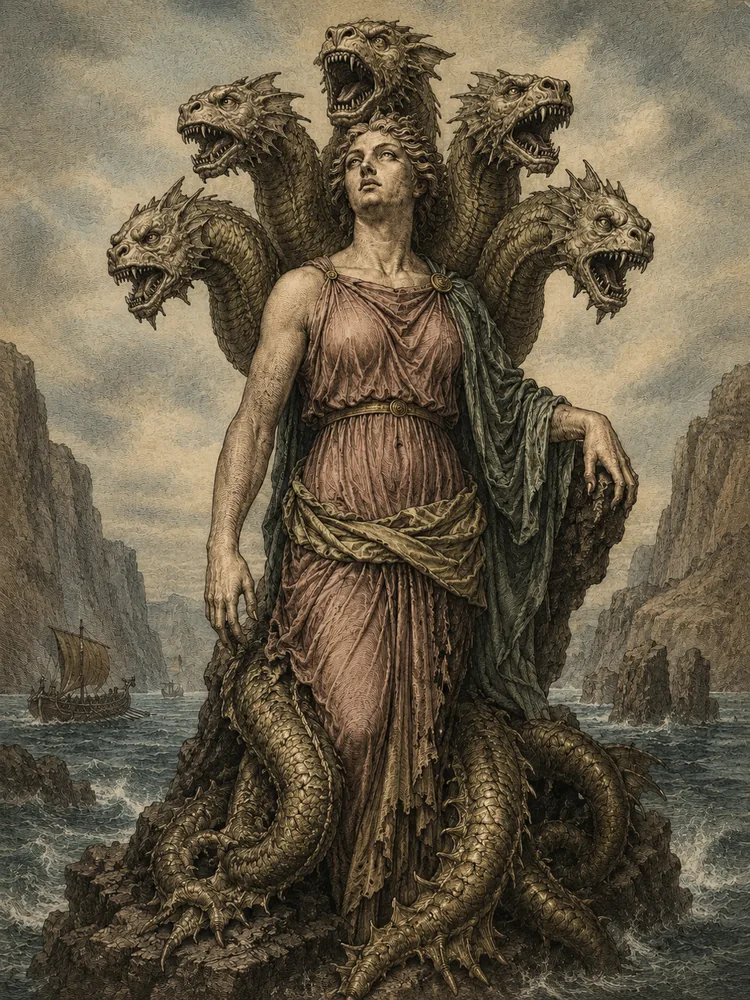
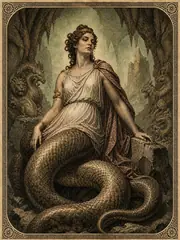
Scylla was a sea-monster who lived in a cave overlooking a narrow strait, with the bay of Charybdis directly opposite. She had originally been (in the Ovidian elaboration) a beautiful nymph beloved of the sea-god Glaucus, transformed by the jealousy of Circe into the hideous form she thereafter retained: from the waist up a woman, but from the waist down six monstrous dog-headed serpents, each with a triple row of teeth. From her cave she snatched at sailors passing through the strait, taking six men at a time from any ship that came within her reach. Odysseus encountered her in the twelfth book of the Odyssey and lost six of his men to her, having no defense (since to slow the ship and resist her would have meant entering the whirlpool of Charybdis on the opposite side — and the Greek imagination of the strait, said by Homer to be the strait between Italy and Sicily, gave its sailors no good option). The phrase "between Scylla and Charybdis" passed into Greek and modern usage as the proverbial expression of being trapped between two evils with no clear escape.
 Before thisSphinx
 Next on the wallCharybdis
Curator’s note
What the sources say, and what later tradition added. The sources for this bay
Homer, Odyssey 12.73–126, 222–259 (the principal source); Ovid, Metamorphoses 13.730–14.74 (the transformation narrative). The Strait of Messina (between Italy and Sicily) was the conventional ancient localization. The actual whirlpool there, formed by tidal currents, is real but not nearly as dangerous as Homer's portrait; the conditions of ancient seafaring, with small craft and limited control, would have made it more formidable than it is to modern shipping.
Kin in the sources
Each tie is quoted from the entry that states it.
 Rival ofOdysseus
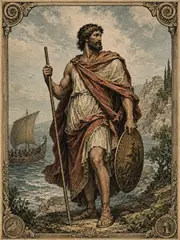
Odysseus encountered her in the twelfth book of the Odyssey and lost six of his men to her
- Companion ofCharybdis
with the bay of Charybdis directly opposite
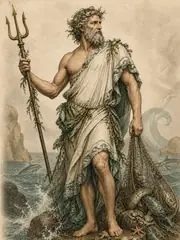 Consort ofGlaucus
a beautiful nymph beloved of the sea-god Glaucus
 Child ofEchidna
the dragon Ladon that guarded the apples of the Hesperides; in some traditions Scylla
When the sources speak
Dated witnesses for The Heroic Bestiary. A date marks when the evidence was written down, not when the belief began. The whole timeline
- c. 1600–1100 BCE
- Mycenaean palace tablets in Linear B record offerings and divine names, but little continuous myth.
- c. 1100–800 BCE
- Post-palatial oral traditions and changing cult landscapes precede the surviving alphabetic epics.
- late 8th–7th centuries BCE
- The Iliad, Odyssey, Hesiodic Theogony and Works and Days give influential but non-exclusive divine orders.
- 7th–6th centuries BCE
- Homeric Hymns, lyric poetry, colonization, and local sanctuary traditions multiply regional narratives.
- 6th–5th centuries BCE
- Orphic, Pythagorean, and mystery materials develop alternative cosmogonies and afterlife doctrines.
- 5th century BCE
- Athenian tragedy and comedy recast heroic houses and divine justice for civic audiences.
- 4th century BCE
- Philosophers, antiquarians, and local historians interpret or criticize inherited myth.
- 323–31 BCE
- Hellenistic poets and scholars systematize variants across an enlarged Greek world.