Glaucus was originally a mortal fisherman of Boeotia who, having pulled in a net of fish to the shore, observed that they revived upon contact with a particular herb growing there; tasting the herb himself out of curiosity, he was seized with a longing for the sea and leapt into it, where he was received by Oceanus and Tethys and transformed into a sea-god, his lower body becoming a fishtail and his hair becoming the green of seaweed. He was thereafter a minor prophet of the deep, occasionally encountered by sailors, and was loved (unsuccessfully) by Scylla, whom he refused; in vengeance for his refusal, he applied to the sorceress Circe, who herself (in some versions) fell in love with Glaucus and, being refused by him in her turn, transformed Scylla out of jealousy into the six-headed monster of the strait.
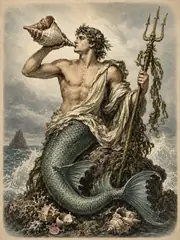 Before thisTriton
 Next on the wallCharon
Curator’s note
What the sources say, and what later tradition added. The sources for this bay
Ovid, Metamorphoses 13.898–14.74 (the principal source for the transformation); Pausanias 9.22.6–7. The Glaucus-Scylla-Circe triangle is one of Ovid's elaborated narratives; older sources are thinner.
Kin in the sources
Each tie is quoted from the entry that states it.
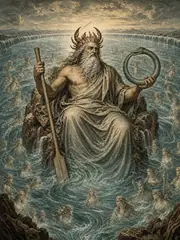 Companion ofOceanus
he was received by Oceanus and Tethys and transformed into a sea-god
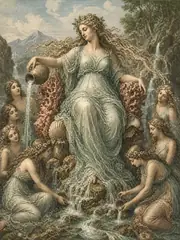 Companion ofTethys
he was received by Oceanus and Tethys and transformed into a sea-god
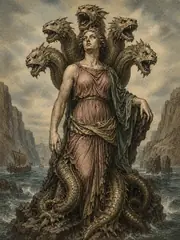 Rival ofScylla
was loved (unsuccessfully) by Scylla, whom he refused
- Consort ofScylla
a beautiful nymph beloved of the sea-god Glaucus
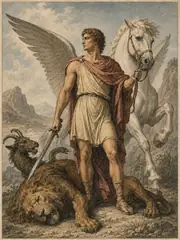 Parent ofBellerophon
Bellerophon was a hero of Corinth, son of Glaucus (or, in some traditions, of Poseidon)
When the sources speak
Dated witnesses for The Sea, the Wild and the Wind. A date marks when the evidence was written down, not when the belief began. The whole timeline
- c. 1600–1100 BCE
- Mycenaean palace tablets in Linear B record offerings and divine names, but little continuous myth.
- c. 1100–800 BCE
- Post-palatial oral traditions and changing cult landscapes precede the surviving alphabetic epics.
- late 8th–7th centuries BCE
- The Iliad, Odyssey, Hesiodic Theogony and Works and Days give influential but non-exclusive divine orders.
- 7th–6th centuries BCE
- Homeric Hymns, lyric poetry, colonization, and local sanctuary traditions multiply regional narratives.
- 6th–5th centuries BCE
- Orphic, Pythagorean, and mystery materials develop alternative cosmogonies and afterlife doctrines.
- 5th century BCE
- Athenian tragedy and comedy recast heroic houses and divine justice for civic audiences.
- 4th century BCE
- Philosophers, antiquarians, and local historians interpret or criticize inherited myth.
- 323–31 BCE
- Hellenistic poets and scholars systematize variants across an enlarged Greek world.