A Compendium of the Ancient Gods
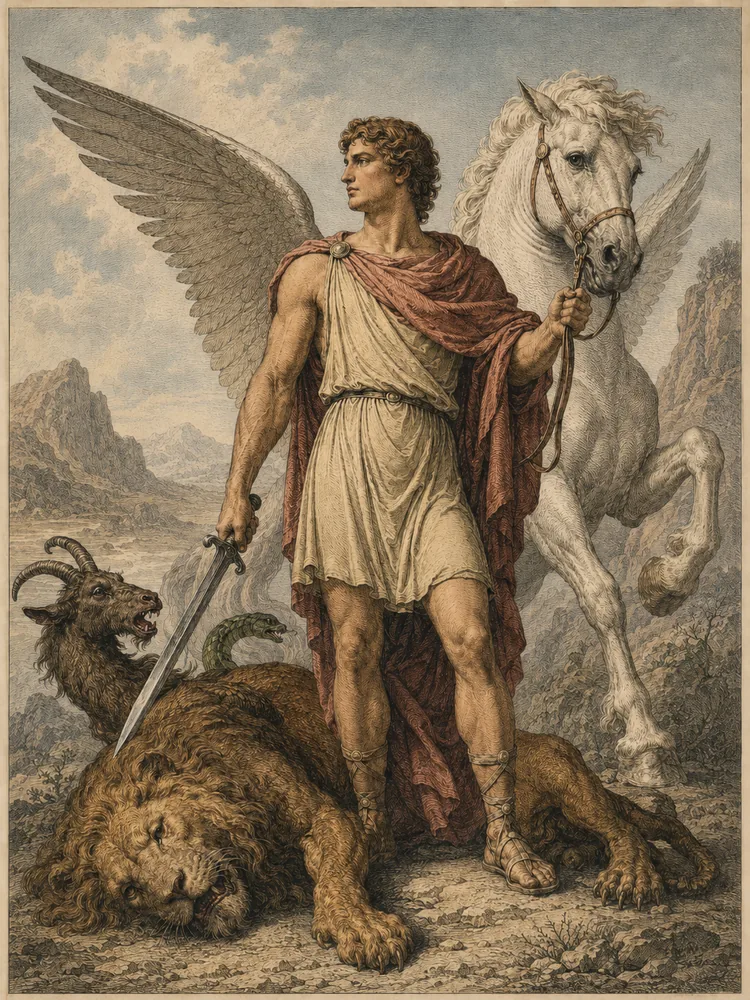
Bellerophon, plate

Bellerophon was a hero of Corinth, son of Glaucus (or, in some traditions, of Poseidon). He fled to Tiryns after accidentally killing his brother (or another man, named Bellerus, from whom Bellerophon's nickname was supposed to derive — "slayer of Bellerus," his original name being Hipponous). At Tiryns, the wife of King Proetus, Stheneboea (or Anteia), conceived a passion for him and was rebuffed; she then accused him to her husband of having attempted upon her. Proetus, unwilling to kill a guest, sent him to his father-in-law Iobates king of Lycia, with a sealed letter requesting that the bearer be killed. Iobates, finding it equally unpleasant to kill a guest, contrived instead to send Bellerophon on what was meant to be a fatal mission: to slay the Chimera, the fire-breathing monster of three parts (lion, goat, and serpent) that was ravaging the Lycian countryside.

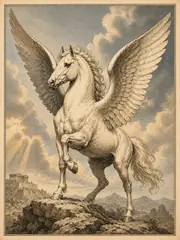
Bellerophon, advised by the seer Polyeidos, tamed the winged horse Pegasus (born from the blood of Medusa, treated in Book VII), riding him to drink at the spring Pirene at Corinth and bridling him with a golden bridle that Athena gave him in a dream. Mounted on Pegasus, he was able to attack the Chimera from the air, beyond the reach of her flame; he killed her with arrows or, in some versions, by dropping a lump of lead into her flaming mouth, where it melted and choked her. Iobates, unwilling to give up, sent him on further perilous missions — against the Solymi, against the Amazons, against the bravest of the Lycians ambushed in his path — but Bellerophon survived them all, and Iobates at length recognized his quality, gave him his daughter to wife, and made him heir.

Bellerophon's downfall was hubris. Having achieved so much, he attempted to fly Pegasus to Olympus itself, presuming to enter the company of the gods. Zeus, offended, sent a gadfly to sting Pegasus; the horse threw his rider, and Bellerophon fell from the sky, landing in a thorn-thicket where he wandered for the rest of his life, lame and blind, an emblem to subsequent Greek imagination of the consequences of overreaching ambition. Pegasus continued to Olympus, where he served as Zeus's bearer of thunderbolts.
Curator’s note

What the sources say, and what later tradition added. The sources for this bay

Homer, Iliad 6.155–202, gives the earliest substantial treatment (the back-story of Glaucus the Lycian); Pindar, Olympian 13 and Isthmian 7, treat the heroic and the cautionary aspects; Apollodorus 2.3.1–2; Hyginus, Fabulae 57 (the Stheneboea episode). The motif of the murderous letter that Bellerophon carries to Iobates (a letter requesting the bearer's death) is a literary commonplace called the "Bellerophontic letter" and gave its name to the type.

Kin in the sources

Each tie is quoted from the entry that states it.

When the sources speak

Dated witnesses for The Heroic Cycle and the Tragic Houses. A date marks when the evidence was written down, not when the belief began. The whole timeline

c. 1600–1100 BCE
Mycenaean palace tablets in Linear B record offerings and divine names, but little continuous myth.
c. 1100–800 BCE
Post-palatial oral traditions and changing cult landscapes precede the surviving alphabetic epics.
late 8th–7th centuries BCE
The Iliad, Odyssey, Hesiodic Theogony and Works and Days give influential but non-exclusive divine orders.
7th–6th centuries BCE
Homeric Hymns, lyric poetry, colonization, and local sanctuary traditions multiply regional narratives.
6th–5th centuries BCE
Orphic, Pythagorean, and mystery materials develop alternative cosmogonies and afterlife doctrines.
5th century BCE
Athenian tragedy and comedy recast heroic houses and divine justice for civic audiences.
4th century BCE
Philosophers, antiquarians, and local historians interpret or criticize inherited myth.
323–31 BCE
Hellenistic poets and scholars systematize variants across an enlarged Greek world.

Floor plan

The rooms follow one another in the order their peoples first appear in the written record.

  1. The Cradle of Citiesc. 3400 BCE to 395 CE. 115 works
  2. The Gift of the Nilec. 4000 BCE to 395 CE. 73 works
  3. The Olympian Orderc. 1600 BCE to 750 CE. 152 works
  4. The Persian Worldc. 2000 BCE to 1010 CE. 30 works
  5. The Levantine Borderlandsc. 1200 BCE to 500 CE. 20 works
  6. The Edges of Empirec. 2000 BCE to 1500 CE. 33 works
  7. The Etruscan Worldc. 900 BCE to 750 CE. 22 works
  8. The Roman Inheritancec. 1200 BCE to 500 CE. 58 works
  9. The Northern Inheritancec. 2000 BCE to 1600 CE. 131 works