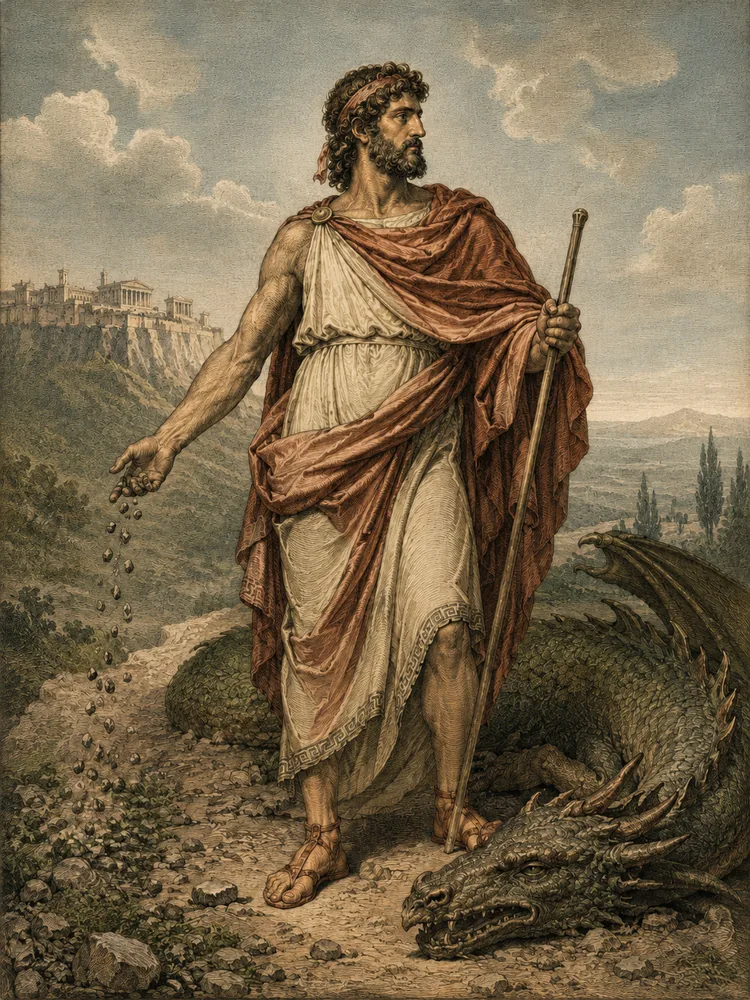
Cadmus was a Phoenician prince, son of King Agenor of Tyre, brother of Europa. When Europa was carried off by Zeus in the form of a bull, Agenor sent his sons after her with orders not to return without her; Cadmus, having searched in vain, consulted the Delphic oracle, which told him to abandon the search and to follow a heifer he would meet, founding a city where she lay down. The heifer led him to Boeotia, where she lay down at the future site of Thebes. Cadmus, intending to sacrifice her to Athena, sent his men to fetch water from a nearby spring; the spring was guarded by a great serpent (sometimes called the dragon of Ares), which killed the men. Cadmus killed the serpent in turn; Athena then advised him to plow the ground and sow the serpent's teeth.
From the sown teeth sprang up a crop of armed warriors, who immediately fell to fighting one another; only five survived, and these — the Spartoi ("sown men") — became the founding aristocracy of Thebes, ancestors of the great Theban houses (the Labdacids and others). Cadmus founded the city, married Harmonia (daughter of Aphrodite and Ares), at whose wedding all the gods attended, and ruled long. His subsequent house was tragic: his daughters were Semele (mother of Dionysus, incinerated by Zeus's glory), Agave (mother of Pentheus, whom she destroyed in Bacchic frenzy), Ino (who killed her own son Melicertes in madness), and Autonoë (mother of Actaeon, torn apart by his hounds); his grandsons were caught up in the great cycles of Theban tragedy. In his old age, Cadmus and Harmonia retreated to Illyria, where in some traditions they were both transformed into serpents, in punishment (or in fulfillment) of his original killing of the dragon at the spring of Thebes.
Cadmus was credited by some Greek traditions with bringing the alphabet to Greece from Phoenicia. The tradition is plausible — the Greek alphabet is demonstrably descended from the Phoenician script (which the Greeks of historical times called Phoenician letters or Cadmean letters) — but the attribution to Cadmus the legendary founder is the kind of explanatory association by which the Greeks tied their cultural inheritance to their mythological figures, rather than a recoverable historical fact.