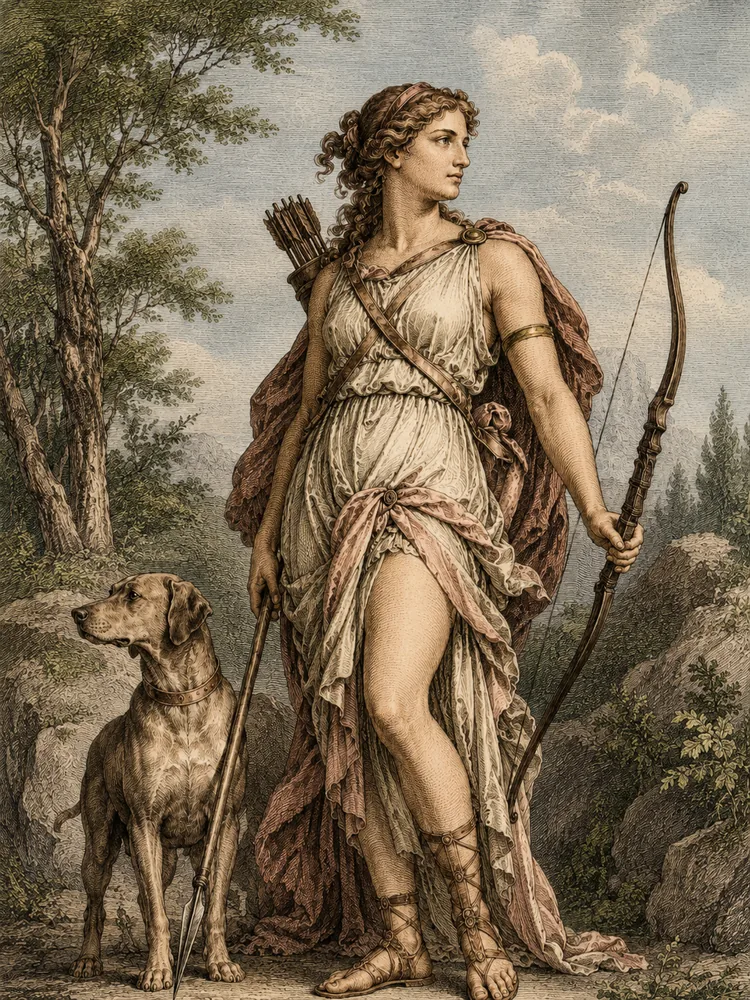
Atalanta was the only woman of substantial heroic rank in Greek mythology, a huntress of Arcadia (or Boeotia, traditions varied) whose father had wanted a son and exposed her at birth on a mountainside; she was nursed by a she-bear and reared by hunters, growing to a beauty and skill in hunting that made her the equal of any male hero. She joined the great Calydonian Boar Hunt — the wild-boar slaying organized by King Oeneus of Calydon when Artemis, in pique at his neglect of her sacrifices, had sent a great boar to ravage his country — and she gave the boar its first wound, an arrow in its back; the prince Meleager, who had organized the hunt and loved her, awarded her the boar's hide as her share of the spoils, against the angry protests of his uncles, whom he then killed in the dispute that followed (and was killed himself by the burning of the brand his mother had kept since his infancy, a complex narrative treated by Greek tragic and lyric poetry). Atalanta also competed at the funeral games of Pelias and was the only woman to sail with the Argonauts on the voyage to Colchis (though Apollonius gives her a marginal role).
Her most distinctive narrative is the footrace. Pressed by her father (now reconciled to her existence) to marry, she insisted that any suitor must first beat her in a footrace; whoever lost the race was put to death. Many suitors raced and lost. At length the youth Hippomenes (or, in some versions, Melanion) prayed to Aphrodite for help; the goddess gave him three golden apples from the garden of the Hesperides; he raced Atalanta and, when she gained on him, threw down an apple to her side; she stooped to pick it up, fell behind, ran on; he threw the second; the same; the third; she stooped a final time, and could not regain the lead. He won, and she married him. They were later transformed (for some impiety toward Aphrodite, or in some versions toward Cybele) into a pair of lions yoked together as her chariot-team.