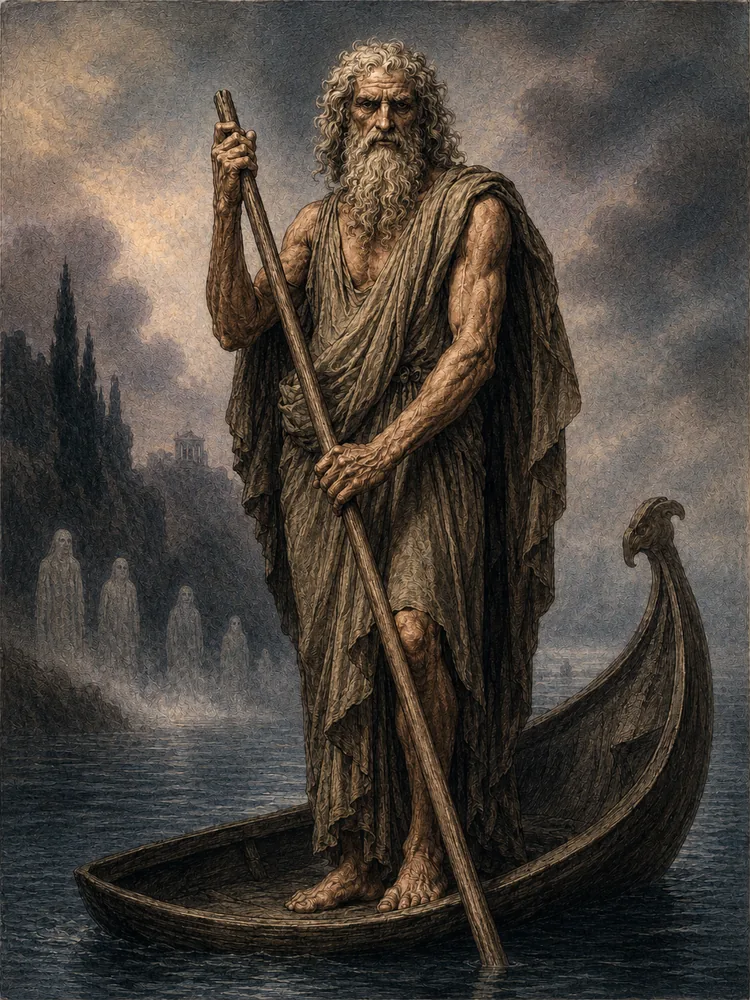
Charon was the ferryman of the underworld — the grim old boatman who, for the price of a single obol, carried the souls of the dead across the river Styx (or, in some versions, the Acheron) into the realm of Hades. Souls who lacked the obol (which the Greeks placed under the tongue of the corpse for this purpose) were left to wander the near shore for a hundred years before being permitted to cross. Charon was a figure of folklore as much as of formal mythology — a stern, taciturn, ill-tempered old man with grey beard and dirty cloak, who admitted only the properly buried dead and turned away the unburied with rough words. His parents were given variously as Erebus and Nyx, or no parents at all; he was a fixture of the underworld geography rather than of any divine genealogy. He had no cult; he was a figure of mortuary practice and of poetic description, attested in Greek funerary art from the Archaic period and surviving into modern Greek folk-tradition (where he has become the more general personification of death, Charos).
 Before thisGlaucus
 Next on the wallThe Anemoi
Curator’s note
What the sources say, and what later tradition added. The sources for this bay
Charon appears in Aristophanes (Frogs, where he is a comic figure ferrying Dionysus to the underworld), in Vergil (Aeneid 6.295–330, the influential Roman elaboration), in Lucian (Dialogues of the Dead, which give him the most extended characterization in any ancient source), and in Greek vase-painting from the fifth century BCE. The practice of placing the obol (the so-called "Charon's obol") under the tongue of the deceased is archaeologically attested; coins are routinely found in the mouths of buried Greek and Roman dead. The modern Greek folkloric Charos descends directly from the ancient figure.
Kin in the sources
Each tie is quoted from the entry that states it.
 Child ofErebus
His parents were given variously as Erebus and Nyx, or no parents at all
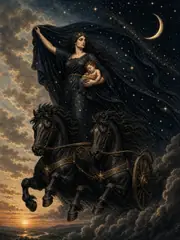 Child ofNyx
His parents were given variously as Erebus and Nyx, or no parents at all
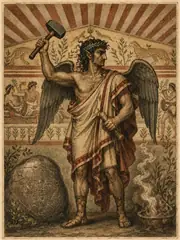 Named as the same god asCharun
the form was eventually assimilated to the Greek Charon (the ferryman of the dead)
The same god in other rooms
The ancient sources themselves name these as one god under different names. See Charon and Charun hung together
When the sources speak
Dated witnesses for The Sea, the Wild and the Wind. A date marks when the evidence was written down, not when the belief began. The whole timeline
- c. 1600–1100 BCE
- Mycenaean palace tablets in Linear B record offerings and divine names, but little continuous myth.
- c. 1100–800 BCE
- Post-palatial oral traditions and changing cult landscapes precede the surviving alphabetic epics.
- late 8th–7th centuries BCE
- The Iliad, Odyssey, Hesiodic Theogony and Works and Days give influential but non-exclusive divine orders.
- 7th–6th centuries BCE
- Homeric Hymns, lyric poetry, colonization, and local sanctuary traditions multiply regional narratives.
- 6th–5th centuries BCE
- Orphic, Pythagorean, and mystery materials develop alternative cosmogonies and afterlife doctrines.
- 5th century BCE
- Athenian tragedy and comedy recast heroic houses and divine justice for civic audiences.
- 4th century BCE
- Philosophers, antiquarians, and local historians interpret or criticize inherited myth.
- 323–31 BCE
- Hellenistic poets and scholars systematize variants across an enlarged Greek world.