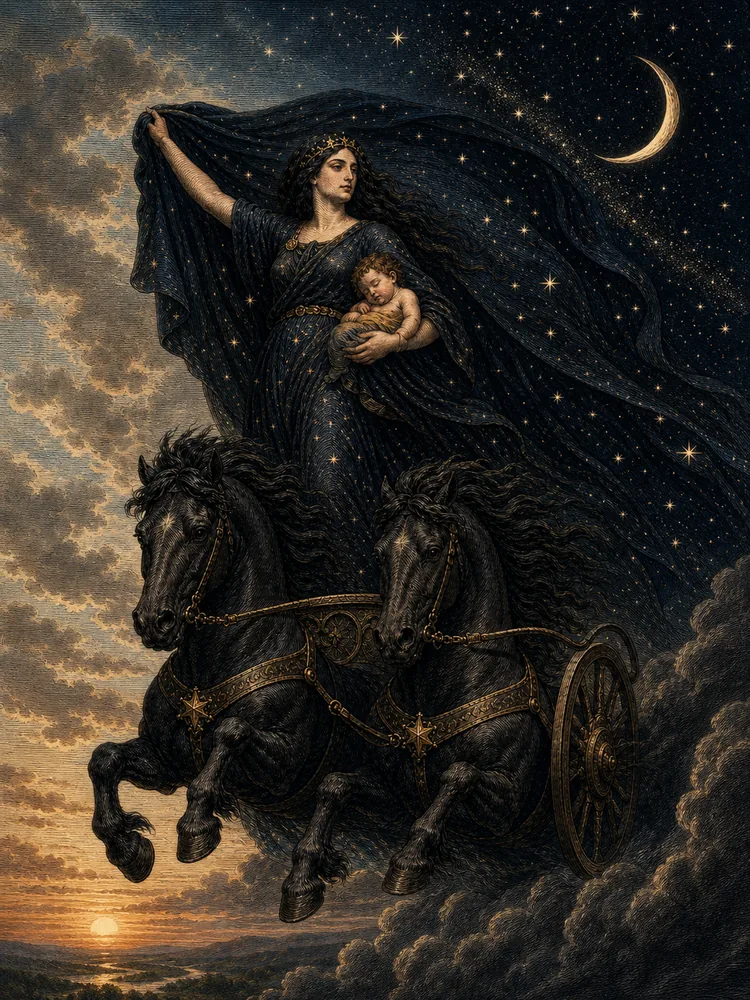
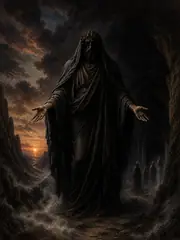
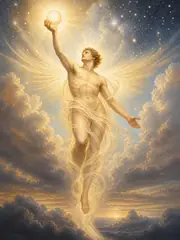
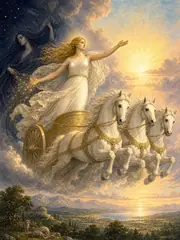
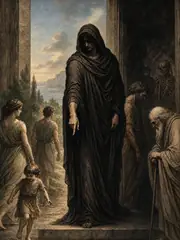
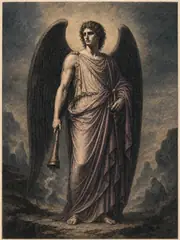
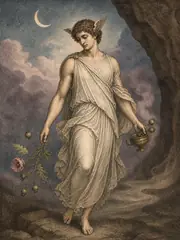
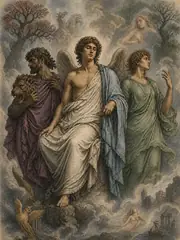
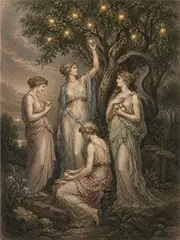
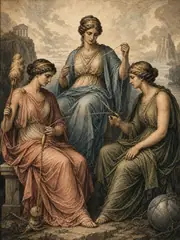
Nyx was Night, daughter of Chaos, sister and wife of Erebus; and she was perhaps the most fearsome of all the primordial powers, more dreadful even than Zeus, who once (in Homer) feared to do what would offend her. By Erebus she gave birth to Aether the upper air and Hemera the day; but by herself, in parthenogenesis, she gave birth to a great catalogue of dark powers: to Doom and Black Fate and Death; to Sleep and the Dreams; to Blame and Painful Misery; to the Hesperides; to the Fates and the Keres; to Nemesis, Deceit, Friendship, baleful Old Age, and Strife. The catalogue, in the Theogony, runs to seventeen offspring, all bred from the womb of darkness without any father.
Nyx dwelt in a great house at the edge of the world, beyond Ocean, in the place where she and her daughter Hemera passed each other twice each day — for the one descended into the house as the other came forth, and they never met within. Her chariot drew across the heavens at evening; her veil of darkness covered the sleeping world; and she was older than any other power, and more revered, even by the Olympians.
Curator’s note
What the sources say, and what later tradition added. The sources for this bay
Hesiod, Theogony 211–232, gives the catalogue of Night's offspring. The episode of Zeus's fear of Nyx is in Homer, Iliad 14.259–261, where Hypnos (Sleep) recounts that he once put Zeus to sleep at Hera's request, and Zeus would have been wroth, but Hypnos took refuge with Nyx, and Zeus did not pursue, for fear of offending her. The image of the two sisters Night and Day passing each other at the threshold of their shared house is preserved with particular beauty in Hesiod, Theogony 748–757; the Greek conception of Night as a primordial power senior to the Olympians and feared even by Zeus is striking, and is one of the most distinctive features of Hesiodic cosmogony. Nyx had cult at the oracle of Megara and was invoked in some Orphic hymns, but she was largely a literary and theological figure.
When the sources speak
Dated witnesses for The Primordial Powers. A date marks when the evidence was written down, not when the belief began. The whole timeline
- c. 1600–1100 BCE
- Mycenaean palace tablets in Linear B record offerings and divine names, but little continuous myth.
- c. 1100–800 BCE
- Post-palatial oral traditions and changing cult landscapes precede the surviving alphabetic epics.
- late 8th–7th centuries BCE
- The Iliad, Odyssey, Hesiodic Theogony and Works and Days give influential but non-exclusive divine orders.
- 7th–6th centuries BCE
- Homeric Hymns, lyric poetry, colonization, and local sanctuary traditions multiply regional narratives.
- 6th–5th centuries BCE
- Orphic, Pythagorean, and mystery materials develop alternative cosmogonies and afterlife doctrines.
- 5th century BCE
- Athenian tragedy and comedy recast heroic houses and divine justice for civic audiences.
- 4th century BCE
- Philosophers, antiquarians, and local historians interpret or criticize inherited myth.
- 323–31 BCE
- Hellenistic poets and scholars systematize variants across an enlarged Greek world.