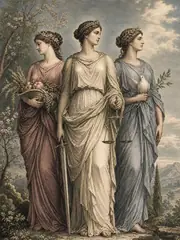
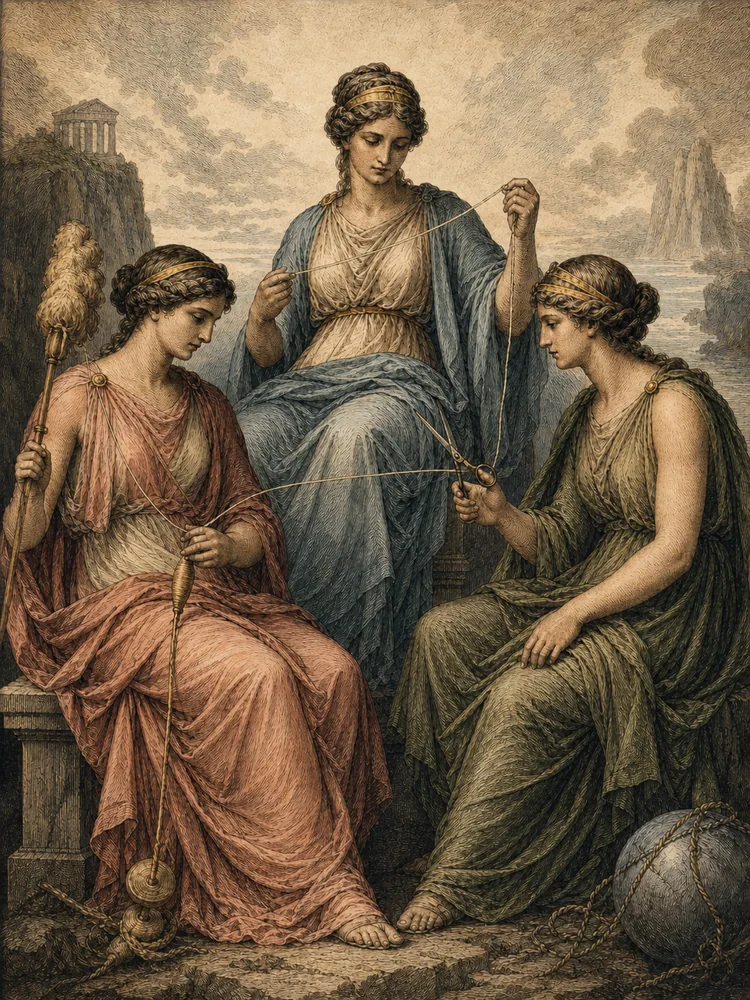
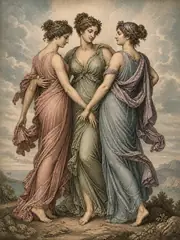
The Moirai — translated as the Fates — were three sister-goddesses who governed the destiny of every mortal from birth to death. Their names and offices were Clotho ("the spinner," who spun the thread of life on her distaff), Lachesis ("the apportioner," who measured out its length), and Atropos ("the unturnable," who cut it with her shears, ending the life). They were daughters of Zeus and Themis, in Hesiod's principal account; in others, daughters of Nyx alone, born without father, signifying their priority over even the rule of Zeus. Plato's myth of Er (in the Republic) gave them their most elaborate philosophical treatment: in his vision they sat upon thrones around the spindle of cosmic Necessity, with Lachesis singing the past, Clotho the present, Atropos the future, and the three weaving the destinies of human lives between them.
The Moirai were inevitable; even the gods could not always alter what they had decreed, though they could occasionally negotiate (Apollo, in Aeschylus's Eumenides, claims to have made the Moirai drunk to extend Admetus's life by allowing his wife Alcestis to die in his stead). Their cult was modest — they were honored at Olympia, at Corinth, and at Sicyon — but their conceptual force in Greek thought was enormous, embodying the Greek conviction that human existence was inscribed in a fabric being woven from beyond the human realm. The English word "fate" descends from Latin fata ("the things spoken"), the Roman counterpart of the Moirai being the Parcae.