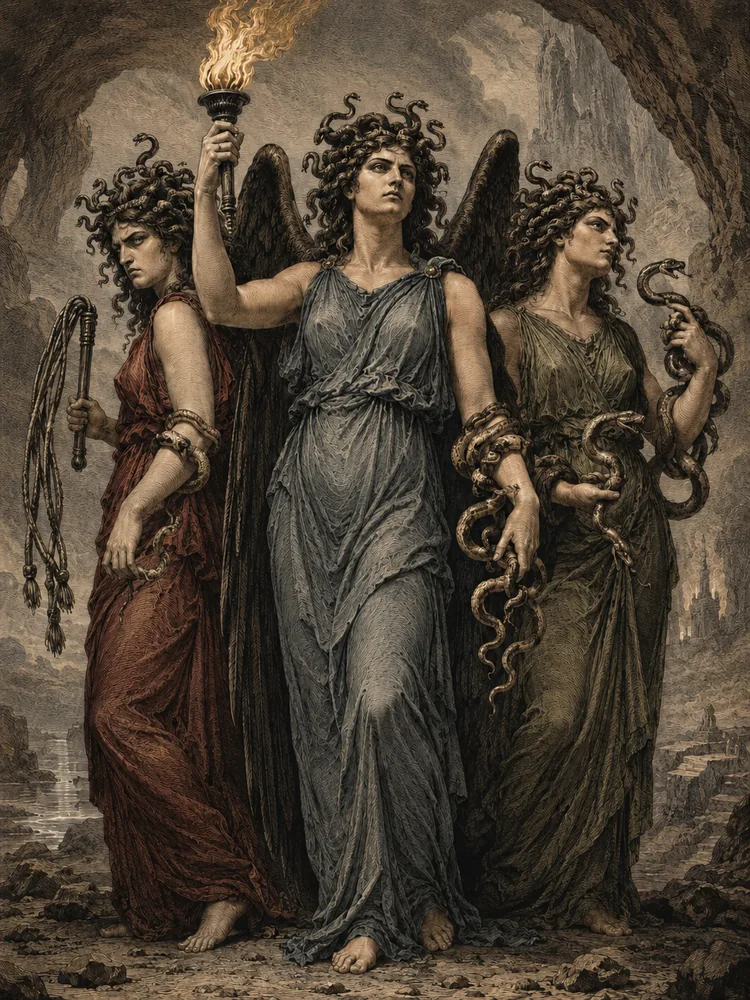
The Erinyes — translated into Latin as the Furiae and into modern English as the Furies — were three sister-goddesses of vengeful retribution, born (according to Hesiod) from the blood that fell upon Gaia when Cronus castrated Uranus. Their names were Tisiphone (the avenger of murder), Megaera (the jealous one), and Alecto (the unceasing). They were depicted as hideous black-clad women, with snakes for hair, blood dripping from their eyes, brandishing whips and torches; their character matched their appearance — they were implacable, pursuing the guilty until justice (or madness) was achieved. Their especial concern was crimes against blood-kin: the killing of a parent, the breaking of an oath, the violation of guest-friendship, the wronging of a suppliant. The matricide Orestes was their most famous victim, pursued from Argos to Athens until at last Athena established the court of the Areopagus to try him; the trial, with the votes equally divided and Athena's casting vote acquitting Orestes, ended with the goddesses being persuaded by Athena to accept a new role as the Eumenides ("the kindly ones") — the propitious goddesses of the soil and of justice rather than of vengeance. The transformation, treated by Aeschylus in the third play of the Oresteia trilogy, was a mythological statement of the Greek transition from blood-feud to civic justice.
 Next on the wallThe Moirai
Curator’s note
What the sources say, and what later tradition added. The sources for this bay
Hesiod, Theogony 184–187 (their birth from Uranus's blood); Aeschylus, Eumenides (the Orestes trial and the conversion to Eumenides) is the principal extended treatment. The Erinyes/Eumenides distinction (terrifying-versus-kindly) was preserved in cult: they were honored at Athens (in a sanctuary on the slope of the Areopagus) and at Sicyon under their kindly name. The euphemism "kindly ones" reflects the same fear-of-naming that was applied to Hades and Persephone; calling the dread goddesses by their proper name might attract their attention. Their identification with the Latin Furiae is post-Greek but the broad iconographic and functional tradition is shared.
Kin in the sources
Each tie is quoted from the entry that states it.
 Child ofGaia
from the blood that fell upon Gaia when Cronus castrated Uranus
 Child ofUranus
from the blood that fell upon Gaia when Cronus castrated Uranus
 Rival ofAthena
the goddesses being persuaded by Athena to accept a new role as the Eumenides
When the sources speak
Dated witnesses for The Margins and the Monsters. A date marks when the evidence was written down, not when the belief began. The whole timeline
- c. 1600–1100 BCE
- Mycenaean palace tablets in Linear B record offerings and divine names, but little continuous myth.
- c. 1100–800 BCE
- Post-palatial oral traditions and changing cult landscapes precede the surviving alphabetic epics.
- late 8th–7th centuries BCE
- The Iliad, Odyssey, Hesiodic Theogony and Works and Days give influential but non-exclusive divine orders.
- 7th–6th centuries BCE
- Homeric Hymns, lyric poetry, colonization, and local sanctuary traditions multiply regional narratives.
- 6th–5th centuries BCE
- Orphic, Pythagorean, and mystery materials develop alternative cosmogonies and afterlife doctrines.
- 5th century BCE
- Athenian tragedy and comedy recast heroic houses and divine justice for civic audiences.
- 4th century BCE
- Philosophers, antiquarians, and local historians interpret or criticize inherited myth.
- 323–31 BCE
- Hellenistic poets and scholars systematize variants across an enlarged Greek world.