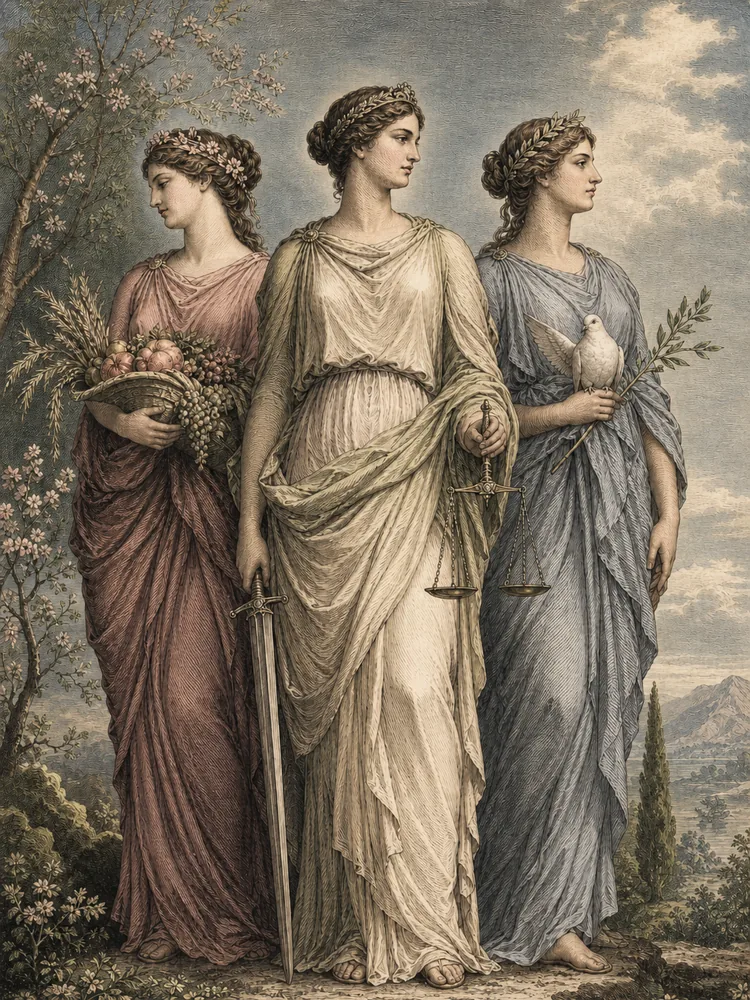
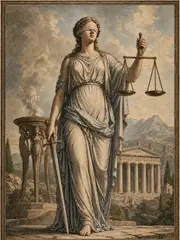
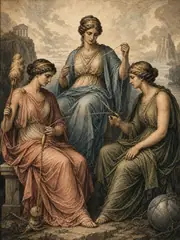
The Horae — translated as the Hours or Seasons — were three sister-goddesses originally of the seasons of the year (the Greek calendar recognized three seasons rather than four: spring, summer, and winter), who in later development came to be three sisters of social order and moral excellence. They were daughters of Zeus and Themis, sisters of the Moirai, and their names in Hesiod's most influential account were Eunomia ("good order" or "good government"), Dike ("justice"), and Eirene ("peace"). They were the personifications of the proper conduct of the agricultural year, and by extension of the proper conduct of human society — for the well-watched seasons that brought good harvests were inseparable, in Greek thought, from the well-watched social arrangements that brought good government. Their cult was modest but their conceptual importance was real, particularly Dike, who was sometimes treated as an independent goddess of justice and was much invoked in tragedy and in philosophical reflection. The English word "hour" descends from the Greek hora, originally meaning a season.
 Before thisThe Charites
 Next on the wallThe Muses
Curator’s note
What the sources say, and what later tradition added. The sources for this bay
Hesiod, Theogony 901–906; Works and Days 220–224 (Dike). The shift from seasonal to ethical signification is one of the more interesting developments in Greek theological vocabulary, paralleling the shift from agricultural to civic concerns in archaic and classical thought. Roman counterparts were the Horae, sometimes also conflated with the seasons proper.
Kin in the sources
Each tie is quoted from the entry that states it.
 Child ofZeus
They were daughters of Zeus and Themis, sisters of the Moirai
 Child ofThemis
They were daughters of Zeus and Themis, sisters of the Moirai
 Sibling ofThe Moirai
They were daughters of Zeus and Themis, sisters of the Moirai
When the sources speak
Dated witnesses for The Margins and the Monsters. A date marks when the evidence was written down, not when the belief began. The whole timeline
- c. 1600–1100 BCE
- Mycenaean palace tablets in Linear B record offerings and divine names, but little continuous myth.
- c. 1100–800 BCE
- Post-palatial oral traditions and changing cult landscapes precede the surviving alphabetic epics.
- late 8th–7th centuries BCE
- The Iliad, Odyssey, Hesiodic Theogony and Works and Days give influential but non-exclusive divine orders.
- 7th–6th centuries BCE
- Homeric Hymns, lyric poetry, colonization, and local sanctuary traditions multiply regional narratives.
- 6th–5th centuries BCE
- Orphic, Pythagorean, and mystery materials develop alternative cosmogonies and afterlife doctrines.
- 5th century BCE
- Athenian tragedy and comedy recast heroic houses and divine justice for civic audiences.
- 4th century BCE
- Philosophers, antiquarians, and local historians interpret or criticize inherited myth.
- 323–31 BCE
- Hellenistic poets and scholars systematize variants across an enlarged Greek world.