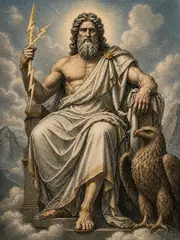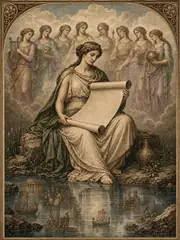
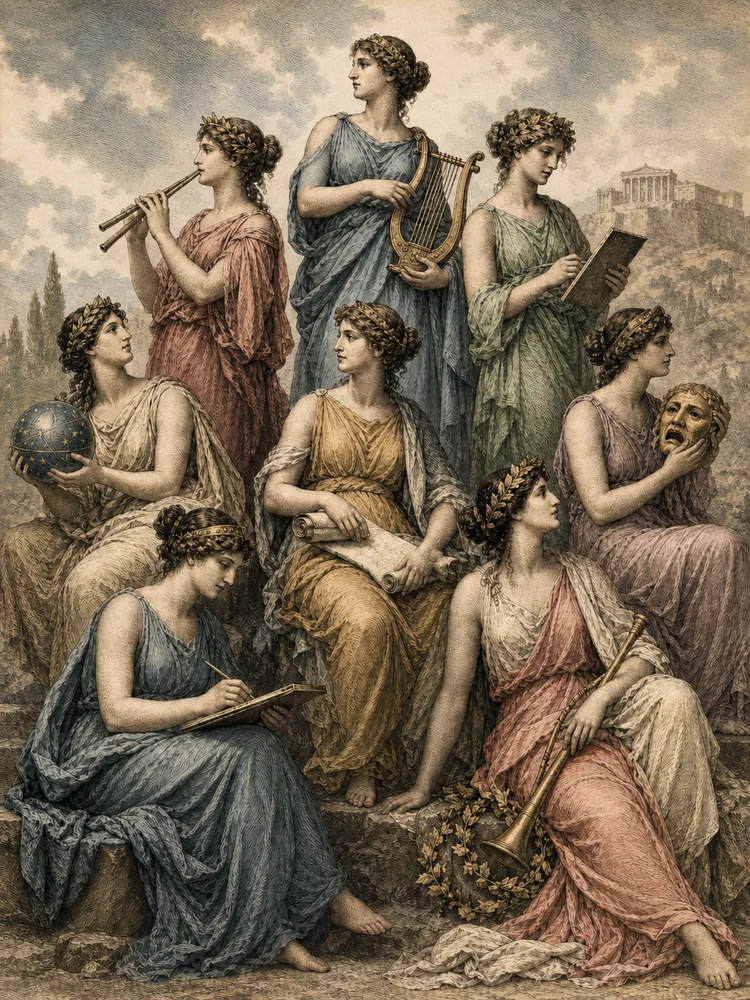
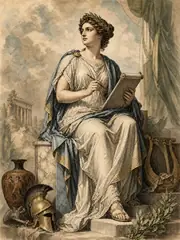
The Muses were nine sister-goddesses of song, poetry, dance, music, and the various arts and sciences in their inspired aspects. They were the daughters of Zeus and Mnemosyne (Memory), conceived in nine successive nights upon Pieria near Olympus, and they took their delight in singing and dancing on Mount Helicon (in Boeotia) and Mount Parnassus (above Delphi). The Muses were invoked at the beginning of every major Greek poetic composition: Homer opened the Iliad with "Sing, goddess, of the wrath of Achilles," and the Odyssey with "Tell me, Muse, of the man of many turns"; Hesiod's Theogony opens with an extended invocation of the Muses upon Helicon; Pindar's odes are saturated with their presence. They were the source of poetic inspiration in the strong sense — the singer or poet did not invent his song but received it from the Muse, who herself remembered all that had been (her mother being Memory) and could communicate the truth of past events to the singer in the present.
The differentiation of the nine Muses by individual office is largely a Hellenistic and Roman development. In Hesiod the nine are simply listed by name without specialized assignments; the canonical pairing of each Muse with a particular art (Calliope with epic poetry, Clio with history, Erato with love-poetry, Euterpe with the flute, Melpomene with tragedy, Polyhymnia with sacred hymns, Terpsichore with dance, Thalia with comedy, Urania with astronomy) is post-classical, codified in late antique handbooks and given visual form in Roman sculpture-cycles. We give each below in her conventional later assignment, with the caveat that the assignments are convention rather than ancient theology.