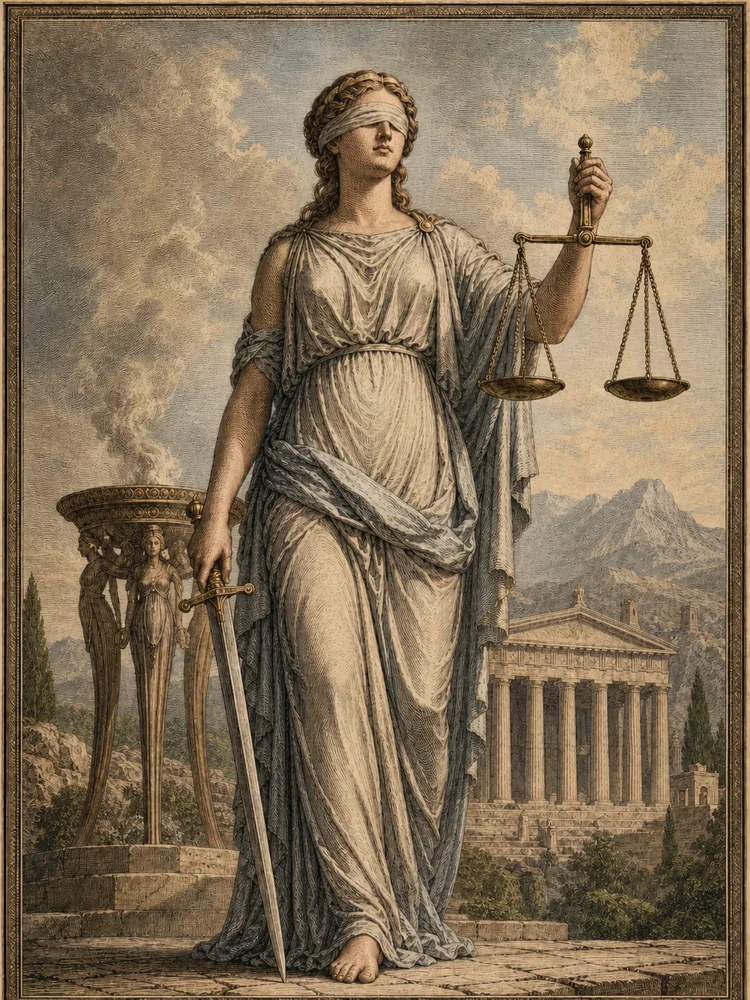
Themis was the Titaness of divine order, of right custom, of the unwritten laws by which the gods and the cosmos were governed. She was a daughter of Uranus and Gaia, sister of Cronus and the other original Titans, but unlike most of her siblings she was not banished after the Titanomachy; she was honored by Zeus and given a seat among the Olympians, where she was his counselor and the guardian of the proprieties of divine assembly. She bore him several children: the Horae (Eunomia, Dike, Eirene — Good Order, Justice, Peace) and the Moirai (Clotho, Lachesis, Atropos — the three Fates), in whose various ways the principle of cosmic order was elaborated. Before Apollo took over the oracle at Delphi from Gaia, Themis had held it for a generation; the tradition that she was the second holder, between Gaia and Apollo, is preserved by Aeschylus.
 Before thisEos
 Next on the wallMnemosyne
Curator’s note
What the sources say, and what later tradition added. The sources for this bay
Hesiod, Theogony 135, 901–906 (the begetting of the Horae); Aeschylus, Eumenides 1–8 (Themis at Delphi). Themis had cult at several sanctuaries — at Delphi (where her share in the oracle was acknowledged), at Athens, and elsewhere — but her principal significance was theological and conceptual rather than cultic. The distinction between Themis and Dike (her daughter, Justice) is the distinction between the structural order of the cosmos and the executed justice within human and divine affairs.
Kin in the sources
Each tie is quoted from the entry that states it.
 Child ofUranus
She was a daughter of Uranus and Gaia, sister of Cronus and the other original Titans
 Child ofGaia
She was a daughter of Uranus and Gaia, sister of Cronus and the other original Titans
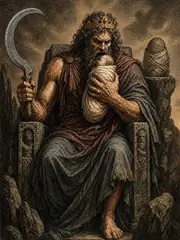 Sibling ofCronus
She was a daughter of Uranus and Gaia, sister of Cronus and the other original Titans
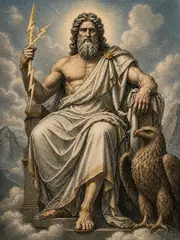 Consort ofZeus
She bore him several children: the Horae (Eunomia, Dike, Eirene
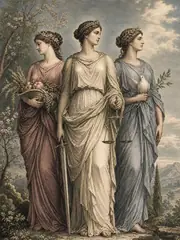 Parent ofThe Horae
She bore him several children: the Horae (Eunomia, Dike, Eirene
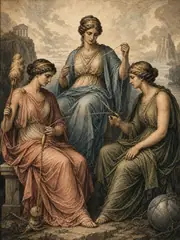 Parent ofThe Moirai
and the Moirai (Clotho, Lachesis, Atropos — the three Fates)
When the sources speak
Dated witnesses for The Titans and Their Children. A date marks when the evidence was written down, not when the belief began. The whole timeline
- c. 1600–1100 BCE
- Mycenaean palace tablets in Linear B record offerings and divine names, but little continuous myth.
- c. 1100–800 BCE
- Post-palatial oral traditions and changing cult landscapes precede the surviving alphabetic epics.
- late 8th–7th centuries BCE
- The Iliad, Odyssey, Hesiodic Theogony and Works and Days give influential but non-exclusive divine orders.
- 7th–6th centuries BCE
- Homeric Hymns, lyric poetry, colonization, and local sanctuary traditions multiply regional narratives.
- 6th–5th centuries BCE
- Orphic, Pythagorean, and mystery materials develop alternative cosmogonies and afterlife doctrines.
- 5th century BCE
- Athenian tragedy and comedy recast heroic houses and divine justice for civic audiences.
- 4th century BCE
- Philosophers, antiquarians, and local historians interpret or criticize inherited myth.
- 323–31 BCE
- Hellenistic poets and scholars systematize variants across an enlarged Greek world.