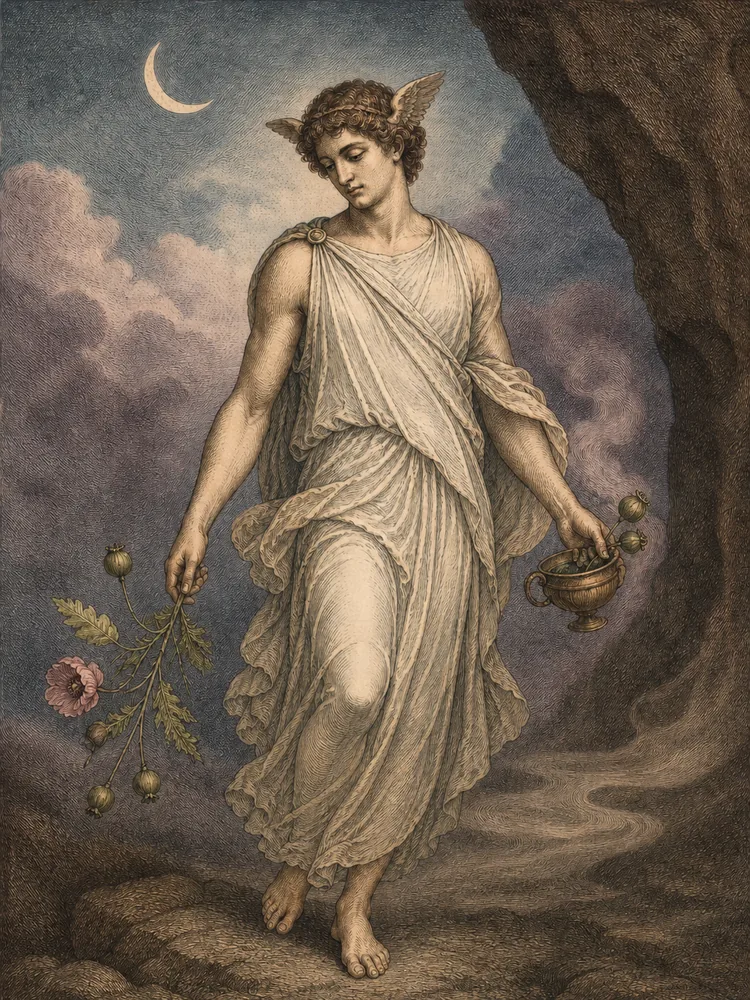
Hypnos was Sleep — the daimon of slumber, twin brother of Thanatos (Death), son of Nyx (Night). He was a gentler figure than his twin: where Thanatos came implacably and once, Hypnos came nightly and lifted his hand each morning. He was depicted as a young winged man, often holding a horn from which he poured the dew of sleep upon mortals' eyes, or a poppy (the source of the genuine soporific that the Greeks knew). His most famous narrative is in the fourteenth book of the Iliad, where Hera, wishing to put Zeus to sleep so that the Greeks at Troy could be aided unobserved, came to Hypnos's island Lemnos to recruit him; Hypnos was reluctant (he had been punished once already for putting Zeus to sleep at Hera's request, and had escaped Zeus's wrath only by taking refuge with Nyx, whom even Zeus feared to anger), but Hera offered him one of the Charites in marriage, and Hypnos accepted. He flew to Mount Ida, took the form of a bird, settled in a fir-tree, and put Zeus to sleep with his accustomed touch. The episode is one of the few in Homer that gives Sleep an active narrative role rather than a merely descriptive one.
 Next on the wallThanatos
Curator’s note
What the sources say, and what later tradition added. The sources for this bay
Hesiod, Theogony 211, 758–766; Homer, Iliad 14.231–360 (the Hera narrative). Hypnos's small cult was at the temple of Asclepius at Troezen, where he was honored along with the dream-spirits as a power favorable to incubation. Roman counterpart: Somnus.
Kin in the sources
Each tie is quoted from the entry that states it.
- Sibling ofThanatos
twin brother of Thanatos (Death), son of Nyx (Night)
 Child ofNyx
twin brother of Thanatos (Death), son of Nyx (Night)
 Companion ofHera
came to Hypnos's island Lemnos to recruit him
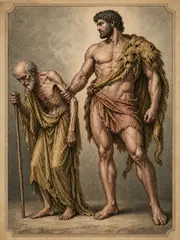 Sibling ofGeras
He was a son of Nyx in Hesiod's catalogue, brother of Death and Sleep and Doom
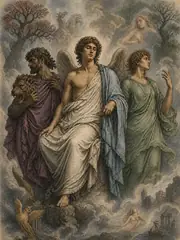 Parent ofMorpheus and the Oneiroi
there dwelt also his thousand sons, the Oneiroi — the Dreams
When the sources speak
Dated witnesses for The Mysteries. A date marks when the evidence was written down, not when the belief began. The whole timeline
- c. 1600–1100 BCE
- Mycenaean palace tablets in Linear B record offerings and divine names, but little continuous myth.
- c. 1100–800 BCE
- Post-palatial oral traditions and changing cult landscapes precede the surviving alphabetic epics.
- late 8th–7th centuries BCE
- The Iliad, Odyssey, Hesiodic Theogony and Works and Days give influential but non-exclusive divine orders.
- 7th–6th centuries BCE
- Homeric Hymns, lyric poetry, colonization, and local sanctuary traditions multiply regional narratives.
- 6th–5th centuries BCE
- Orphic, Pythagorean, and mystery materials develop alternative cosmogonies and afterlife doctrines.
- 5th century BCE
- Athenian tragedy and comedy recast heroic houses and divine justice for civic audiences.
- 4th century BCE
- Philosophers, antiquarians, and local historians interpret or criticize inherited myth.
- 323–31 BCE
- Hellenistic poets and scholars systematize variants across an enlarged Greek world.