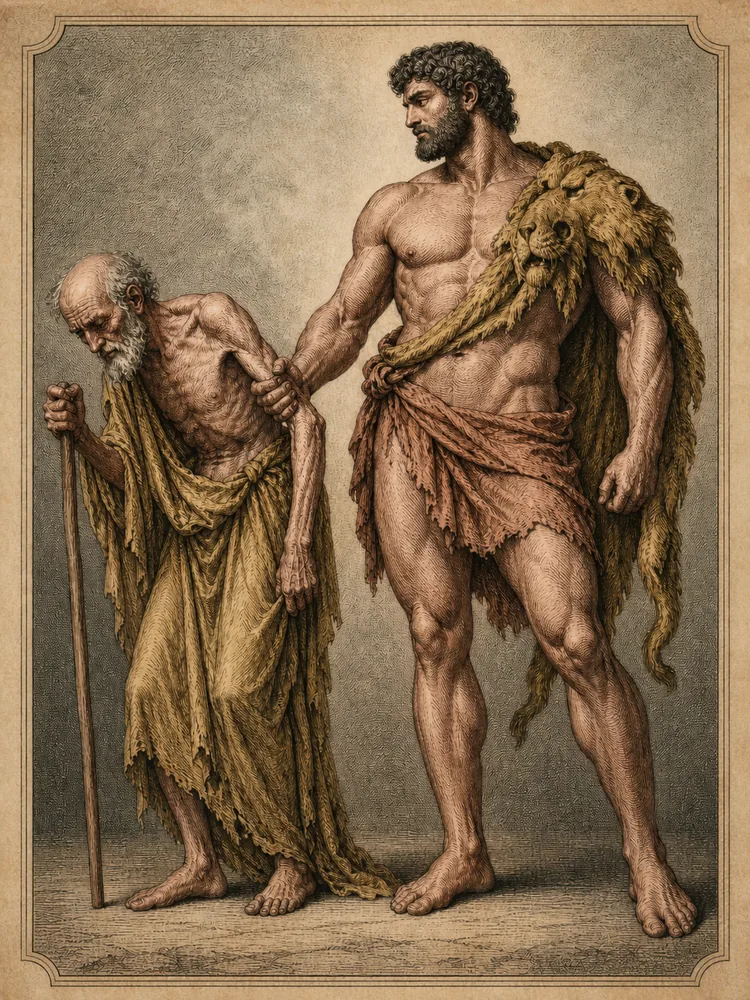
Geras was the daimon of Old Age — the personified decline of the body, the sapping of strength, the wrinkling and weakening that every long-lived mortal endured. He was a son of Nyx in Hesiod's catalogue, brother of Death and Sleep and Doom, and he was depicted in vase-painting (notably on a fifth-century Attic red-figure amphora) as a withered, emaciated old man, often shown shrinking before the strength of Heracles, who in some accounts wrestled and overcame him. The figure had no cult; he was a literary and visual personification, and the Heracles-defeats-Geras motif is a small but striking instance of the Greek tendency to allegorize natural processes as personified opponents.
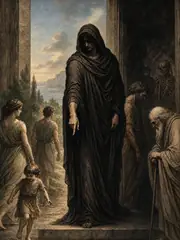 Before thisMoros
 Next on the wallOizys
Curator’s note
What the sources say, and what later tradition added. The sources for this bay
Hesiod, Theogony 225. The vase-painting of Heracles wrestling Geras is on an Attic red-figure pelike of c. 470 BCE (Louvre G 234), where the contrast between the heroic body of Heracles and the shrunken figure of Old Age is rendered with considerable artistic point. Geras had no cult.
Kin in the sources
Each tie is quoted from the entry that states it.
 Child ofNyx
He was a son of Nyx in Hesiod's catalogue, brother of Death and Sleep and Doom
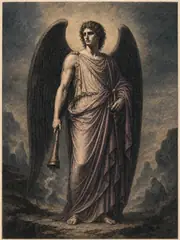 Sibling ofThanatos
He was a son of Nyx in Hesiod's catalogue, brother of Death and Sleep and Doom
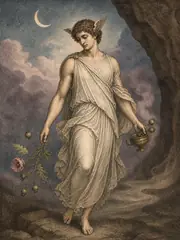 Sibling ofHypnos
He was a son of Nyx in Hesiod's catalogue, brother of Death and Sleep and Doom
- Sibling ofMoros
He was a son of Nyx in Hesiod's catalogue, brother of Death and Sleep and Doom
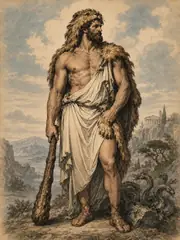 Rival ofHeracles
shrinking before the strength of Heracles, who in some accounts wrestled and overcame him
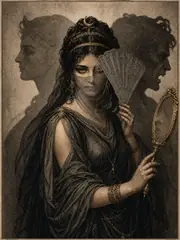 Sibling ofApate
alongside Friendship, Old Age, Strife, and the rest of the abstract personifications
When the sources speak
Dated witnesses for The Primordial Powers. A date marks when the evidence was written down, not when the belief began. The whole timeline
- c. 1600–1100 BCE
- Mycenaean palace tablets in Linear B record offerings and divine names, but little continuous myth.
- c. 1100–800 BCE
- Post-palatial oral traditions and changing cult landscapes precede the surviving alphabetic epics.
- late 8th–7th centuries BCE
- The Iliad, Odyssey, Hesiodic Theogony and Works and Days give influential but non-exclusive divine orders.
- 7th–6th centuries BCE
- Homeric Hymns, lyric poetry, colonization, and local sanctuary traditions multiply regional narratives.
- 6th–5th centuries BCE
- Orphic, Pythagorean, and mystery materials develop alternative cosmogonies and afterlife doctrines.
- 5th century BCE
- Athenian tragedy and comedy recast heroic houses and divine justice for civic audiences.
- 4th century BCE
- Philosophers, antiquarians, and local historians interpret or criticize inherited myth.
- 323–31 BCE
- Hellenistic poets and scholars systematize variants across an enlarged Greek world.