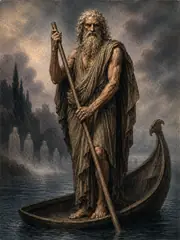
Charun was the Etruscan demon of death — and one of the most distinctive and terrifying figures of the Etruscan underworld. His name is Etruscan in origin (perhaps from a root meaning 'to be lord' or 'to keep'), though the form was eventually assimilated to the Greek Charon (the ferryman of the dead) by the Hellenizing tradition; the original Etruscan Charun, however, was a quite different figure from the Greek ferryman, and the assimilation was secondary.
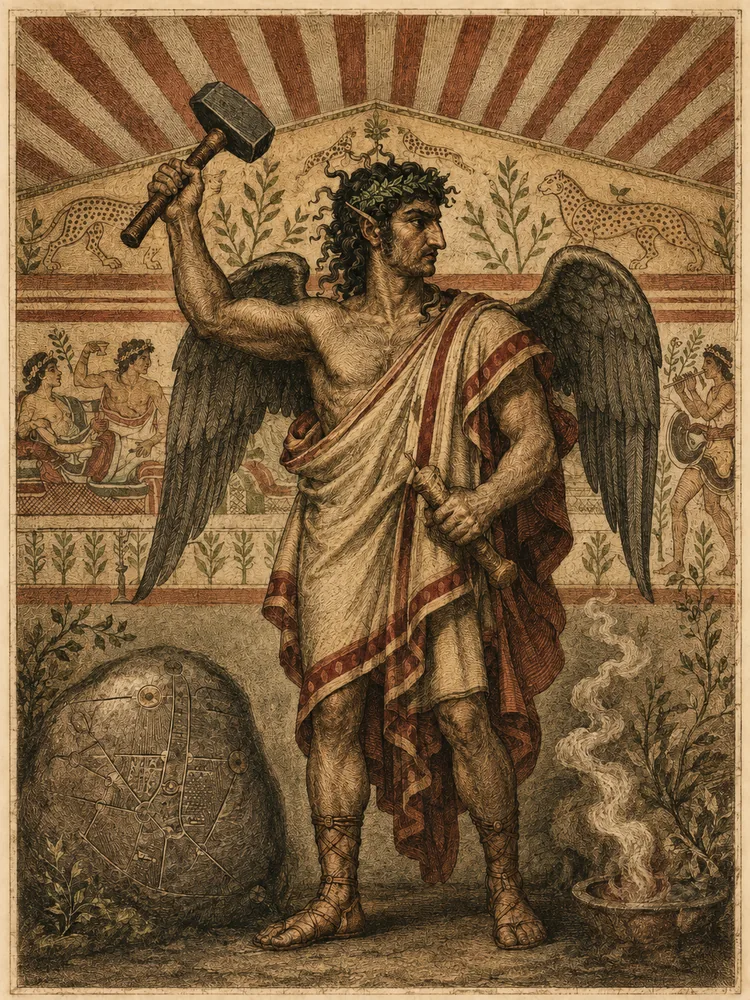
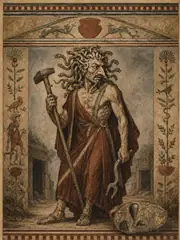
Charun was depicted on tomb paintings and on funerary urns as a great hideous figure — pointed ears, hooked nose (sometimes a beak), greenish or blue-grey skin, sometimes with snakes wrapped around his arms — wielding a great hammer. With this hammer he struck the dying at the moment of death, dispatching them with a blow that severed the soul from the body. He was thus not a guide of the dead (as the Greek Charon was, ferrying them across the river) but rather an active agent of dying — the executioner of mortality, whose blow ended the life and inaugurated the journey to the underworld.
On the great fourth-century painted tomb called the Tomba dei Caronti at Tarquinia (named after the Charun-figures it contains), Charun is shown in multiple forms — Charun Chunchulis, Charun Lufe, Charun Huths — each apparently a particular demon-form within the broader Charun-category. The multiplication suggests that the Etruscans understood Charun not as a single individual but as a class of underworld demons, each with its proper function in the bringing of death. The naming of individual Charuns is paralleled by the naming of individual Lasa (in the previous book) and reflects the Etruscan tendency to multiply specialized divine beings.
After the Romanization, the Etruscan Charun and the Greek Charon were fused into a single figure — sometimes the hammer-wielder, sometimes the ferryman, sometimes both at once. This composite Charon-Charun passed into the Latin and medieval Christian imagination, where the death-demon with the hammer became the prototype of the medieval iconography of Death personified — the skeletal figure with the scythe (a transformed hammer) — and where the ferryman aspect contributed to the iconography of the soul's passage across a great water. The Etruscan original is one of the surest cases of an ancient Italian deity persisting, in transformed but recognizable form, into Christian iconography of the late medieval and early modern periods.