A Compendium of the Ancient Gods
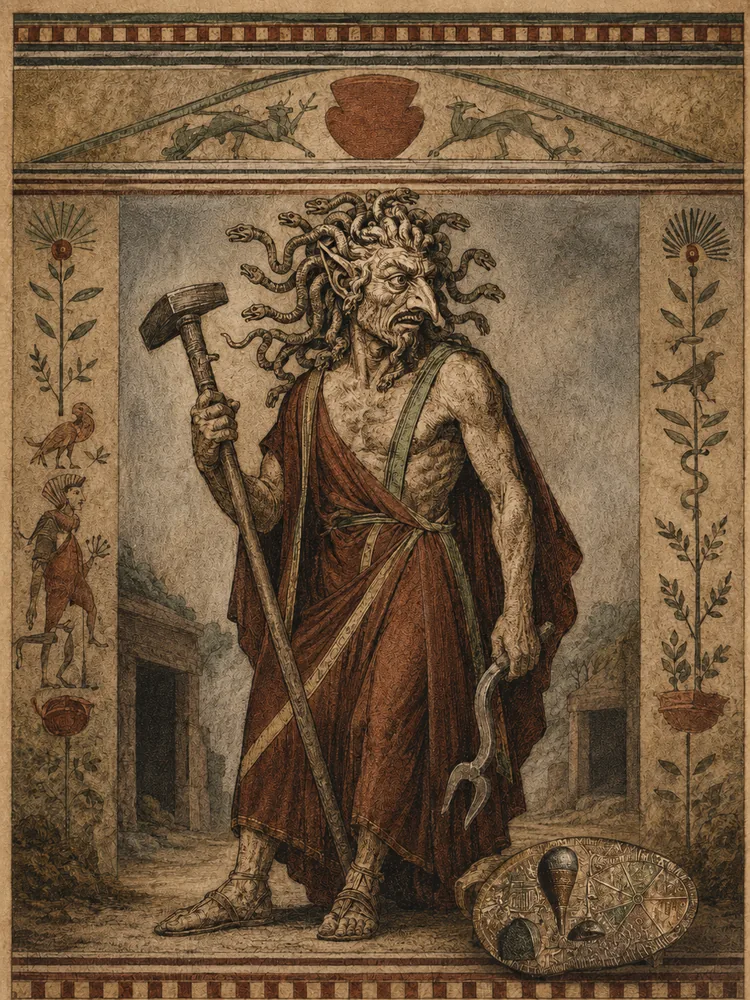
Tuchulcha, plate

Tuchulcha was perhaps the most terrifying of the Etruscan underworld demons. He is depicted on a single famous tomb-painting — in the Tomba dell'Orco at Tarquinia, the same fourth-century BCE tomb that gives us Aita and Phersipnai — as a hideous winged creature with the beaked face of a vulture, the donkey-like ears of a great beast, snakes coiling about his head and arms in place of hair, and gripping a serpent in his outstretched hand. He stands beside the seated figure of the hero Theseus, who has been condemned by the Etruscan judges of the dead to eternal punishment in the underworld, and Tuchulcha appears to be tormenting him.

The image is unique. No other Etruscan tomb preserves a Tuchulcha; no inscriptions name him outside this single painting; no later mythography records him. He stands in the iconographic record as a single witness to the elaboration of Etruscan demonology — but a vivid witness, for the figure is grotesque and terrifying in a way that anticipates medieval Christian images of demons by more than a thousand years. The torment of the wicked dead by hybrid hideous creatures, with snakes for hair and beaks for noses, is one of the great themes of medieval iconography of hell; Tuchulcha is the prototype.

Whether Tuchulcha was a single named demon or whether he was one of a class of similar demons (like the Charuns in the previous entry, or the Lasa in Book III), we cannot tell. The single occurrence makes either interpretation possible. What is certain is that the Etruscan religion contained a developed conception of post-mortem punishment for the wicked, with hideous tormenting demons appointed to inflict the proper punishments — a conception that overlapped with the Greek Tartarus tradition (where the wicked were punished by Furies and similar beings) but went further in iconographic specificity.

After the Romanization, Tuchulcha disappeared from the record. His type — the hybrid demon-tormentor — was preserved indirectly through the Roman absorption of Greek underworld imagery, and through that channel passed into Christian iconography. The medieval frescoes of hell, with their snake-haired devils tormenting the damned, are the distant descendants of the Tuchulcha of the Tomba dell'Orco.
Curator’s note

What the sources say, and what later tradition added. The sources for this bay

Tuchulcha is depicted on one tomb-painting only, in the Tomba dell'Orco I (also called the Tomba dell'Orco di Murina) at Tarquinia. The painting is described in detail in Stephan Steingräber's Abundance of Life and in many other treatments of Etruscan tomb art. The standard treatment of the figure is in Mauro Cristofani's Dizionario della civiltà etrusca and in the LIMC entry; de Grummond's Etruscan Myth chapter 7 puts the figure in context. The transmission of Etruscan underworld iconography to medieval Christian iconography is the subject of much art-historical scholarship; the line of descent runs through Roman funerary art (which preserved much of the Etruscan iconography in altered form) into early Christian and then medieval imagery of hell.

Kin in the sources

Each tie is quoted from the entry that states it.

When the sources speak

Dated witnesses for The Underworld and the Spirits of Death. A date marks when the evidence was written down, not when the belief began. The whole timeline

c. 900–750 BCE
Villanovan communities establish the Iron Age background from which historically Etruscan cities emerge.
c. 750–600 BCE
Orientalizing exchange and urban growth transform elite ritual, iconography, writing, and sanctuary display.
c. 600–475 BCE
Etruscan city-states reach their widest political and artistic influence; temples and mythic imagery proliferate.
c. 474 BCE
The defeat at Cumae marks changing Etruscan power in Campania and the Tyrrhenian world.
5th–4th centuries BCE
Tomb painting, mirrors, votive deposits, and regional cults provide dense evidence for divine and funerary imagery.
396–264 BCE
Roman conquest progressively incorporates Etruscan cities while Etruscan priestly expertise remains prestigious.
2nd–1st centuries BCE
Late inscriptions and Roman antiquarian interest document cultural integration and the persistence of divinatory traditions.
1st century BCE–1st century CE
Cicero, Varro, Livy, Seneca, and others preserve testimony about haruspicy, lightning, and prodigies.

Floor plan

The rooms follow one another in the order their peoples first appear in the written record.

  1. The Cradle of Citiesc. 3400 BCE to 395 CE. 115 works
  2. The Gift of the Nilec. 4000 BCE to 395 CE. 73 works
  3. The Olympian Orderc. 1600 BCE to 750 CE. 152 works
  4. The Persian Worldc. 2000 BCE to 1010 CE. 30 works
  5. The Levantine Borderlandsc. 1200 BCE to 500 CE. 20 works
  6. The Edges of Empirec. 2000 BCE to 1500 CE. 33 works
  7. The Etruscan Worldc. 900 BCE to 750 CE. 22 works
  8. The Roman Inheritancec. 1200 BCE to 500 CE. 58 works
  9. The Northern Inheritancec. 2000 BCE to 1600 CE. 131 works