A Compendium of the Ancient Gods
Vanth, plate

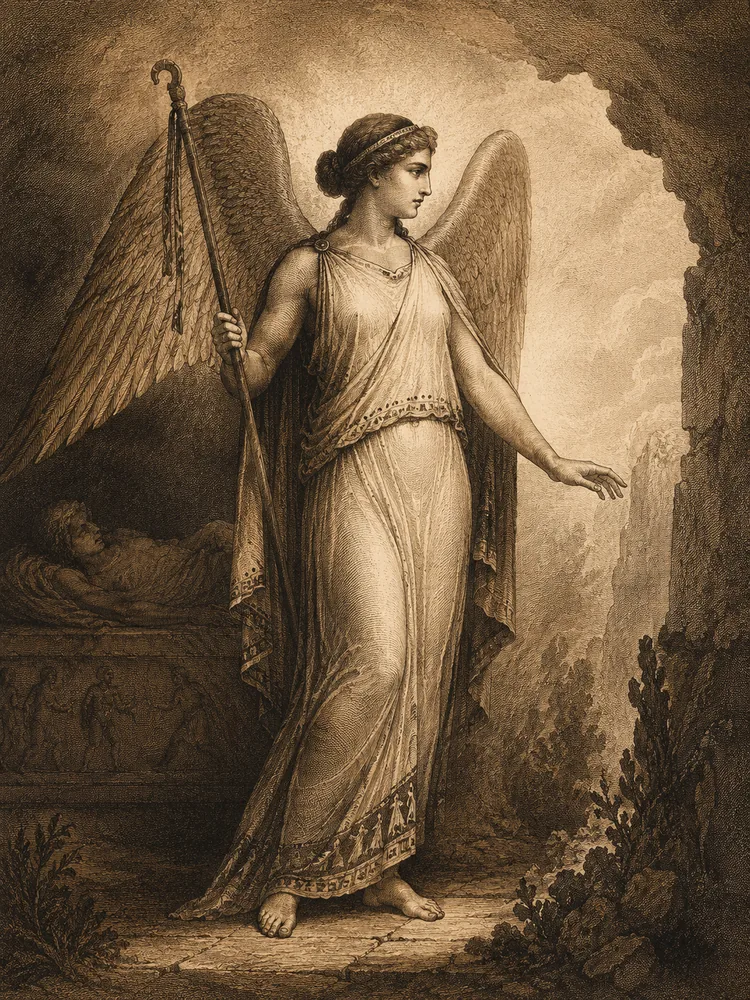
Vanth was the Etruscan female spirit of death — a winged young woman who appeared at the moment of dying to escort the soul to the underworld. Unlike Charun (who struck the dying with his hammer) and Tuchulcha (who tormented the wicked dead), Vanth was not herself a violent or terrifying figure; she was a guide and an escort, present at the moment of transition, accompanying the soul along the road. Her function corresponds roughly to that of the Greek Hermes Psychopompos (the conductor of souls), but her gender, her wingedness, and her presence in numbers (often multiple Vanths appear in a single scene) distinguish her from the Greek figure.

Vanth is depicted on numerous tomb-paintings and on funerary urns and sarcophagi as a beautiful winged young woman, often nude or partly clothed, holding a torch (to light the way to the underworld) and a scroll (perhaps inscribed with the name of the dying or with the prophetic announcement of death). She wears boots and a short tunic in some images, and crossed bands across her chest in others; her wings are large and feathered. The iconography is consistent across many examples, and is one of the most distinctive of all Etruscan religious imagery.

Multiple Vanths often appear in single scenes — sometimes two or three or more, accompanying the soul along the underworld road, gesturing toward the entrance of the tomb-world, or attending the throne of Aita. Like the Lasa (the attendants of Turan, treated above) and the Charuns (the death-demons), Vanth seems to have been a category of beings rather than a single individual; the named Vanths in some inscriptions (Vanth Vetra, for example) confirm this multiplicity.

Vanth's connection to the moment of dying — and her function as escort rather than executioner — gave her a relatively positive aspect in the Etruscan understanding of death. She was the kindly guide, the one who took the soul by the hand and led it onward; her presence in tomb art was a comfort, the assurance that the dead were not abandoned but accompanied. In the late Etruscan period, this aspect was emphasized increasingly, and Vanth approaches a function parallel to that of the Christian guardian angel — the divine being who attends the soul through its great transitions. The transmission to Christian iconography is harder to demonstrate directly than for Charun, but the iconographic resonances are strong, and the winged female figures who attend the soul in late-antique and early-medieval Christian art owe something, however distant, to the Etruscan Vanth.
Curator’s note

What the sources say, and what later tradition added. The sources for this bay

Vanth is depicted on numerous Etruscan tomb-paintings (Tomba degli Anina at Tarquinia, Tomba dei Demoni Azzurri, and many others) and on countless funerary urns and sarcophagi. The standard treatment is in de Grummond's Etruscan Myth, chapter 7, and in Theresa Huntsman's various articles; the LIMC entry catalogs the iconographic evidence. The multiplicity of Vanths and the question of whether 'Vanth' is an individual name or a category-term is discussed in Cristofani's Dizionario. The iconographic resonance with Christian guardian angels and psychopomp figures is suggestive but the historical line of descent (if any) runs through Roman funerary art and is hard to trace in detail; Roberto Bianchi Bandinelli's various works on the continuity of Roman funerary iconography into early Christian art are the standard treatments.

Kin in the sources

Each tie is quoted from the entry that states it.

When the sources speak

Dated witnesses for The Underworld and the Spirits of Death. A date marks when the evidence was written down, not when the belief began. The whole timeline

c. 900–750 BCE
Villanovan communities establish the Iron Age background from which historically Etruscan cities emerge.
c. 750–600 BCE
Orientalizing exchange and urban growth transform elite ritual, iconography, writing, and sanctuary display.
c. 600–475 BCE
Etruscan city-states reach their widest political and artistic influence; temples and mythic imagery proliferate.
c. 474 BCE
The defeat at Cumae marks changing Etruscan power in Campania and the Tyrrhenian world.
5th–4th centuries BCE
Tomb painting, mirrors, votive deposits, and regional cults provide dense evidence for divine and funerary imagery.
396–264 BCE
Roman conquest progressively incorporates Etruscan cities while Etruscan priestly expertise remains prestigious.
2nd–1st centuries BCE
Late inscriptions and Roman antiquarian interest document cultural integration and the persistence of divinatory traditions.
1st century BCE–1st century CE
Cicero, Varro, Livy, Seneca, and others preserve testimony about haruspicy, lightning, and prodigies.

Floor plan

The rooms follow one another in the order their peoples first appear in the written record.

  1. The Cradle of Citiesc. 3400 BCE to 395 CE. 115 works
  2. The Gift of the Nilec. 4000 BCE to 395 CE. 73 works
  3. The Olympian Orderc. 1600 BCE to 750 CE. 152 works
  4. The Persian Worldc. 2000 BCE to 1010 CE. 30 works
  5. The Levantine Borderlandsc. 1200 BCE to 500 CE. 20 works
  6. The Edges of Empirec. 2000 BCE to 1500 CE. 33 works
  7. The Etruscan Worldc. 900 BCE to 750 CE. 22 works
  8. The Roman Inheritancec. 1200 BCE to 500 CE. 58 works
  9. The Northern Inheritancec. 2000 BCE to 1600 CE. 131 works