Aita was the Etruscan king of the underworld, the lord of the dead, the consort of Phersipnai. His name is the Etruscan form of the Greek Aides (Hades), borrowed in the Hellenizing period of Etruscan religion (probably the fifth or fourth century before our era) and applied to a figure who may previously have had a different Etruscan name (perhaps Calus, mentioned in some inscriptions as a god of the dark and the night, though the identification is uncertain).
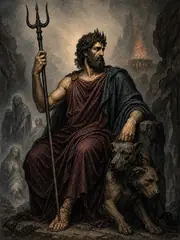
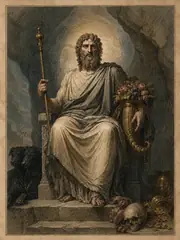
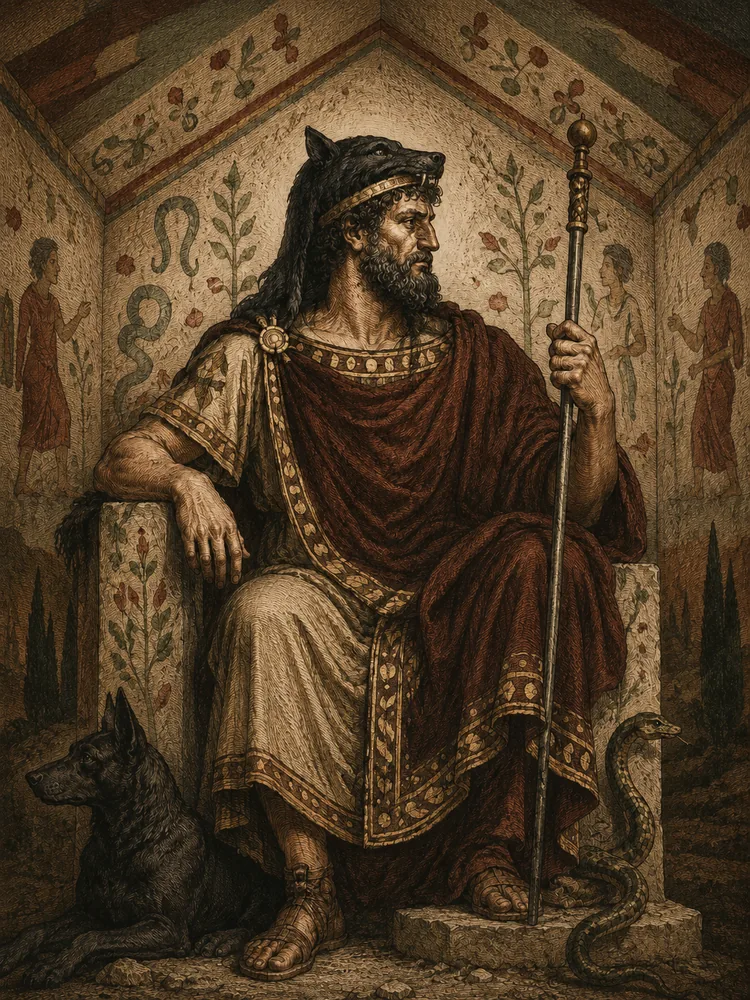
Aita is depicted in the great Etruscan tomb-paintings — particularly the Tomba dell'Orco at Tarquinia, dated to the fourth century BCE — as a stern bearded man wearing a wolf-skin cap, the wolf's head pulled forward over his own brow as a hood. The wolf-skin is a distinctively Etruscan element of iconography (the Greek Hades wears a helmet of invisibility, but no wolf-skin); the wolf was associated in Italian religion with the threshold between this world and the other, and the wolf-skin headdress identified Aita as a guardian of that threshold.
He sat enthroned in his underworld kingdom alongside Phersipnai, with Charun and Vanth as his attendants. The dead came to him at the end of the underworld road; before his throne the long process of judgment, allotment, and final placement in the realms of the dead was carried out. The Etruscan underworld was probably divided into different regions for different categories of dead — the heroic, the ordinary, the wicked — and Aita's court was the central administrative point of the entire system.
After the Romanization of Etruria, Aita was identified with Roman Dis Pater and Pluto and disappeared as a distinct figure. But his iconography — the bearded king in the wolf-skin cap — survived in Etruscan-Roman tomb art into the late Republic, and contributed in altered form to the medieval iconography of the king of hell.