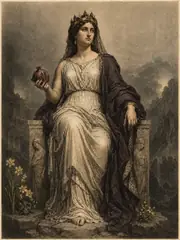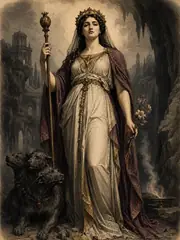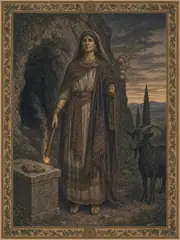
Phersipnai was the Etruscan queen of the underworld, the consort of Aita, the figure equivalent to the Greek Persephone. Her name is plainly the Etruscan adaptation of the Greek Persephone, and her cult was probably introduced together with Aita's in the Hellenizing period; whether there had been an indigenous Etruscan underworld queen before this is unknown, though some scholars have proposed candidates from older Etruscan inscriptions.
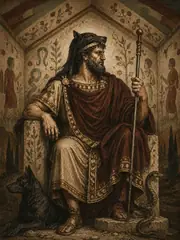
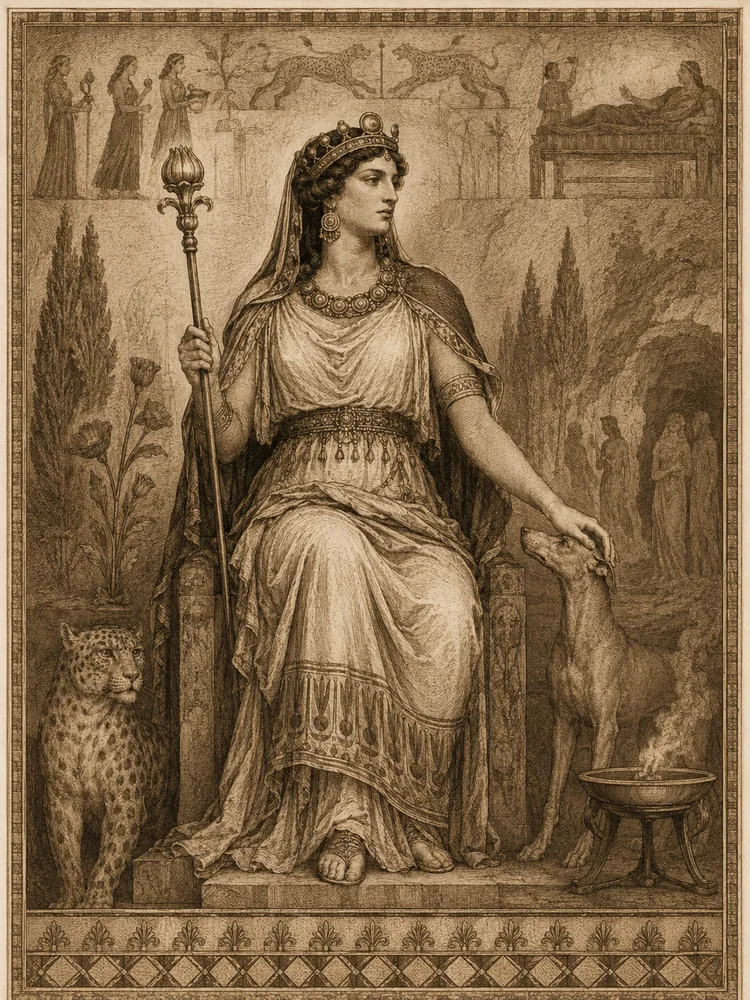
Phersipnai is depicted in the Tomba dell'Orco at Tarquinia (the same fourth-century BCE tomb that gives us the great image of Aita) as a stately seated queen, crowned and robed, her hair entwined with snakes — a distinctive feature of the Etruscan iconography that has no Greek precedent. The snake-hair connects her with the chthonic powers more directly than the Greek Persephone's iconography does, and suggests that the Etruscan tradition emphasized her terrible aspect more strongly than the Greek myth (which preserved at least the memory of her annual return to the upper world and her continuing relation with her mother Demeter).
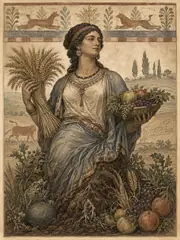
Whether the Etruscan tradition preserved the seasonal-return narrative is unclear. Some scholars have argued that the cult of Cel-Demeter and Phersipnai-Persephone formed a coherent mother-daughter pairing in Etruscan religion, parallel to the Greek; others have argued that the Etruscan emphasis was almost wholly on Phersipnai's underworld role, with the seasonal aspect either absent or much diminished. The evidence is too fragmentary to settle the question, but the Tarquinian images suggest a queen of the dead more terrible and more permanently chthonic than her Greek counterpart.
After the Romanization, Phersipnai was simply identified with Roman Proserpina, who carried into Roman religion most of the original Greek mythological apparatus. The Etruscan Phersipnai disappeared as a distinct figure, surviving only in the funerary iconography that continued to depict the snake-haired queen for some generations into the imperial period.