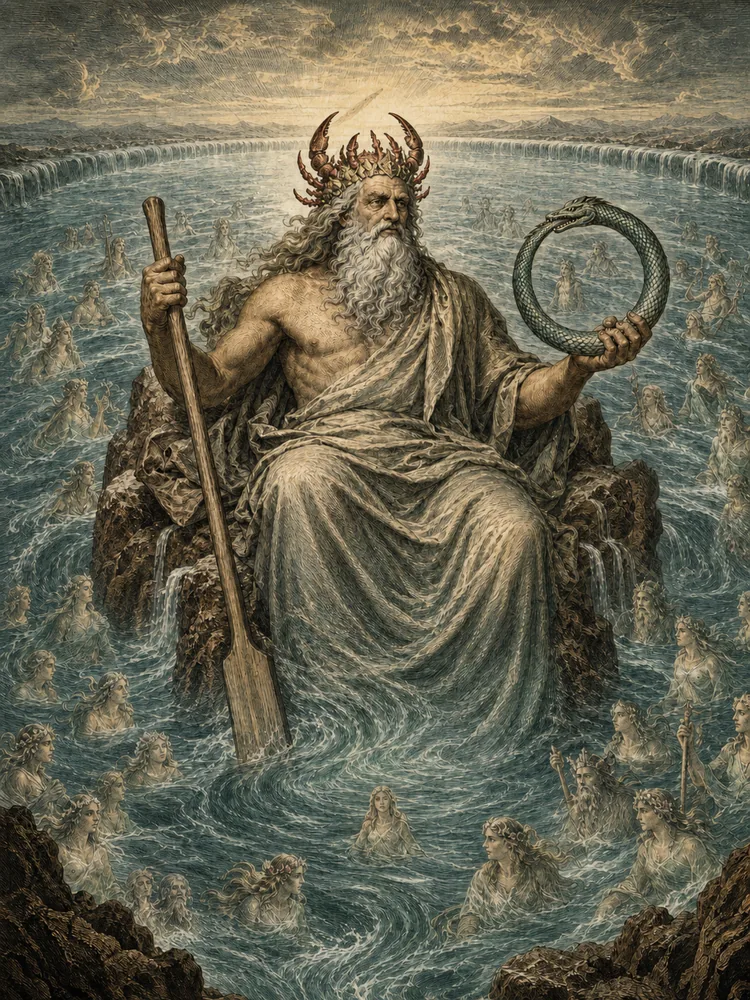
Oceanus was the eldest of the twelve Titans, the great freshwater river that was conceived by the early Greeks as encircling the entire flat disk of the earth — the world-river, beyond which lay the kingdoms of the dead and the realms of myth. He was the husband of his sister Tethys, and father by her of three thousand Oceanid nymphs (the rivers and streams of the world) and three thousand Potamoi (the river-gods). Unlike his brother Cronus, Oceanus did not join the war against the Olympians; he sat out the Titanomachy in his own waters, and in consequence was not imprisoned with the rest of the defeated, but continued to flow as the encircling river of the world. In the Iliad Homer calls him "the origin of all gods," perhaps preserving a memory of an earlier cosmogonic tradition in which Oceanus, like the Mesopotamian Apsu, was the freshwater abyss from which all things proceeded. The geographical conception of Oceanus as the encircling river was eventually replaced by the more accurate notion of a great outer sea, but the name persisted; our word "ocean" descends from his.
 Before thisRhea
 Next on the wallTethys
Curator’s note
What the sources say, and what later tradition added. The sources for this bay
Hesiod, Theogony 133, 337–370; Homer, Iliad 14.201, 246, 302. The Homeric line that calls Oceanus "origin of the gods" (theon genesis, Iliad 14.201) has been much discussed in connection with the question of pre-Hesiodic cosmogonies and possible Near Eastern parallels (the Babylonian Apsu of Enuma Elish). Oceanus had no major civic cult but was honored in coastal sanctuaries and in the libations to the rivers.
Kin in the sources
Each tie is quoted from the entry that states it.
- Consort ofTethys
He was the husband of his sister Tethys, and father by her of three thousand Oceanid nymphs
- Sibling ofTethys
He was the husband of his sister Tethys
 Sibling ofCronus
Unlike his brother Cronus, Oceanus did not join the war against the Olympians
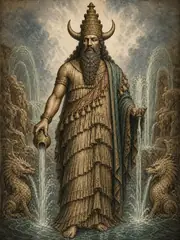 Compared withApsu
Oceanus, like the Mesopotamian Apsu, was the freshwater abyss from which all things proceeded
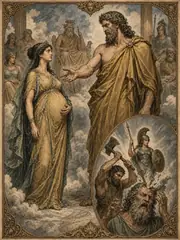 Parent ofMetis
an Oceanid, daughter of Oceanus and Tethys, and the first wife of Zeus
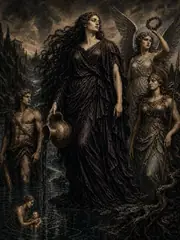 Parent ofStyx
Styx was a daughter of Oceanus and Tethys, the eldest of the three thousand Oceanids
When the sources speak
Dated witnesses for The Titans and Their Children. A date marks when the evidence was written down, not when the belief began. The whole timeline
- c. 1600–1100 BCE
- Mycenaean palace tablets in Linear B record offerings and divine names, but little continuous myth.
- c. 1100–800 BCE
- Post-palatial oral traditions and changing cult landscapes precede the surviving alphabetic epics.
- late 8th–7th centuries BCE
- The Iliad, Odyssey, Hesiodic Theogony and Works and Days give influential but non-exclusive divine orders.
- 7th–6th centuries BCE
- Homeric Hymns, lyric poetry, colonization, and local sanctuary traditions multiply regional narratives.
- 6th–5th centuries BCE
- Orphic, Pythagorean, and mystery materials develop alternative cosmogonies and afterlife doctrines.
- 5th century BCE
- Athenian tragedy and comedy recast heroic houses and divine justice for civic audiences.
- 4th century BCE
- Philosophers, antiquarians, and local historians interpret or criticize inherited myth.
- 323–31 BCE
- Hellenistic poets and scholars systematize variants across an enlarged Greek world.