A Compendium of the Ancient Gods
Metis, plate

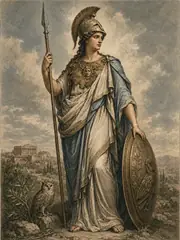
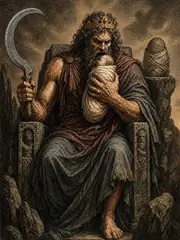
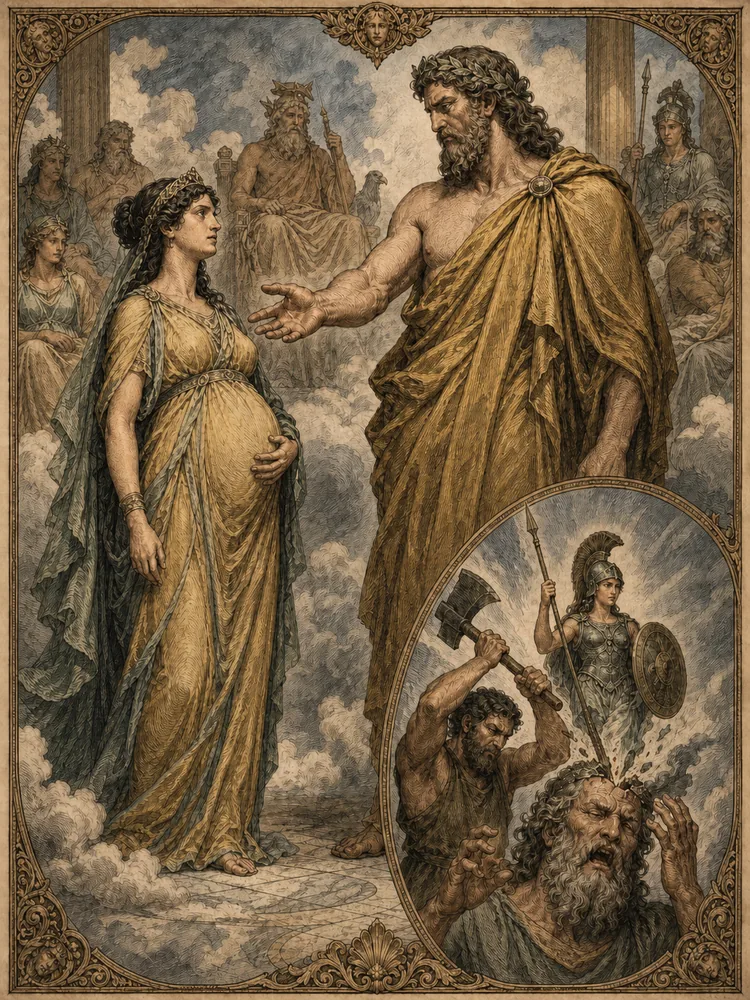
Metis ("counsel," "cunning intelligence") was an Oceanid, daughter of Oceanus and Tethys, and the first wife of Zeus. She was, in Hesiodic tradition, the wisest of all the gods and goddesses; it was Metis who gave Cronus the emetic by which he disgorged the swallowed Olympians, and so she was instrumental in the very foundation of Zeus's kingship. But it was prophesied that any child she bore would surpass its father in wisdom and might overthrow him; and Zeus, mindful of how he himself had overthrown his father, dealt with the problem by swallowing Metis whole when she was already pregnant. She continued to give him counsel from within (Zeus thereafter being the cleverest of gods, having Metis inside him); and when the time came for her child to be born, Zeus suffered such a headache that Hephaestus split his head with an axe — and Athena emerged in full armor, the daughter of Zeus and Metis, born from her father's head because her mother was already inside him.

The Metis-swallowing is one of the more striking episodes of theogonic violence in the Hesiodic tradition, and its symbolic point — that the sovereign god incorporates wisdom rather than being subject to it, and that the wise daughter Athena springs from the head of the father rather than from the womb of a separate mother — has not gone unnoticed by modern interpreters.
Curator’s note

What the sources say, and what later tradition added. The sources for this bay

Hesiod, Theogony 886–900, gives the swallowing of Metis; the birth of Athena from Zeus's head is in Hesiod (Theogony 924) and is elaborated in the Homeric Hymn to Athena 28 and in countless artistic representations from the Archaic period onward. The symbolic interpretation has been a staple of mythographic and feminist scholarship since the work of Jane Harrison.

Kin in the sources

Each tie is quoted from the entry that states it.

When the sources speak

Dated witnesses for The Titans and Their Children. A date marks when the evidence was written down, not when the belief began. The whole timeline

c. 1600–1100 BCE
Mycenaean palace tablets in Linear B record offerings and divine names, but little continuous myth.
c. 1100–800 BCE
Post-palatial oral traditions and changing cult landscapes precede the surviving alphabetic epics.
late 8th–7th centuries BCE
The Iliad, Odyssey, Hesiodic Theogony and Works and Days give influential but non-exclusive divine orders.
7th–6th centuries BCE
Homeric Hymns, lyric poetry, colonization, and local sanctuary traditions multiply regional narratives.
6th–5th centuries BCE
Orphic, Pythagorean, and mystery materials develop alternative cosmogonies and afterlife doctrines.
5th century BCE
Athenian tragedy and comedy recast heroic houses and divine justice for civic audiences.
4th century BCE
Philosophers, antiquarians, and local historians interpret or criticize inherited myth.
323–31 BCE
Hellenistic poets and scholars systematize variants across an enlarged Greek world.

Floor plan

The rooms follow one another in the order their peoples first appear in the written record.

  1. The Cradle of Citiesc. 3400 BCE to 395 CE. 115 works
  2. The Gift of the Nilec. 4000 BCE to 395 CE. 73 works
  3. The Olympian Orderc. 1600 BCE to 750 CE. 152 works
  4. The Persian Worldc. 2000 BCE to 1010 CE. 30 works
  5. The Levantine Borderlandsc. 1200 BCE to 500 CE. 20 works
  6. The Edges of Empirec. 2000 BCE to 1500 CE. 33 works
  7. The Etruscan Worldc. 900 BCE to 750 CE. 22 works
  8. The Roman Inheritancec. 1200 BCE to 500 CE. 58 works
  9. The Northern Inheritancec. 2000 BCE to 1600 CE. 131 works