A Compendium of the Ancient Gods
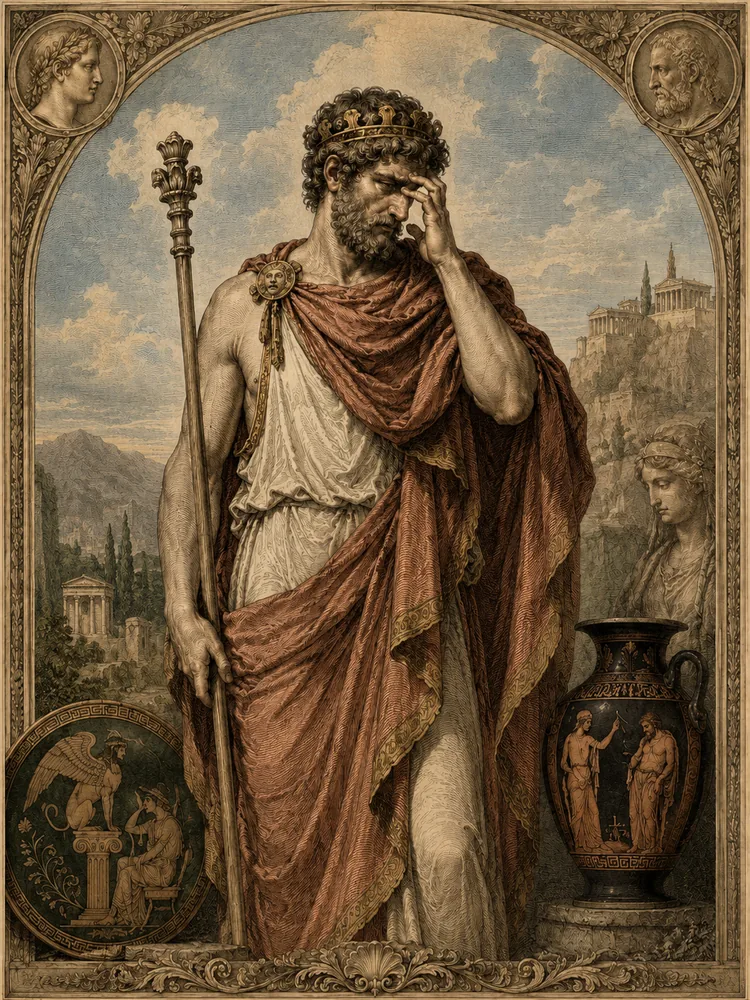
Oedipus, plate

Laius king of Thebes had been warned by the oracle of Apollo that he should beget no son, for if he did, that son would slay him. But in his cups he forgot the warning and lay with his queen Jocasta, and a child was born. Then Laius, remembering the prophecy, gave the child to a herdsman with orders to expose it on Mount Cithaeron, having first pierced its ankles with a spike — from which the child took its name, Oedipus, the Swollen-Footed. But the herdsman pitied the babe and gave it to a shepherd of King Polybus of Corinth; and the Corinthian king, who was childless, raised Oedipus as his own son.

When Oedipus was grown, he went to Delphi to inquire of the oracle concerning his birth, for there was a rumor at Corinth that he was not Polybus's son. The oracle gave him no answer to that question, but warned him that he should slay his father and lie with his mother. Believing himself a son of Polybus and Merope, Oedipus fled from Corinth that he might never see them again — and so came, by the road from Delphi to Thebes, to a place where three roads met. There he encountered an old man in a chariot who would not yield the way; they quarrelled, and Oedipus slew the old man and his attendants. The old man was Laius, his true father; the prophecy was half fulfilled.

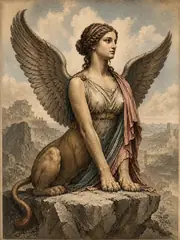
Coming on to Thebes, Oedipus found the city in distress, for the Sphinx was destroying it; he answered the riddle, freed the city, and was given the kingship and the hand of the queen, who was Jocasta his mother. Of this marriage four children were born — Eteocles, Polyneices, Antigone, and Ismene — before the truth came out. When at last a plague struck the city and the oracle declared that the killer of Laius must be expelled, Oedipus pursued the matter to its end, and by stages — the Theban herdsman, the Corinthian shepherd, the prophet Tiresias — uncovered what he had done. Jocasta hanged herself; Oedipus took her brooches from her dress and put out his own eyes, that he might never look upon what he had brought to pass.

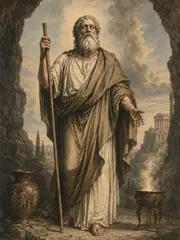
Blind, accursed, exiled by his own decree, Oedipus wandered out of Thebes leaning upon his daughter Antigone. He came at last to the grove at Colonus near Athens, sacred to the Eumenides, and there King Theseus received him; and there, after he had pronounced his blessing upon Athens and his curse upon his sons, the earth opened, and Oedipus was taken into it, and his place became a hero-shrine that the Athenians honored ever after.
Curator’s note

What the sources say, and what later tradition added. The sources for this bay

The Oedipus legend is told most fully in the two great tragedies of Sophocles, Oedipus Tyrannus (c. 429 BCE) and Oedipus at Colonus (composed in his old age, produced posthumously in 401), with the third play of the cycle, Antigone, completing the family's history. The story is older than these — it is alluded to in Iliad 23.679-680 and Odyssey 11.271-280, and was the subject of a lost epic, the Oedipodea, of the early seventh century. Pseudo-Apollodorus (Bibliotheca 3.5.7-9) and Diodorus Siculus (4.64) preserve the basic narrative. The hero-cult of Oedipus at Colonus, where his tomb was a real cult-place, is well-attested archaeologically. The Sphinx's riddle — 'what walks on four legs in the morning, two at noon, three at evening?' — is preserved by Pseudo-Apollodorus (3.5.8) and is the locus classicus of the riddle as literary form.

Kin in the sources

Each tie is quoted from the entry that states it.

When the sources speak

Dated witnesses for The Heroic Cycle and the Tragic Houses. A date marks when the evidence was written down, not when the belief began. The whole timeline

c. 1600–1100 BCE
Mycenaean palace tablets in Linear B record offerings and divine names, but little continuous myth.
c. 1100–800 BCE
Post-palatial oral traditions and changing cult landscapes precede the surviving alphabetic epics.
late 8th–7th centuries BCE
The Iliad, Odyssey, Hesiodic Theogony and Works and Days give influential but non-exclusive divine orders.
7th–6th centuries BCE
Homeric Hymns, lyric poetry, colonization, and local sanctuary traditions multiply regional narratives.
6th–5th centuries BCE
Orphic, Pythagorean, and mystery materials develop alternative cosmogonies and afterlife doctrines.
5th century BCE
Athenian tragedy and comedy recast heroic houses and divine justice for civic audiences.
4th century BCE
Philosophers, antiquarians, and local historians interpret or criticize inherited myth.
323–31 BCE
Hellenistic poets and scholars systematize variants across an enlarged Greek world.

Floor plan

The rooms follow one another in the order their peoples first appear in the written record.

  1. The Cradle of Citiesc. 3400 BCE to 395 CE. 115 works
  2. The Gift of the Nilec. 4000 BCE to 395 CE. 73 works
  3. The Olympian Orderc. 1600 BCE to 750 CE. 152 works
  4. The Persian Worldc. 2000 BCE to 1010 CE. 30 works
  5. The Levantine Borderlandsc. 1200 BCE to 500 CE. 20 works
  6. The Edges of Empirec. 2000 BCE to 1500 CE. 33 works
  7. The Etruscan Worldc. 900 BCE to 750 CE. 22 works
  8. The Roman Inheritancec. 1200 BCE to 500 CE. 58 works
  9. The Northern Inheritancec. 2000 BCE to 1600 CE. 131 works