Orpheus was the supreme singer of Greek mythology, whose music could charm not only men and animals but trees and stones, the rivers in their flow, and at last even the powers of the underworld. He was a son of Apollo (or, in some accounts, of the river-god Oeagrus) by the Muse Calliope; from his divine mother he had his music. He sailed with Jason on the Argo and saved the Argonauts from various perils — out-singing the Sirens so that the crew passed unharmed, calming the clashing waves, soothing the dragon at Colchis. After the voyage he settled in Thrace and married the nymph Eurydice.
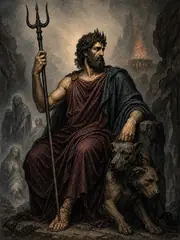
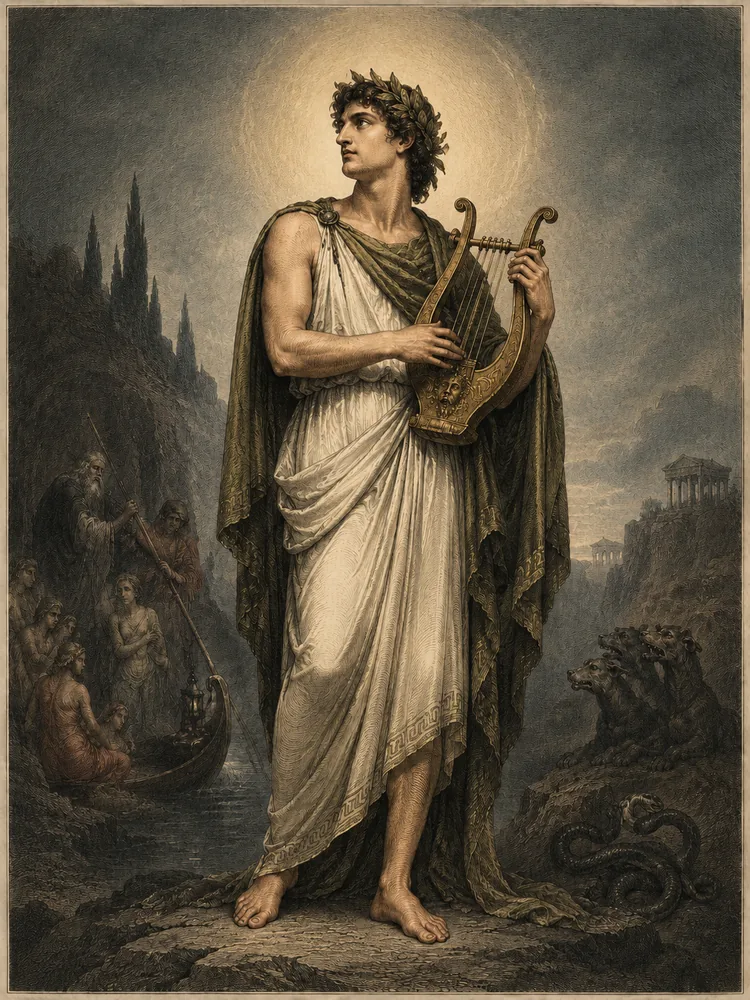
The narrative for which he is most famous, however, is the descent into the underworld. Eurydice, fleeing the unwanted advances of Aristaeus (a son of Apollo and a beekeeper), was bitten in the foot by a serpent and died. Orpheus, inconsolable, descended to Hades to recover her. His music charmed Charon into ferrying him living across the Styx; it lulled Cerberus to sleep at the gates; it suspended the eternal punishments of Tartarus (Sisyphus rested upon his stone, Tantalus forgot his thirst, Ixion's wheel ceased turning, the daughters of Danaus paused in their endless filling of leaking jars); it drew tears from the very Furies. Hades and Persephone consented to release Eurydice on a single condition: Orpheus must not look back at her as he led her up to the world above, until both had reached the daylight. He led her up the long ascent; he heard her footsteps behind him; the silence of the dead, and his own anxious longing, and at last he could not bear it; just at the threshold of light, he turned to see if she was indeed following — and she was, but the condition was broken, and she slipped back into the underworld with a faint farewell, lost forever.
Orpheus thereafter wandered Thrace inconsolable, refusing to take any other woman. The Maenads of Dionysus, in some versions enraged at his neglect of their god (he having become exclusively a worshiper of Apollo), in others simply maddened by his rejection of their advances, fell upon him at last in their bacchic frenzy and tore him to pieces. His head, severed but still singing, floated down the river Hebrus and across the sea to the island of Lesbos, where it was buried in a cave and continued to give oracles for some years afterwards. His lyre was placed in the heavens as the constellation Lyra.
Orpheus was, in the Greek world, more than a mythological character. He was the supposed founder of a body of religious literature (the Orphic poems and theogonies) that constituted an alternative to the Hesiodic mainstream, with their cosmic egg, their Phanes, their elaborate cosmogonies, their teaching of the soul's pre-existence and reincarnation, their rituals of purification and initiation. The Orphic mysteries, distinct from but overlapping with the Eleusinian and the Bacchic, had their adherents from the sixth century BCE onward; the Orphic gold tablets (small inscribed leaves, found in tombs in southern Italy and Crete from the fifth century BCE) preserve fragments of Orphic eschatology and instruction for the soul. The historical Orpheus was probably a Thracian shamanic figure whose name became attached to the religious literature; the mythological Orpheus is the singer of the underworld-descent, an emblem of the artist's power and the artist's loss.