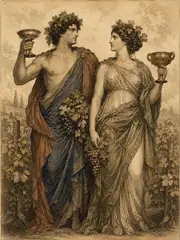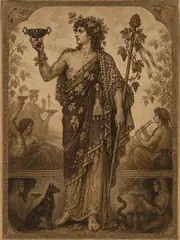
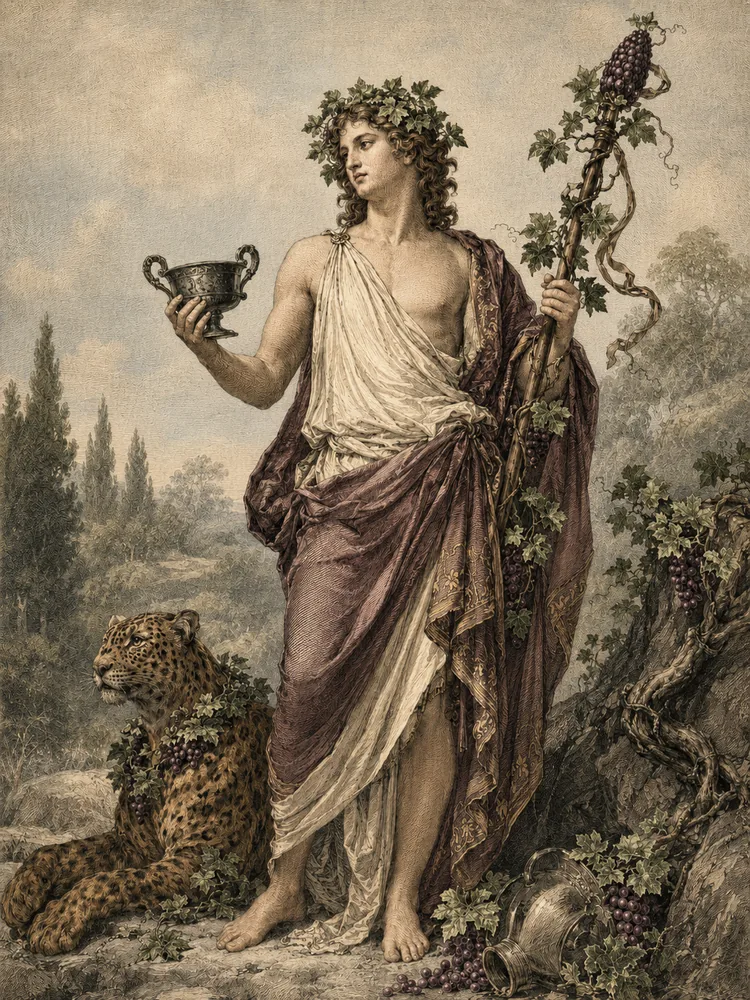
Dionysus was the god of wine, of vegetation (especially of the vine and the ivy), of ritual madness, of theatrical performance, of the dissolution of the boundaries of self and society in the ecstatic ritual that his cult demanded. He was a son of Zeus, but his maternal origins were unusual. His mother was the mortal Theban princess Semele, granddaughter of Cadmus; loved by Zeus, she was tricked by Hera (in disguise) into demanding that her divine lover appear to her in his full glory. Zeus, having promised by the unbreakable oath of the Styx, was constrained to comply; but mortal flesh cannot survive the unmediated brilliance of divinity, and Semele was incinerated. Zeus, however, snatched the unborn Dionysus from her dying body and sewed him into his own thigh, where the child was carried to term and brought forth — "twice-born," as his epithets describe him.
He was raised in secret (Hera's wrath being still active) by the nymphs of Mount Nysa, and at maturity he wandered the earth from Asia to Greece, teaching the cultivation of the vine and the rites of his cult. Where he was received with reverence, the country flourished and his ecstatic rites brought blessing; where he was rejected, his vengeance was terrible. The most famous instance is the case of Pentheus, king of Thebes, who refused to acknowledge his cousin's divinity and forbade the women of his city to participate in the rites; the women of Thebes nevertheless went out into the wilderness to celebrate, and the king who came spying upon them was torn to pieces by his own mother and aunts in their bacchic frenzy, mistaking him for a wild beast — the matter of Euripides's Bacchae, the supreme dramatic statement of the cult. Similar fates befell other resistors: King Lycurgus of Thrace, who attacked the god's nurses, was driven mad and tore apart his own son with an axe, mistaking him for a vine; the daughters of Minyas at Orchomenus refused to attend the rites and were transformed into bats.
Dionysus's cult was distinctive among Greek cults for its ecstatic dimension. His female devotees, the Maenads or Bacchae, processed into the wilderness in seasonal nighttime rites, dressed in fawnskins, crowned with ivy, carrying the thyrsus (a wand topped with a pine-cone), suckled wild fawns and wolves at their breasts, tore living animals apart with their bare hands and ate them raw (the rite of sparagmos and omophagia), and danced themselves into frenzy. His male initiates participated in his theatrical festivals, particularly the Great Dionysia at Athens, where the great tragic and comic competitions were held in his honor — for the Greek theater, in its origins and in its institutional setting, was a department of the Dionysian cult, and Aeschylus, Sophocles, Euripides, and Aristophanes wrote their works for performance at the god's festival.
He was, in late tradition, sometimes counted among the Twelve Olympians (replacing Hestia in the late canon); in older listings he was not, partly because of his late arrival on Olympus (he was admitted relatively late in the divine succession, after he had restored his mother Semele from the underworld and translated her under the name Thyone to a place among the gods) and partly because his cult was always somewhat at a slant from the proper Olympic register, with its emphasis on the dissolution rather than the maintenance of order. His Roman counterpart Bacchus (also called Liber) preserved his wine-and-ecstasy associations; the suppression of the Bacchanalia at Rome in 186 BCE is among the more striking moments of Roman religious history.