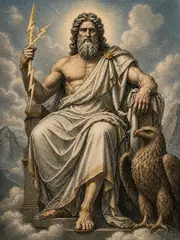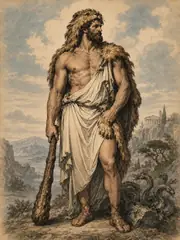
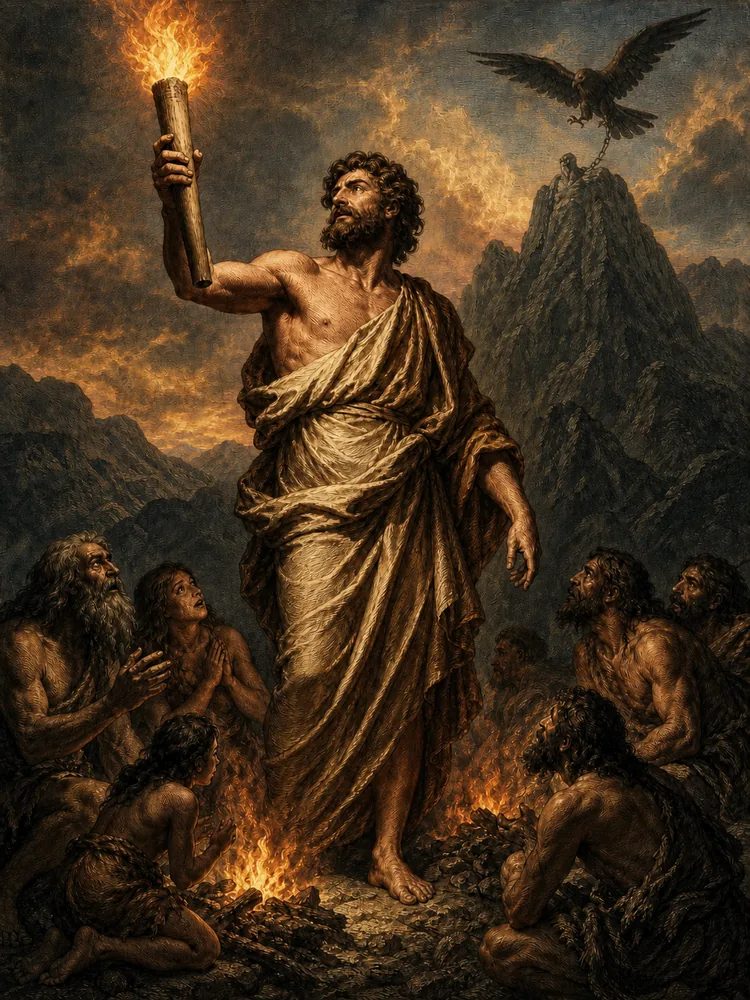

Prometheus, whose name signified "forethought," was a Titan of the second generation, son of Iapetus and the Oceanid Clymene, brother of Atlas and Epimetheus. He was the great benefactor of mankind in Greek myth, the Titan who, when Zeus had withdrawn fire from human beings as a punishment, stole it back from the gods (concealed in the hollow stalk of a fennel) and brought it down to the human race. Zeus's vengeance was twofold. Against mankind he sent the first woman, Pandora, fashioned by Hephaestus and gifted by all the gods, to bring with her the jar of evils (curiosity opening it, all the world's troubles flying out, only Hope remaining within when she shut it again). Against Prometheus himself Zeus contrived a torment of cosmic scope: the Titan was bound to a crag in the Caucasus mountains, where each day an eagle came and tore out his liver, which grew back each night, that the torture might be renewed. The torment lasted for many ages — by some accounts thirty thousand years — until at length Heracles, on his way to one of his labors, shot the eagle and freed the Titan with Zeus's tacit consent.
Beyond the fire-theft, Prometheus had two other notable deeds. Earlier, when the gods and mortals were to apportion the parts of the sacrificial ox, Prometheus tricked Zeus into choosing the worse share — wrapping the bones in attractive fat, the meat in unappealing entrails — so that thereafter the gods received only the bones and fat (the smoke of which rose to them), while mortals kept the meat. And — most significantly in some traditions — Prometheus was held to be the actual creator of the human race, whom he had fashioned from clay (with Athena breathing life into them, in the older version; in some Hellenistic versions, with the soul-fire that he had stolen from heaven). Whether or not he was their maker, he was throughout their patron; the Athenians honored him as the patron of potters (whose art required fire) and held a torch-race in his honor at the Promethea festival.