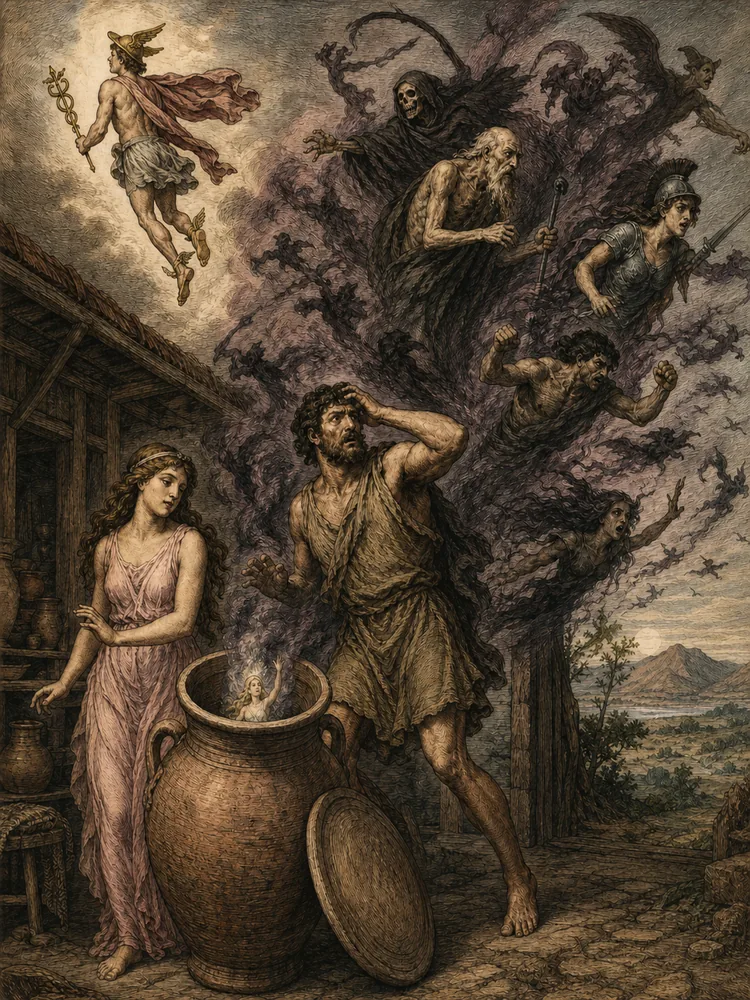
Epimetheus was the brother of Prometheus, and his name ("afterthought") was set in deliberate antithesis to his brother's: where Prometheus thought ahead, Epimetheus thought too late. To him, in the standard tradition, was given the task of distributing capacities among the animals; he distributed swiftness to the deer, claws to the cat, scales to the fish, fur to the bear, and so on through all the species, until — having forgotten that he was meant to leave something for mankind — he found at the end nothing left to give, and man was left bare and unprotected; whereupon Prometheus, to remedy his brother's improvidence, stole fire from heaven to give man the only protection that remained available. And it was Epimetheus who, despite his brother's warnings, accepted the gift of Pandora when Hermes brought her to him; he took her to wife, and her jar's evils were thereby loosed upon the world. The Epimethean fault was the failure of foresight — and the Greek tongue gave to the whole tribe of unwise rashness the figure of Epimetheus as its emblem.
 Before thisPrometheus
 Next on the wallAtlas
Curator’s note
What the sources say, and what later tradition added. The sources for this bay
Hesiod, Works and Days 83–89 (Pandora's reception); Plato, Protagoras 320d–321e (the distribution of capacities). The Platonic myth in the Protagoras is the classical statement of the Epimethean role; Hesiod gives only the Pandora episode in any detail.
Kin in the sources
Each tie is quoted from the entry that states it.
- Sibling ofPrometheus
Epimetheus was the brother of Prometheus
- Sibling ofAtlas
son of Iapetus and Clymene, brother of Prometheus and Epimetheus
 Child ofIapetus
Prometheus the over-cunning, and Epimetheus the under-cunning
When the sources speak
Dated witnesses for The Titans and Their Children. A date marks when the evidence was written down, not when the belief began. The whole timeline
- c. 1600–1100 BCE
- Mycenaean palace tablets in Linear B record offerings and divine names, but little continuous myth.
- c. 1100–800 BCE
- Post-palatial oral traditions and changing cult landscapes precede the surviving alphabetic epics.
- late 8th–7th centuries BCE
- The Iliad, Odyssey, Hesiodic Theogony and Works and Days give influential but non-exclusive divine orders.
- 7th–6th centuries BCE
- Homeric Hymns, lyric poetry, colonization, and local sanctuary traditions multiply regional narratives.
- 6th–5th centuries BCE
- Orphic, Pythagorean, and mystery materials develop alternative cosmogonies and afterlife doctrines.
- 5th century BCE
- Athenian tragedy and comedy recast heroic houses and divine justice for civic audiences.
- 4th century BCE
- Philosophers, antiquarians, and local historians interpret or criticize inherited myth.
- 323–31 BCE
- Hellenistic poets and scholars systematize variants across an enlarged Greek world.