A Compendium of the Ancient Gods
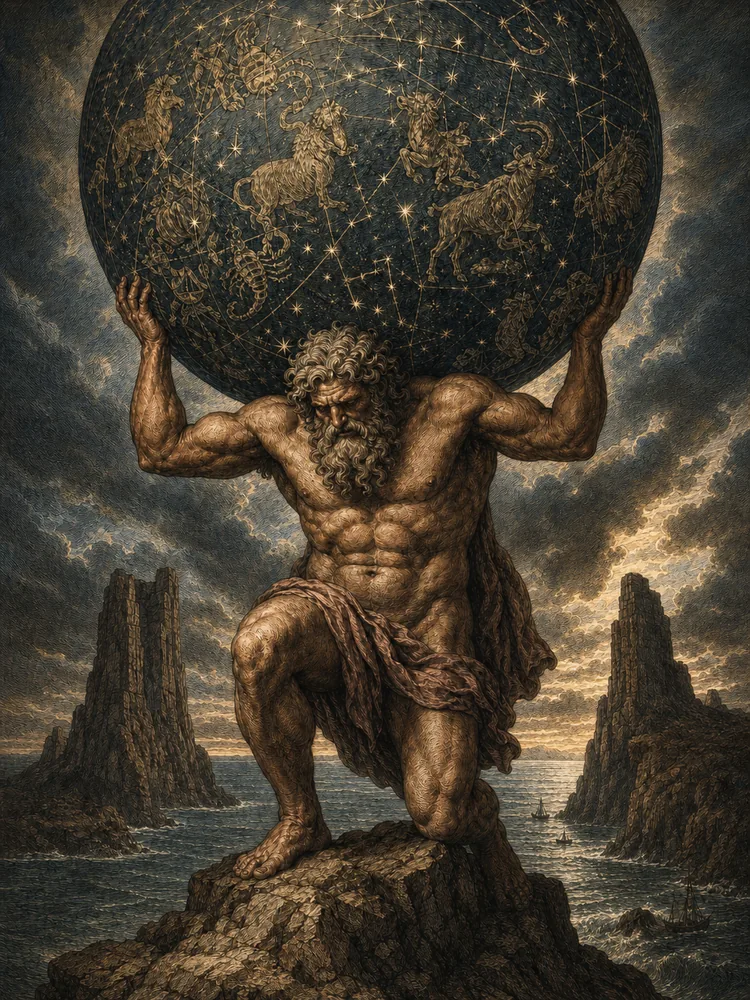
Atlas, plate

Atlas was a Titan of the second generation, son of Iapetus and Clymene, brother of Prometheus and Epimetheus. After the Titanomachy, Zeus sentenced him — for he had been a leader on the Titans' side — to bear the heavens upon his shoulders forever. He stood at the western edge of the world, where the sun set into the Ocean, and held up the firmament; his name became attached to the great mountain-range of northwestern Africa (the modern Atlas Mountains), and from there in modern times to the volume of geographical maps that bear his image on their frontispiece — a use that goes back to Mercator's collection of 1595, on whose cover Atlas was depicted holding the world.

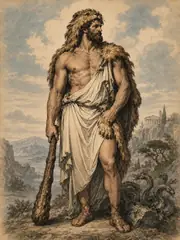
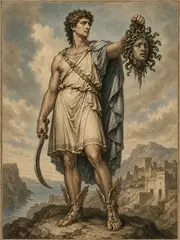
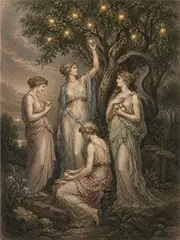
The principal narrative-episode involving Atlas is his encounter with Heracles, who came to him in the course of one of his labors (the eleventh, the apples of the Hesperides). Heracles offered to take up the burden of the heavens for a moment if Atlas would fetch the golden apples from the garden where his daughters the Hesperides kept them. Atlas, glad of any respite, agreed, and went off to fetch the apples; when he returned with them, he proposed to leave Heracles bearing the sky permanently while he himself delivered the apples to Eurystheus. Heracles, anticipating this, asked only that Atlas resume the burden for a moment that he might adjust his cloak as a cushion; Atlas obliged, took up the heavens again — and Heracles seized the apples and departed. Atlas was thus left bearing the sky for eternity, except in the Perseus-and-Medusa episode, in which the hero used Medusa's head to turn him to stone, becoming thereby the petrified Atlas Mountain (a different version, harder to harmonize with the Heracles narrative).
Curator’s note

What the sources say, and what later tradition added. The sources for this bay

Hesiod, Theogony 517–520 (Atlas's punishment); Apollodorus 2.5.11 (the Heracles encounter); Ovid, Metamorphoses 4.624–662 (the Perseus encounter and petrification). The two accounts of how Atlas came to be the mountain (Heraclean trick versus Perseus's Medusa-petrification) are inconsistent and reflect different traditions; the harmonization of them is awkward and was already noted as a difficulty in antiquity.

Kin in the sources

Each tie is quoted from the entry that states it.

When the sources speak

Dated witnesses for The Titans and Their Children. A date marks when the evidence was written down, not when the belief began. The whole timeline

c. 1600–1100 BCE
Mycenaean palace tablets in Linear B record offerings and divine names, but little continuous myth.
c. 1100–800 BCE
Post-palatial oral traditions and changing cult landscapes precede the surviving alphabetic epics.
late 8th–7th centuries BCE
The Iliad, Odyssey, Hesiodic Theogony and Works and Days give influential but non-exclusive divine orders.
7th–6th centuries BCE
Homeric Hymns, lyric poetry, colonization, and local sanctuary traditions multiply regional narratives.
6th–5th centuries BCE
Orphic, Pythagorean, and mystery materials develop alternative cosmogonies and afterlife doctrines.
5th century BCE
Athenian tragedy and comedy recast heroic houses and divine justice for civic audiences.
4th century BCE
Philosophers, antiquarians, and local historians interpret or criticize inherited myth.
323–31 BCE
Hellenistic poets and scholars systematize variants across an enlarged Greek world.

Floor plan

The rooms follow one another in the order their peoples first appear in the written record.

  1. The Cradle of Citiesc. 3400 BCE to 395 CE. 115 works
  2. The Gift of the Nilec. 4000 BCE to 395 CE. 73 works
  3. The Olympian Orderc. 1600 BCE to 750 CE. 152 works
  4. The Persian Worldc. 2000 BCE to 1010 CE. 30 works
  5. The Levantine Borderlandsc. 1200 BCE to 500 CE. 20 works
  6. The Edges of Empirec. 2000 BCE to 1500 CE. 33 works
  7. The Etruscan Worldc. 900 BCE to 750 CE. 22 works
  8. The Roman Inheritancec. 1200 BCE to 500 CE. 58 works
  9. The Northern Inheritancec. 2000 BCE to 1600 CE. 131 works