A Compendium of the Ancient Gods
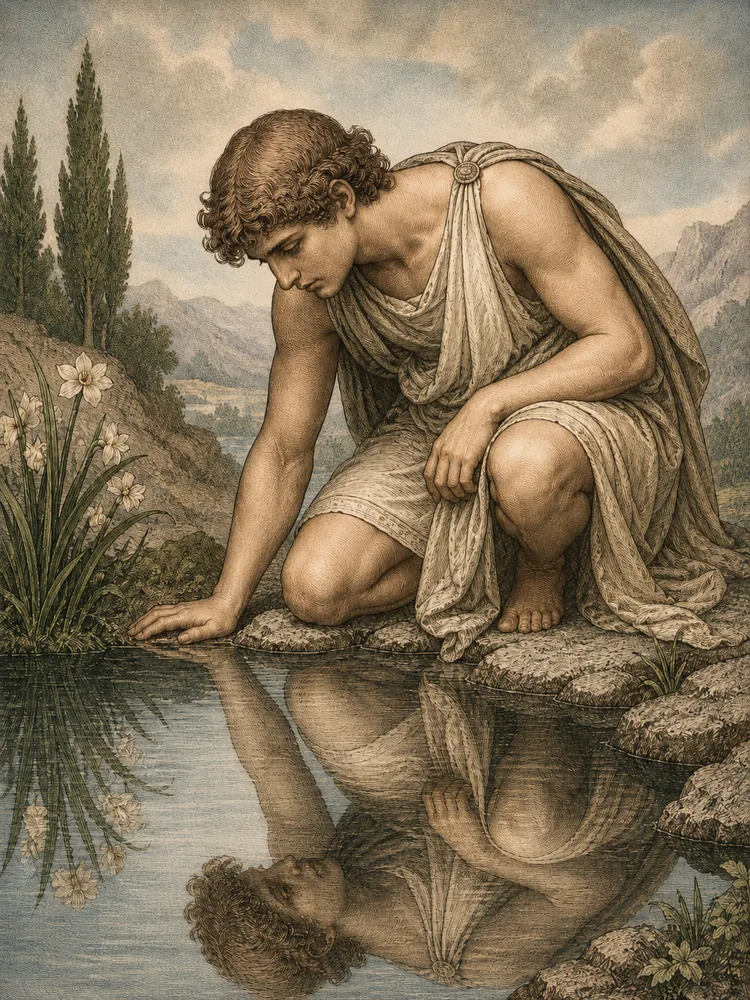
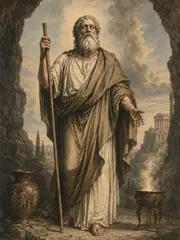
Narcissus, plate

Liriope the river-nymph bore a son to the river-god Cephissus, and she named him Narcissus; and going to the seer Tiresias she asked whether the child would live to a long age. Tiresias answered her with the strange words: "He shall, if he never comes to know himself." And so it proved.

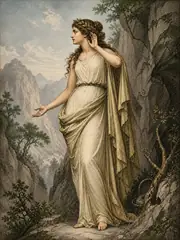
Narcissus grew into a youth of surpassing beauty, who scorned all who loved him — boys and girls of his own age, the nymphs of the woods, even Echo who could only echo back his own voice. One youth whom he had spurned cried out to heaven, "Let him love thus, and not obtain the thing he loves!" — and Nemesis heard the prayer.

It happened that Narcissus, weary from hunting, came to a clear pool in a hidden glade, where neither shepherd nor goat had ever come, and where the surface of the water was undisturbed; and he knelt to drink, and saw his reflection in the water, and was struck with a love such as he had given to no other. He could not understand that what he saw was himself, and he reached for it and embraced the water and could not grasp it; and he stayed there beside the pool, refusing to eat or sleep, gazing at the image he could not reach, until at last he understood — and his understanding was his death.

He pined away there beside the pool, and when his sisters the dryads came to mourn him, they could not find his body; in its place there grew the flower we call narcissus, the white flower with the yellow heart, which bends its head toward the surface of any nearby water as if still gazing into it.
Curator’s note

What the sources say, and what later tradition added. The sources for this bay

The Narcissus myth is preserved fullest in Ovid (Metamorphoses 3.339-510), where it is woven together with Echo's story. A different and probably older version is given in a fragmentary papyrus from Oxyrhynchus published in 2004 (P.Oxy. 4711), in which the story is set at Thespiae in Boeotia and Narcissus, falling in love with himself and failing to obtain himself, kills himself with a sword; the flower springs from his blood. Pausanias (9.31.7-8) records the Boeotian local tradition and gives a rationalizing variant in which Narcissus had a twin sister whose death he mourned at the pool. Conon (Narrationes 24) preserves the suicide-and-flower version. The flower itself was sacred to the chthonic powers — Persephone was gathering narcissus when Hades seized her — and the whole story stands at the intersection of vegetation-myth and moral fable.

Kin in the sources

Each tie is quoted from the entry that states it.

When the sources speak

Dated witnesses for The Sea, the Wild and the Wind. A date marks when the evidence was written down, not when the belief began. The whole timeline

c. 1600–1100 BCE
Mycenaean palace tablets in Linear B record offerings and divine names, but little continuous myth.
c. 1100–800 BCE
Post-palatial oral traditions and changing cult landscapes precede the surviving alphabetic epics.
late 8th–7th centuries BCE
The Iliad, Odyssey, Hesiodic Theogony and Works and Days give influential but non-exclusive divine orders.
7th–6th centuries BCE
Homeric Hymns, lyric poetry, colonization, and local sanctuary traditions multiply regional narratives.
6th–5th centuries BCE
Orphic, Pythagorean, and mystery materials develop alternative cosmogonies and afterlife doctrines.
5th century BCE
Athenian tragedy and comedy recast heroic houses and divine justice for civic audiences.
4th century BCE
Philosophers, antiquarians, and local historians interpret or criticize inherited myth.
323–31 BCE
Hellenistic poets and scholars systematize variants across an enlarged Greek world.

Floor plan

The rooms follow one another in the order their peoples first appear in the written record.

  1. The Cradle of Citiesc. 3400 BCE to 395 CE. 115 works
  2. The Gift of the Nilec. 4000 BCE to 395 CE. 73 works
  3. The Olympian Orderc. 1600 BCE to 750 CE. 152 works
  4. The Persian Worldc. 2000 BCE to 1010 CE. 30 works
  5. The Levantine Borderlandsc. 1200 BCE to 500 CE. 20 works
  6. The Edges of Empirec. 2000 BCE to 1500 CE. 33 works
  7. The Etruscan Worldc. 900 BCE to 750 CE. 22 works
  8. The Roman Inheritancec. 1200 BCE to 500 CE. 58 works
  9. The Northern Inheritancec. 2000 BCE to 1600 CE. 131 works