A Compendium of the Ancient Gods
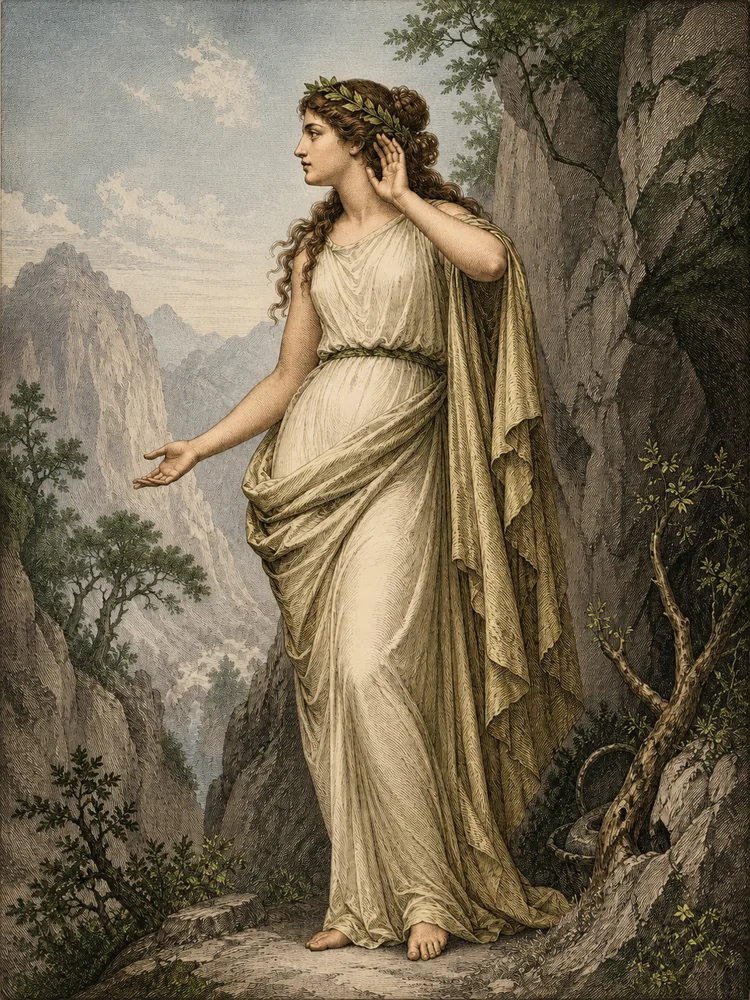
Echo, plate

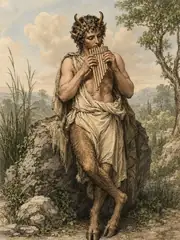
Echo was a mountain nymph of Boeotia, in Hera's company, and she had a chattering tongue and a love of the last word. Now Zeus had taken to wandering on the mountainside to dally with the other nymphs, and Echo would draw Hera aside with long stories and bright conversation while the others hid themselves; until at length Hera discovered the trick, and laid upon Echo this curse: that she should never again speak first, but should be condemned to repeat only the last words of others.

It happened then that Echo saw the youth Narcissus walking in the woods, and was struck with love for him; but she could not call to him, nor declare herself, but only repeat the last words he spoke. When at length she came forth and tried to embrace him, he thrust her away with disdain, saying "I would die before you should have me"; and she, wasting in her grief, withdrew into the rocks and the lonely places, until her body wasted away and only her voice remained. So she lives still — in caves, in cliffs, in the hollows of valleys — repeating what she hears, but unable to speak first or to say what she would.
Curator’s note

What the sources say, and what later tradition added. The sources for this bay

The Echo and Narcissus tale is preserved chiefly in Ovid (Metamorphoses 3.339-510), which is our most extensive narrative; a separate version, in which Echo is loved by Pan rather than Narcissus, is given by Longus (Daphnis and Chloe 3.23). The cursing of Echo by Hera and her transformation into a disembodied voice are Ovid's contribution, but the figure of Echo as a mountain nymph is older and appears in Greek lyric. Pausanias (9.31.7) records a cult of Echo in Boeotia. The pairing of Echo with Narcissus, both wasting away from love that cannot be answered — she for the body without the voice, he for the voice without the body — is one of Ovid's most concentrated mythological inventions.

Kin in the sources

Each tie is quoted from the entry that states it.

When the sources speak

Dated witnesses for The Sea, the Wild and the Wind. A date marks when the evidence was written down, not when the belief began. The whole timeline

c. 1600–1100 BCE
Mycenaean palace tablets in Linear B record offerings and divine names, but little continuous myth.
c. 1100–800 BCE
Post-palatial oral traditions and changing cult landscapes precede the surviving alphabetic epics.
late 8th–7th centuries BCE
The Iliad, Odyssey, Hesiodic Theogony and Works and Days give influential but non-exclusive divine orders.
7th–6th centuries BCE
Homeric Hymns, lyric poetry, colonization, and local sanctuary traditions multiply regional narratives.
6th–5th centuries BCE
Orphic, Pythagorean, and mystery materials develop alternative cosmogonies and afterlife doctrines.
5th century BCE
Athenian tragedy and comedy recast heroic houses and divine justice for civic audiences.
4th century BCE
Philosophers, antiquarians, and local historians interpret or criticize inherited myth.
323–31 BCE
Hellenistic poets and scholars systematize variants across an enlarged Greek world.

Floor plan

The rooms follow one another in the order their peoples first appear in the written record.

  1. The Cradle of Citiesc. 3400 BCE to 395 CE. 115 works
  2. The Gift of the Nilec. 4000 BCE to 395 CE. 73 works
  3. The Olympian Orderc. 1600 BCE to 750 CE. 152 works
  4. The Persian Worldc. 2000 BCE to 1010 CE. 30 works
  5. The Levantine Borderlandsc. 1200 BCE to 500 CE. 20 works
  6. The Edges of Empirec. 2000 BCE to 1500 CE. 33 works
  7. The Etruscan Worldc. 900 BCE to 750 CE. 22 works
  8. The Roman Inheritancec. 1200 BCE to 500 CE. 58 works
  9. The Northern Inheritancec. 2000 BCE to 1600 CE. 131 works