A Compendium of the Ancient Gods
Hyacinthus, plate

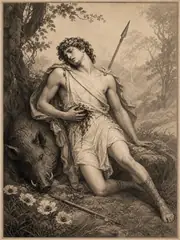
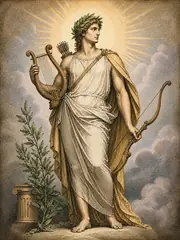
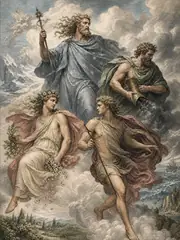
There was at Amyclae, near Sparta, a youth named Hyacinthus, the son of King Amyclas — exceedingly fair, beloved by Apollo, and beloved also (the older traditions say) by the singer Thamyris and by the West Wind Zephyrus. Apollo would come down from Delphi to spend his days with the youth, hunting in the Laconian hills and contesting in the games at which Hyacinthus excelled.

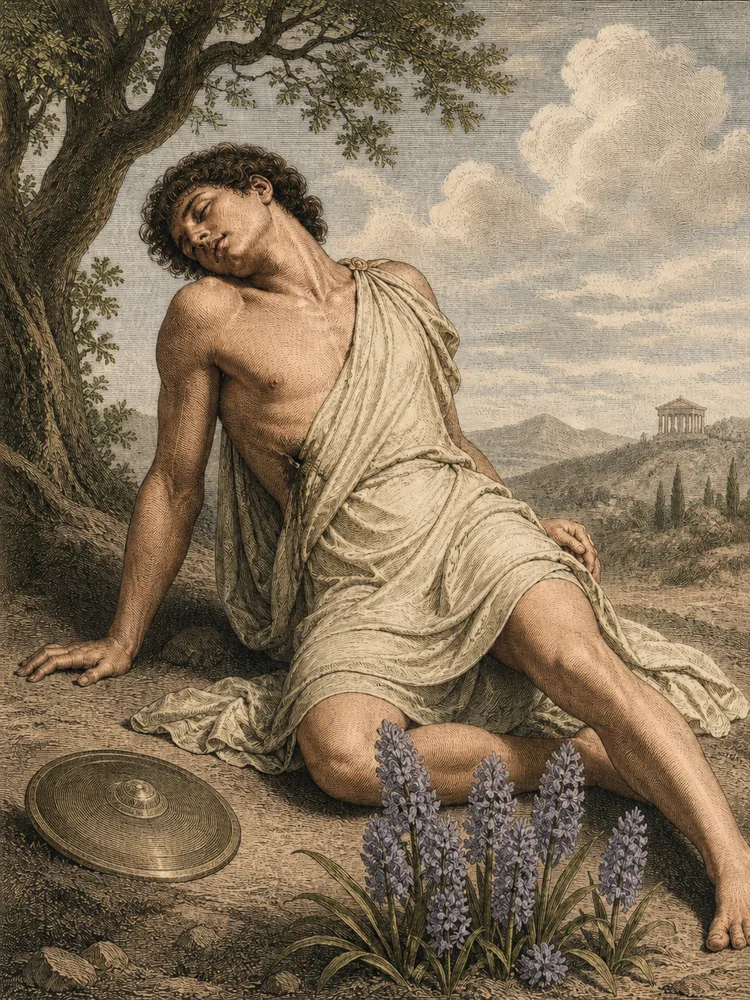
One day the two were throwing the discus, and Apollo cast first; the bronze rose high and arced toward Hyacinthus, who ran forward to take his turn. But Zephyrus the West Wind, jealous that Apollo should have the boy's love, blew upon the discus as it descended, and turned it from its course; and it struck Hyacinthus full upon the temple. The youth fell, and the god caught him in his arms; but no medicine of Apollo's, who is the lord of healing, could close the wound. Hyacinthus died there beside the river Eurotas, and from the blood that fell upon the grass there sprang up a flower, marked upon its petals with the letters AI, AI, the Greek cry of mourning — and this was the hyacinth, which the Greeks named for him.

The Spartans observed every year the Hyacinthia, a three-day festival at Amyclae which combined mourning for the youth and celebration of Apollo, and which was so important to the Spartan calendar that even on campaign their armies would withdraw to keep it. The throne of Apollo at Amyclae, the great work of Bathycles of Magnesia in the sixth century before our era, was supported upon an altar that was at the same time the tomb of Hyacinthus; and Pausanias, who saw it, has preserved a detailed description.
Curator’s note

What the sources say, and what later tradition added. The sources for this bay

The Hyacinthus story is told in Ovid (Metamorphoses 10.162-219), Pseudo-Apollodorus (Bibliotheca 1.3.3 and 3.10.3), and Pausanias (3.1.3, 3.19.4-5 — the description of the throne at Amyclae). The Hyacinthia festival is discussed by Herodotus (9.7), Xenophon (Hellenica 4.5.11), and the late lexicographers; modern scholarship (Pettersson 1992) has clarified its Bronze Age origins. The flower we call hyacinth is not the modern bulb of that name but probably an iris or larkspur, on whose petals the Greeks read the marks AIAI; the issue was disputed already in antiquity. The name Hyacinthus is pre-Greek — the -nthos suffix marks it, like Corinth and Tiryns, as a relic of the language spoken in the peninsula before the coming of the Greeks — and the youth himself was probably an aboriginal vegetation deity, displaced into mythology when his cult was overlaid by that of the new god Apollo.

Kin in the sources

Each tie is quoted from the entry that states it.

When the sources speak

Dated witnesses for The Sea, the Wild and the Wind. A date marks when the evidence was written down, not when the belief began. The whole timeline

c. 1600–1100 BCE
Mycenaean palace tablets in Linear B record offerings and divine names, but little continuous myth.
c. 1100–800 BCE
Post-palatial oral traditions and changing cult landscapes precede the surviving alphabetic epics.
late 8th–7th centuries BCE
The Iliad, Odyssey, Hesiodic Theogony and Works and Days give influential but non-exclusive divine orders.
7th–6th centuries BCE
Homeric Hymns, lyric poetry, colonization, and local sanctuary traditions multiply regional narratives.
6th–5th centuries BCE
Orphic, Pythagorean, and mystery materials develop alternative cosmogonies and afterlife doctrines.
5th century BCE
Athenian tragedy and comedy recast heroic houses and divine justice for civic audiences.
4th century BCE
Philosophers, antiquarians, and local historians interpret or criticize inherited myth.
323–31 BCE
Hellenistic poets and scholars systematize variants across an enlarged Greek world.

Floor plan

The rooms follow one another in the order their peoples first appear in the written record.

  1. The Cradle of Citiesc. 3400 BCE to 395 CE. 115 works
  2. The Gift of the Nilec. 4000 BCE to 395 CE. 73 works
  3. The Olympian Orderc. 1600 BCE to 750 CE. 152 works
  4. The Persian Worldc. 2000 BCE to 1010 CE. 30 works
  5. The Levantine Borderlandsc. 1200 BCE to 500 CE. 20 works
  6. The Edges of Empirec. 2000 BCE to 1500 CE. 33 works
  7. The Etruscan Worldc. 900 BCE to 750 CE. 22 works
  8. The Roman Inheritancec. 1200 BCE to 500 CE. 58 works
  9. The Northern Inheritancec. 2000 BCE to 1600 CE. 131 works